Solution Builders team
Jump to a section
- 77% of US small and midsize businesses already use AI regularly, and the biggest barrier they name is privacy and security, not cost.
- A chatbot answers and waits. An agent takes a goal, plans, acts inside your apps, checks its work and comes back done.
- Governance comes before licenses: tidy permissions, classified data and an acceptable use policy make Copilot safe on day one.
- Forrester puts Copilot at about 1.5 hours freed per person each week. For a 50 person firm that is roughly 3,750 hours a year.
AI for small business in Minnesota is already here
Walk through any 80 person company in the Twin Cities and you will find AI at work whether or not anyone approved it. The controller is drafting the variance commentary with it. A sales rep is summarizing calls with it. Someone in support pasted a customer's email into a free chatbot to get a reply written. The useful version of AI is not science fiction. It is sitting in your inbox, your spreadsheets and your support queue, and it just made the leap from tools that answer to agents that act.
Those numbers come from a survey of more than 34,000 business owners, and two of them explain the whole opportunity. Most of your competitors are using AI. Most of them are worried about doing it safely, and 28% admit they do not know what it can actually do. The company that answers both questions, what to use it for and how to keep it inside the lines, gets the advantage. That is the E in RISE, Evolving, and it sits deliberately on top of a foundation that is Resilient, Integrated and Secure. Get those right and AI becomes a force multiplier. Skip them and it becomes a fast way to make expensive mistakes.
AI is not coming. It is already on payroll.The AI Advantage
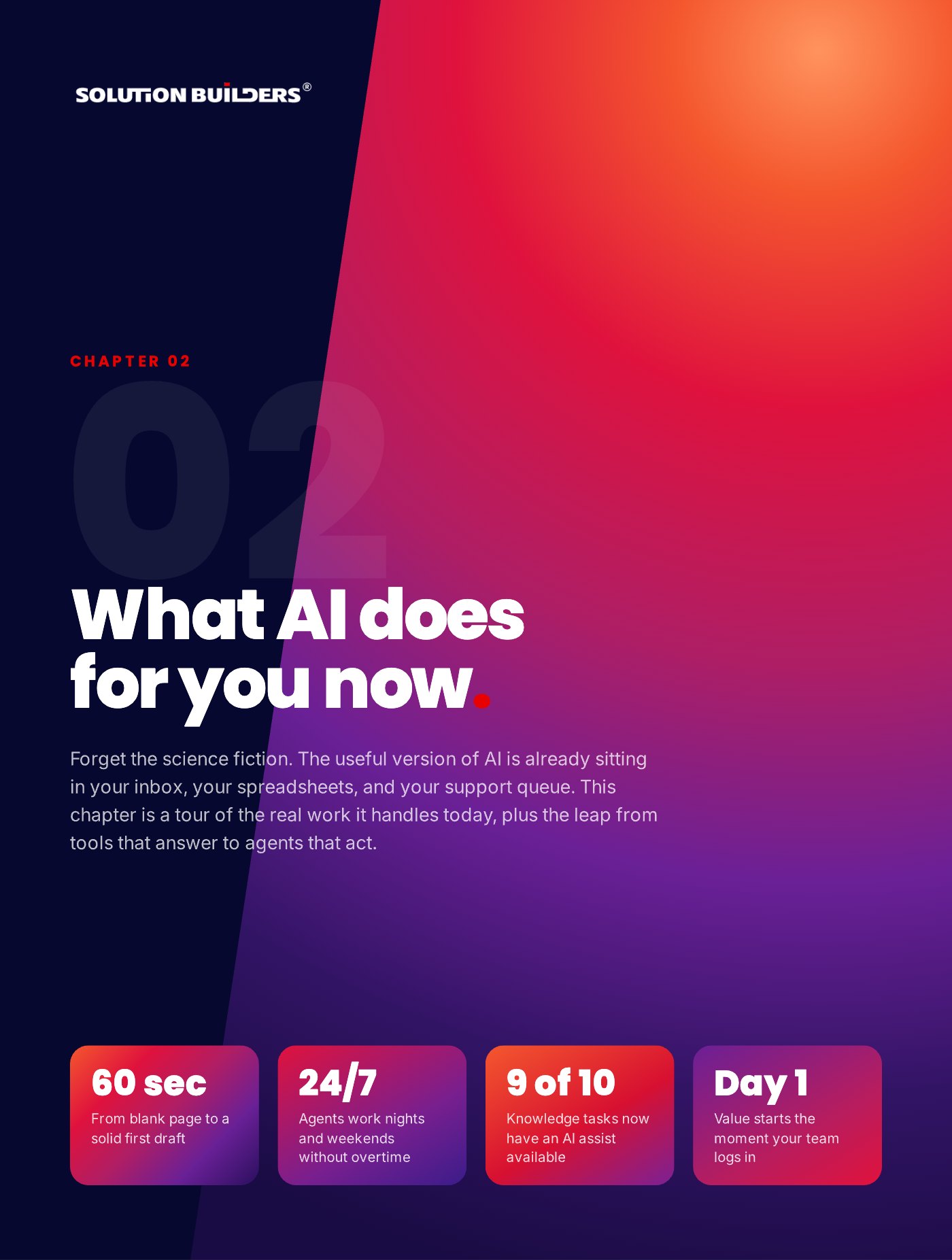
Seventy years in seven beats, and why it suddenly feels different
AI is not new. It is a seventy year old idea that spent decades waiting for the world to catch up. Then the data, the chips and the math all showed up at the same party. The short version helps you tell a durable shift from a fad, and this one is durable.
- 1950s: the dream and the dareAlan Turing asks if machines can think. A 1956 workshop names the field. Computers are room sized and patience runs out.
- 1980s: rules, then a winterExpert systems hard code human know how into if then rules. Useful, brittle, and when hype outruns reality the funding freezes.
- 1997 and 2012: machines start to winIBM's Deep Blue beats Garry Kasparov at chess. Fifteen years later, neural networks plus graphics chips plus oceans of data teach computers to see.
- 2017: the transformer arrivesA research paper titled Attention Is All You Need introduces the architecture behind every modern chatbot.
- 2022: AI meets everyoneChatGPT launches and reaches a hundred million users faster than any product in history. Suddenly your accountant and your kid are both using it.
- Today: the age of agentsAI stops just answering and starts doing. Agents draft, research, book, reconcile and follow up on their own.
Notice the gaps get shorter. Three forces finally lined up to make the leap from rules to learning to reasoning real.
- An ocean of data. Every email, document and click became training fuel, at a scale no human could match.
- Cheaper compute. Graphics chips made the heavy math affordable. Work that needed a supercomputer now runs in a browser tab.
- A smarter design. The transformer let models understand context, not just keywords. That is why AI can now hold a real conversation.
For decades AI could only follow rules a human wrote, then it learned patterns from examples, and now it writes, reasons and acts in plain language across almost any task. One tool, a thousand jobs, ready on day one.
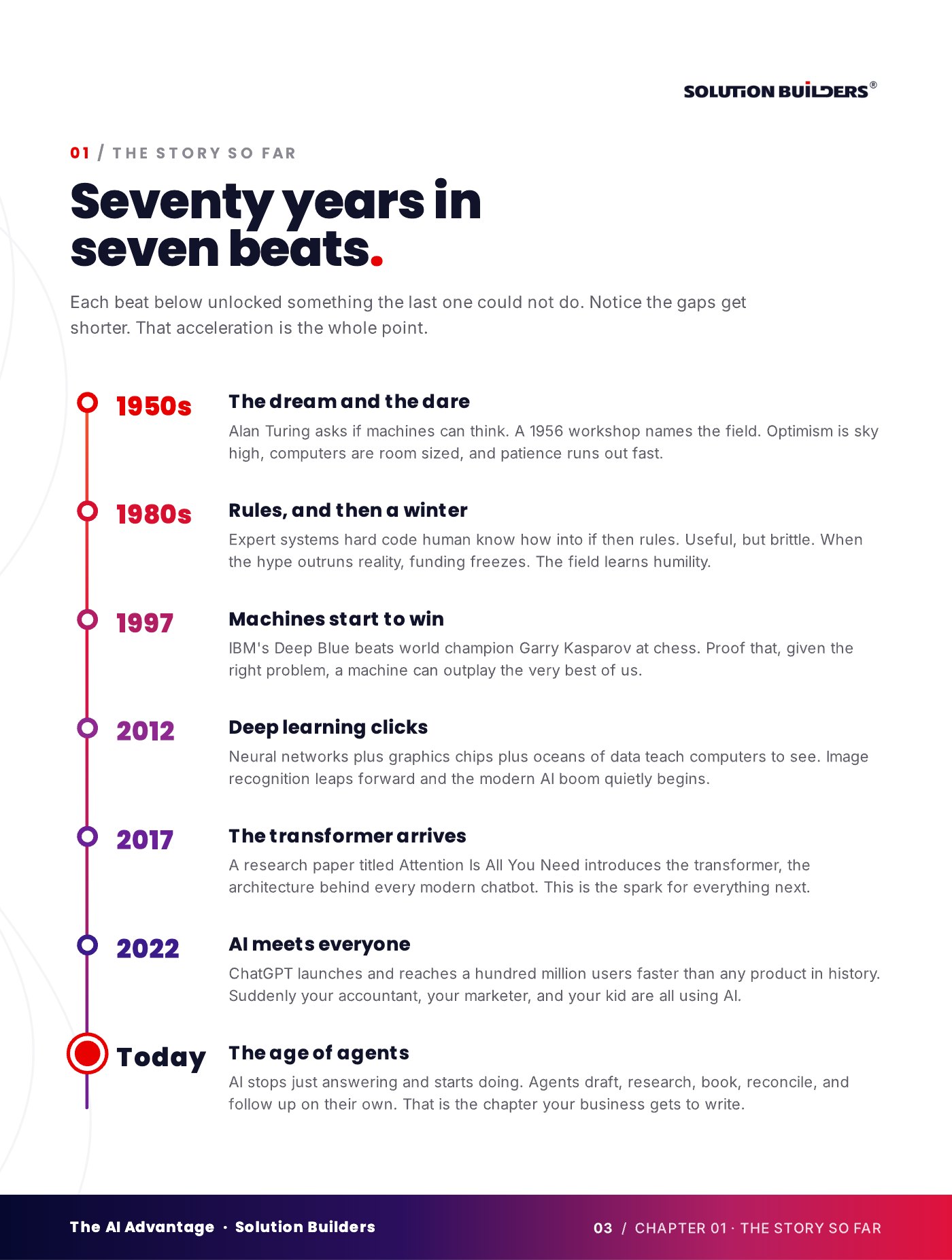
Every team has a job AI can lighten
AI is not one feature for one department. It is a layer of help across the whole company, and it earns its keep first by giving each team back the hours they spend on repetitive work. A 60 person engineering firm in St. Paul does not need an AI strategy to start. It needs one win per team.
| Team | What AI handles today | A first win to try this month |
|---|---|---|
| Sales | Drafts outreach, summarizes calls, updates the CRM | Call summaries written before the rep hangs up |
| Marketing | Turns one idea into a campaign, blog and posts in your voice | One monthly newsletter drafted from the sales notes |
| Finance | Reconciles transactions, flags odd invoices, drafts the forecast | Variance commentary in plain English |
| Operations | Writes procedures, triages tickets, schedules work | A messy email thread turned into an action list |
| Customer support | Answers common questions, drafts replies, hands over a summary | Nobody asks the customer to repeat themselves |
| People and IT | Onboards new hires, answers policy questions, writes the help article | The help desk article written before the ticket lands twice |
Let AI do the first ninety percent
Every example is the same move: take a task that is repetitive, text heavy or research heavy, and let AI produce the first ninety percent so your people spend their time on the last ten that actually needs them. If a task does not fit that shape, it is not a good first project.
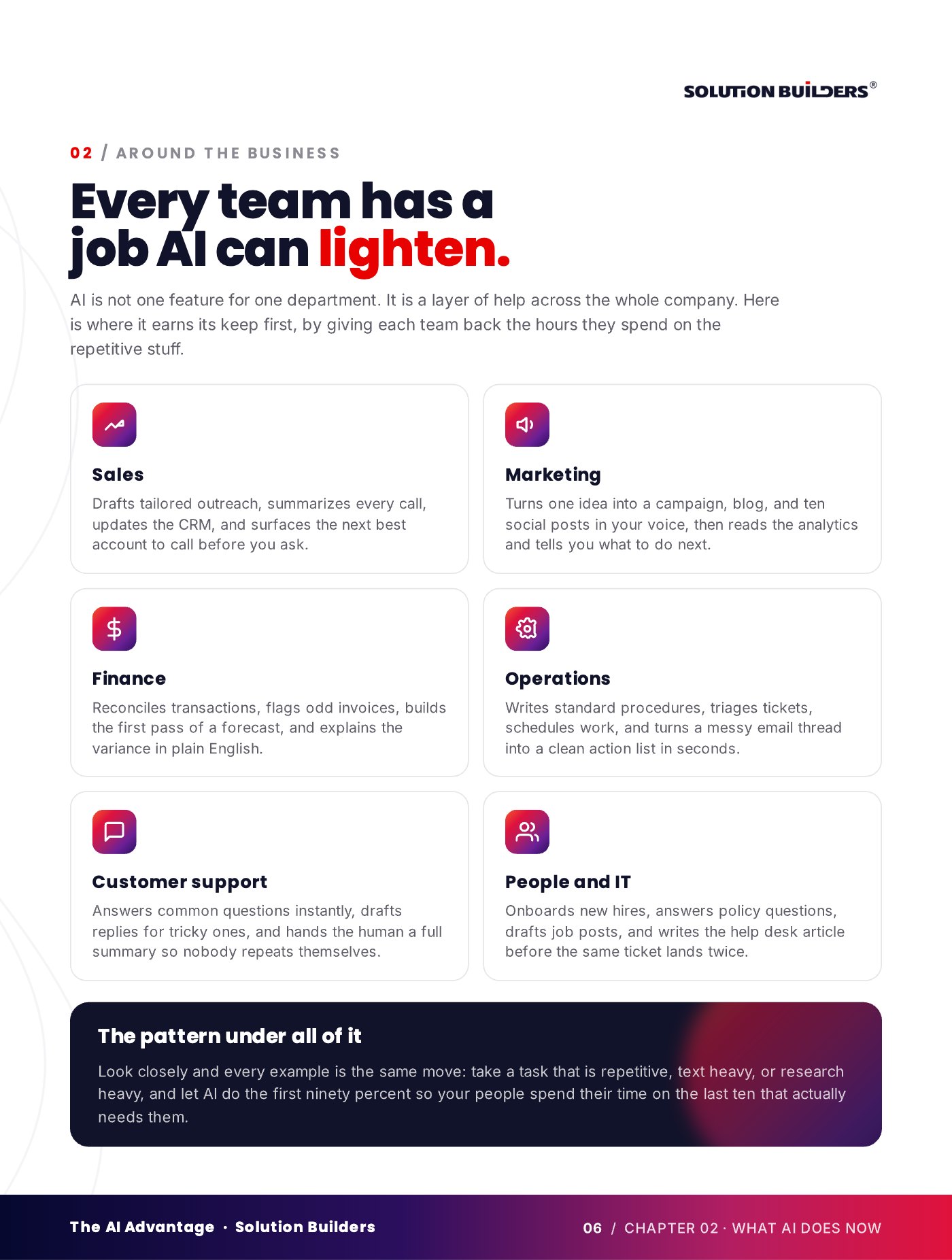
From chatbot to coworker, with safe AI governance built in
A chatbot answers a question and waits. An agent takes a goal, makes a plan, uses your tools, checks its own work and comes back when the job is done. That difference is the whole story of the next few years, and it is why governance stops being a policy document and becomes an engineering requirement.
- UnderstandTakes a goal in plain language: "reconcile this month's vendor invoices against purchase orders and flag the mismatches."
- PlanBreaks it into ordered steps without a human scripting every branch in advance.
- ActUses your email, files and line of business apps to do the task, not just describe it.
- CheckReviews and corrects its own work, then pauses for a human on the approvals that matter.
- DeliverHands back finished work, and the loop repeats with a person still in the seat.
Agents are already on the job in growing companies: inbox triage, meeting notes and follow ups, invoice matching, lead research, ticket resolution, report generation and onboarding checklists. What turns a tool into a teammate is that it can act, it can reason, and it stays in bounds. That third one is yours to build, and safe AI governance for a company with 25 to 500 employees fits on one list.
- Permissions before licenses. Copilot and agents see whatever the user can see, so fix oversharing in SharePoint and Teams first.
- Classify the data. Decide what is public, internal and confidential, and label it so AI respects the line.
- Write a one page acceptable use policy: approved tools, what never gets pasted into a public chatbot, who approves new uses.
- Keep a human in the seat for anything that moves money, changes a customer record or leaves the company.
- Log what agents do, the same way you log what admins do.
- Start with one workflow and one agent, measure it, then add the next.
The first item is where most Copilot pilots stall, which is why the Microsoft 365 environment gets tidied before anyone buys a license. The Copilot Readiness Playbook walks through the oversharing risk in plain language.
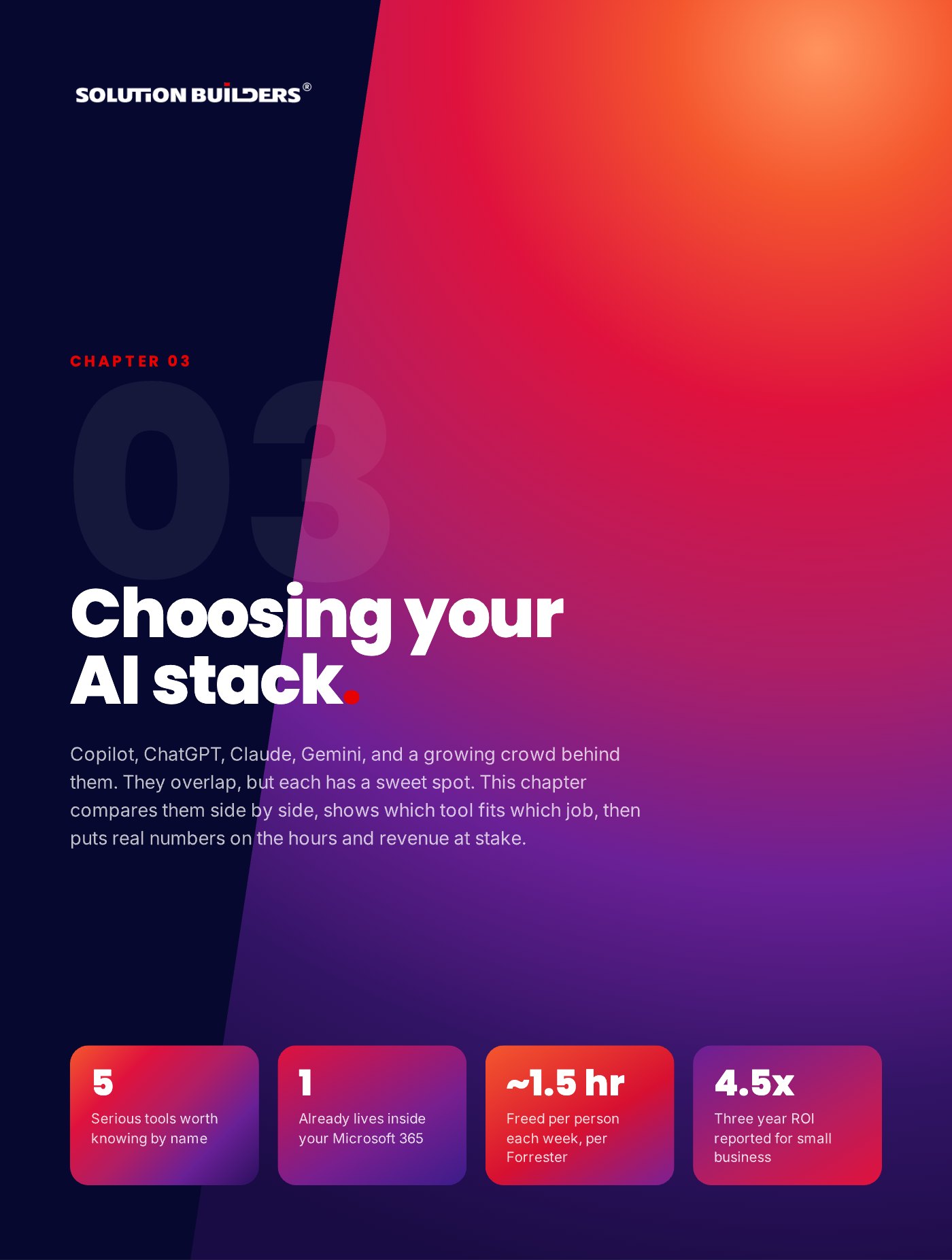
Choosing your AI stack: Copilot, ChatGPT, Claude, Gemini and Perplexity
No single tool wins everything. They overlap, but each has a sweet spot, and the honest lay of the land is shorter than the vendor decks suggest. If your business runs on Microsoft 365, Copilot has a real home field advantage because it works inside the apps you already use and is grounded in your own data through Microsoft Graph, with the permissions you already set.
| Tool | Best for | Keep in mind |
|---|---|---|
| Microsoft 365 Copilot | Teams that run on Microsoft 365 every day, grounded in your own files and email | Needs a base license and tidy file permissions to shine |
| ChatGPT | General drafting, brainstorming, quick answers, custom GPTs and voice | Sits outside your company data unless you connect it |
| Claude | Long documents, careful reasoning, on brand writing and coding | A smaller plug in ecosystem than ChatGPT today |
| Gemini | Teams that live in Google Workspace, research with very large context | Best payoff if Workspace is your home base, not Microsoft 365 |
| Perplexity | Fast research with clickable sources attached | A focused research tool, not a full work suite |
Start with Copilot for the everyday work that lives in Microsoft 365. Reach for a specialist when the job calls for it. One stack, the right tool for each task.The AI Advantage
On cost, Microsoft 365 Copilot for businesses under 300 users ran about 18 to 21 dollars per user each month on top of a base license at mid 2026 list pricing, with the enterprise add on around 30 dollars. List pricing moves, so confirm current rates before you budget. For most of our clients, Microsoft Copilot for business in the Twin Cities is the first tool in the stack, and a specialist gets added only when a team can name the job it will do.
The payoff in hours and dollars, and the road ahead
Meet a fifty person professional services firm. Same people, same clients, now with AI in the daily workflow. Forrester's Total Economic Impact research on Microsoft 365 Copilot for small business points to roughly 90 minutes freed per person each week and a 4.5 times three year return. Across fifty people, that is about 3,750 hours a year. At a blended rate of 75 dollars an hour, the book's illustrative model puts the capacity freed at roughly $280,000, not a guarantee, but the scale of the opportunity.
Where does the time come back? In the model, a proposal drops from about three hours to just over one, a monthly client report from four hours to an hour and a half, inbox and meeting notes from five hours a week to two, and a research brief from two and a half hours to under one. Hours are not the prize. Capacity is. The same fifty people take on more clients, answer faster and chase the work that grows revenue without adding headcount. For the mirror image, what a year of unplanned downtime costs the same company, see 250 Hours.
Standing still is not staying even. The book's illustrative growth model shows teams that adopt AI compounding their advantage year after year while everyone else inches along. Four lanes are worth watching on the road ahead.
- Agentic. AI that pursues goals, not just prompts, with a human approving what matters.
- Multimodal. It sees, hears and speaks, not only text, so a photo of the plant floor becomes a work order.
- Personal. Tuned to your business, your data and your voice.
- Quantum. Useful business machines are still years out. The practical move today is planning for quantum safe encryption, simple hygiene rather than panic.
AI consulting in Minneapolis: your first three wins
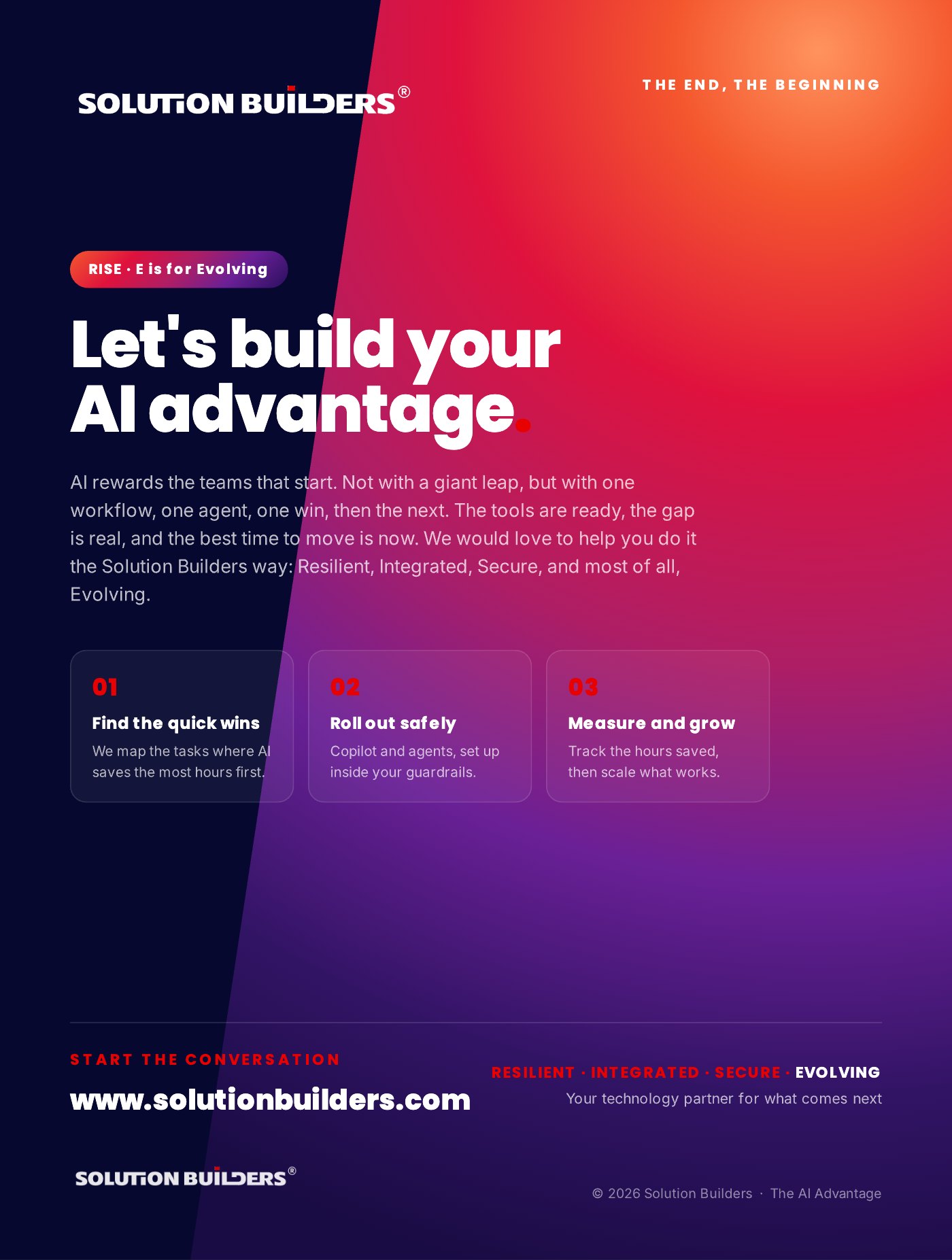
AI rewards the teams that start. Not with a giant leap, but with one workflow, one agent, one win, then the next. This is how Solution Builders runs it with clients across Minneapolis, St. Paul and Greater Minnesota, and the first step costs nothing but an afternoon.
- Find the quick winsList the tasks in each department that are repetitive, text heavy or research heavy. Rank them by hours per week. The top three are your pilot.
- Roll out safelyFix permissions, classify data and publish the one page acceptable use policy. Then license Copilot for the pilot group and set up the first agent inside those guardrails.
- Measure and growTrack hours saved per person per week for 60 days. Scale what works to the next team, retire what does not, and add a specialist tool only when a team can name the job.
If you want help with any of those steps, AI consulting from Solution Builders starts with a readiness conversation: where AI already lives in your company, what the governance gap is, and which three workflows pay back first. We have been the technology partner for Minnesota businesses from Bloomington since 1995, with 50+ engineers who roll out Copilot the Solution Builders way: Resilient, Integrated, Secure, and most of all, Evolving.
AI for growing companies across the Twin Cities
Solution Builders has been the technology partner for Minnesota businesses from Bloomington since 1995. Our 50+ engineers roll out Copilot, agents and the governance behind them for companies with 25 to 500 employees in Minneapolis, St. Paul and across the metro, from professional services firms downtown to manufacturers on the I-494 corridor. Related services: AI Consulting, Microsoft Copilot, Microsoft 365, Cybersecurity. Contact us or book a 30 minute call.