Solution Builders team
Jump to a section
- Only about 28% of business applications are integrated, so most companies run on exports, retyping and the person who knows the real number.
- You cannot patch a design problem. Start with the way the business wants to work, then design the technology around it.
- Bridge every system into your CRM or ERP core so there is one source of truth, and decisions stop waiting on a spreadsheet.
- A 90 day plan gets you from stitched to connected: map and plan, bridge and connect, then automate and measure.
Killing Frankenstein: how thirty years of upgrades built a monster
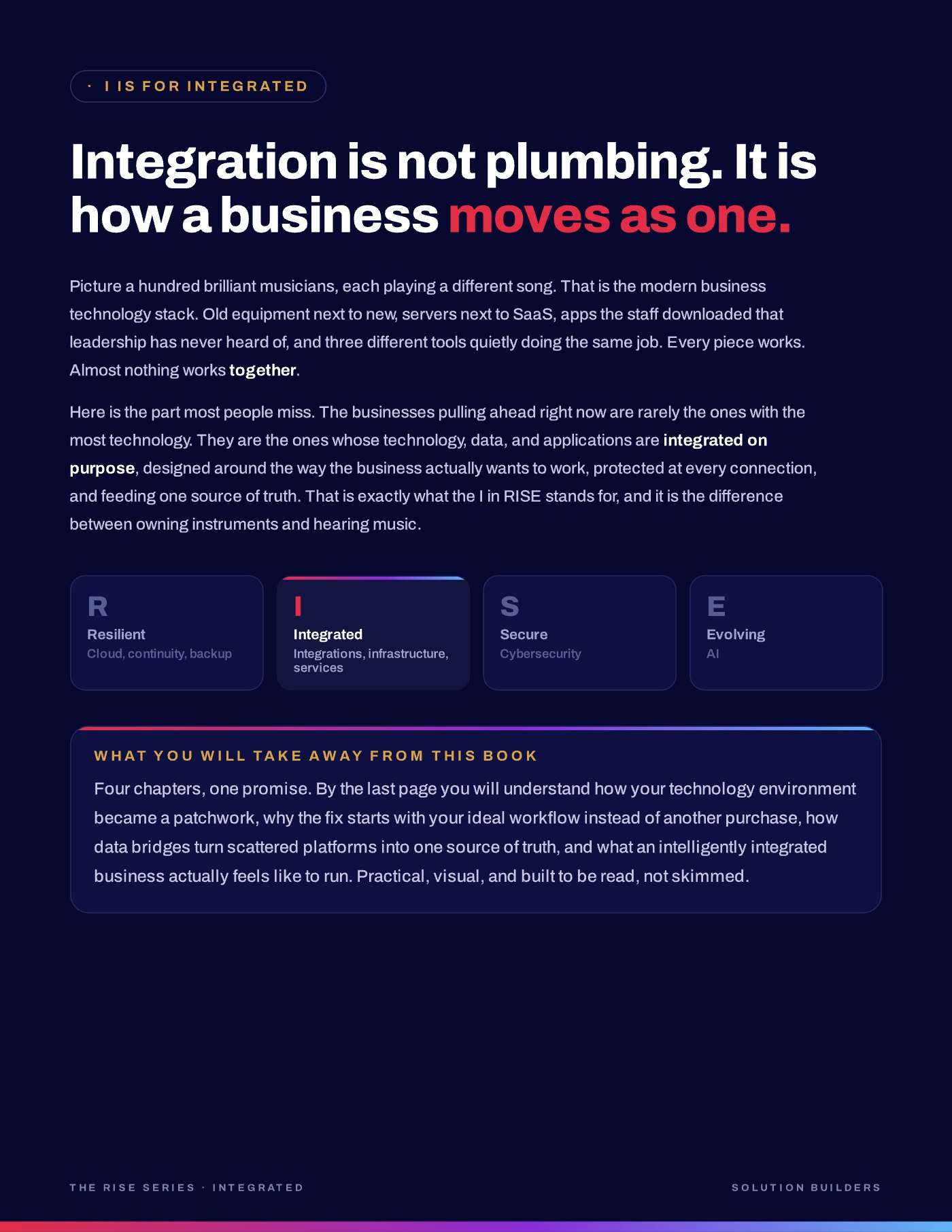
Picture a hundred brilliant musicians, each playing a different song. That is the technology stack inside most growing companies in Minneapolis and St. Paul. Every instrument was a good purchase at the time. Nobody ever wrote the score. The result is a business that owns a lot of instruments and never hears music.
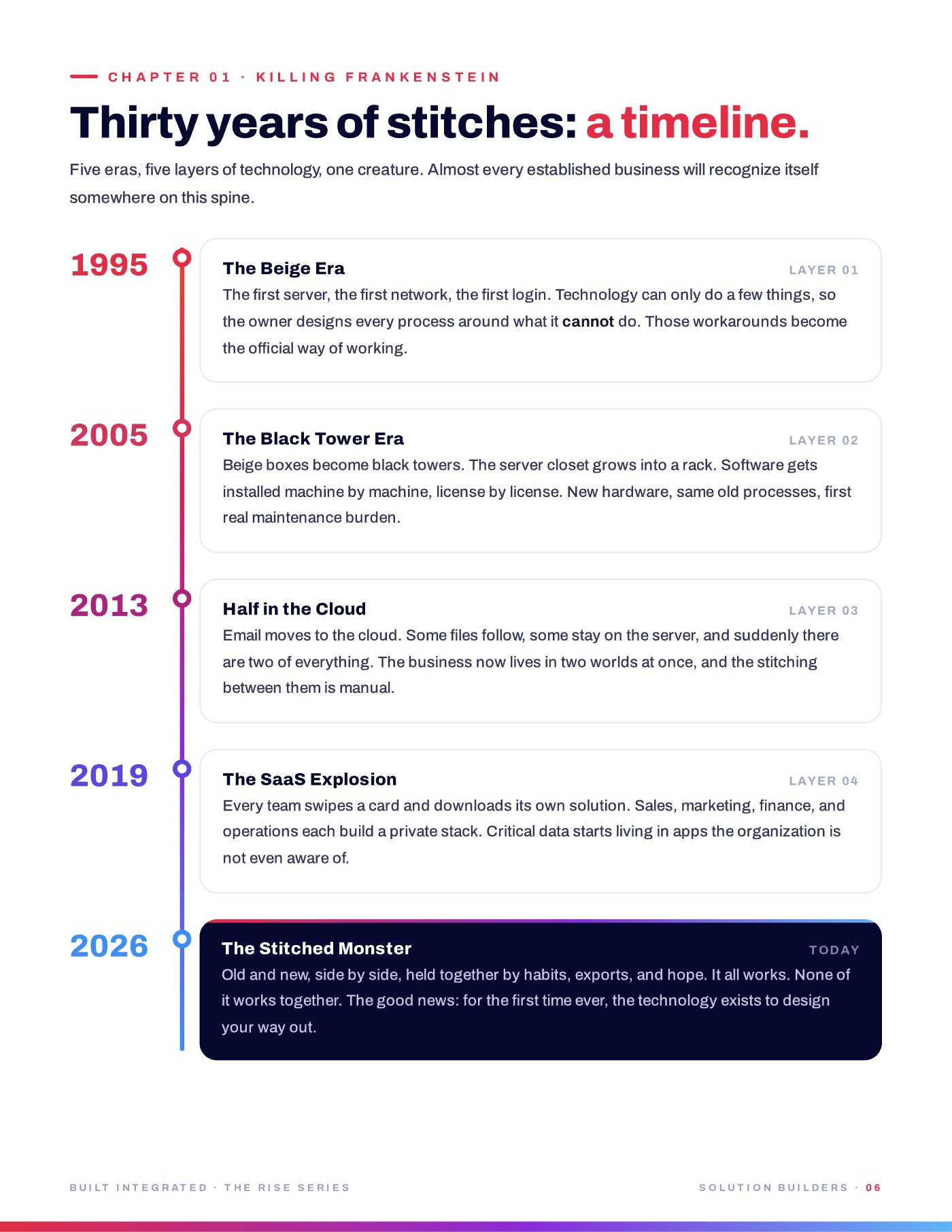
It did not happen on purpose. It happened one reasonable upgrade at a time, and the timeline looks the same in a Bloomington distributor, a St. Paul law firm or a manufacturer with a plant in Greater Minnesota.
- 1995: the beige box networkA server in a closet, a file share, and processes designed around what that server could do.
- 2005: towers everywhereAn accounting system here, a customer database there, each on its own machine with its own login.
- 2013: half in the cloudEmail moves to Microsoft 365, the ERP stays on premises, and the two never meet.
- 2019: the SaaS explosionEvery department buys its own app with a credit card. Marketing, support, HR and operations each get a system of record.
- Today: spreadsheets and shadow ITThe real business runs on exports, retyped orders and the one person who knows which number is right.
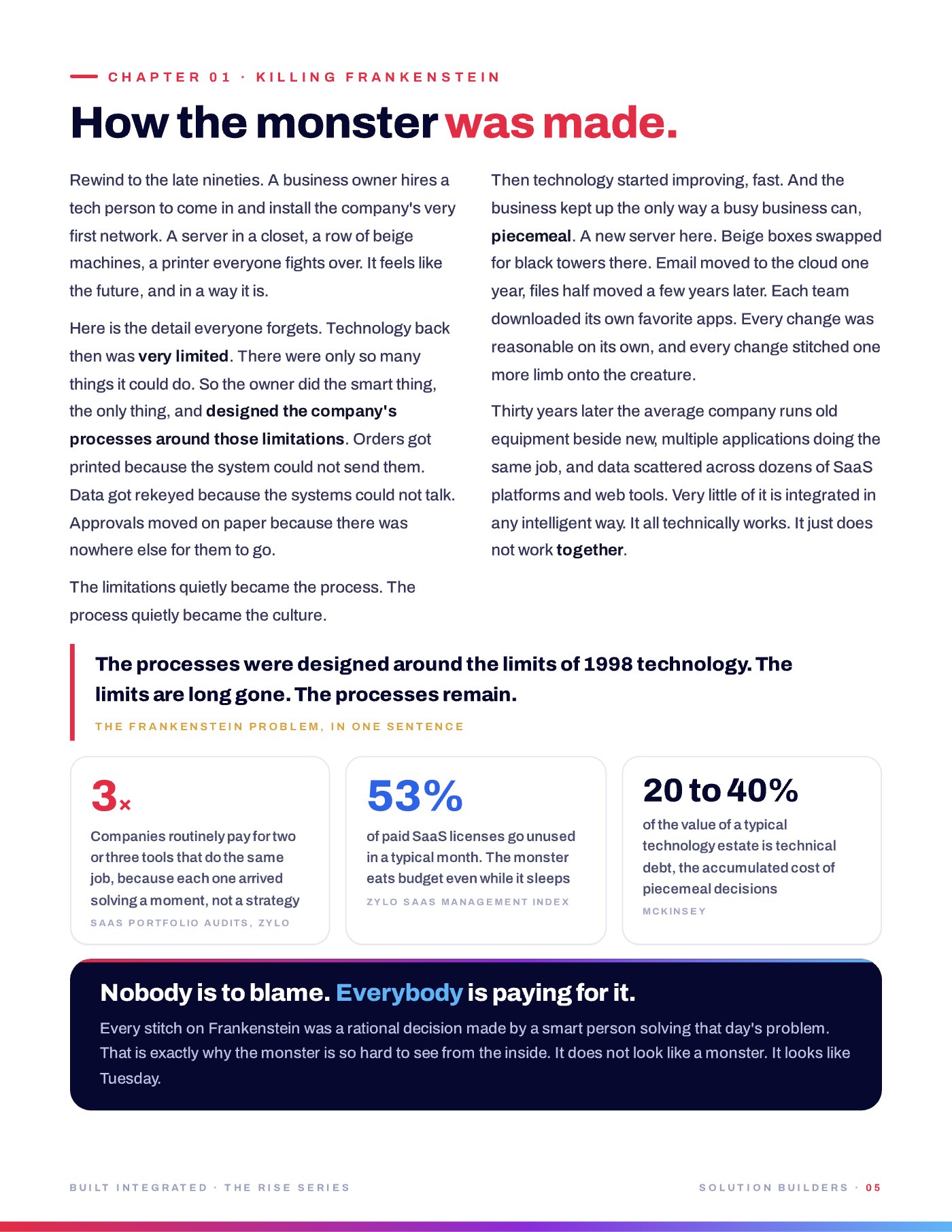
Here is the part that stings. Most of your processes were designed around the limits of 1998 technology. The limits are gone. The processes remain. Someone still prints the order, walks it to the floor, and keys it into the second system, because that is how it was done when the two systems could not talk. Adding another tool on top does not fix that. It adds another instrument to the noise.
You cannot patch a design problem.RISE: Integrated
Shadow IT and SaaS sprawl: what the pile actually costs
The pile has a price, and it rarely shows up as one line on the budget. BetterCloud counts more than 130 SaaS applications inside the average company, most of them never mapped by anyone. MuleSoft's Connectivity Benchmark puts the share of business applications that are actually integrated at about 28%, and its 2026 edition found IT teams spend 36% of their time building and fixing custom integrations while 26% of projects were delivered late. Gartner estimates 30 to 40% of technology spending happens outside IT, and Zylo found 53% of paid SaaS licenses sit idle. Companies routinely pay for two or three tools doing the same job.
Then there is the human cost. Harvard Business Review found workers toggle between applications about 1,200 times a day and lose roughly four hours a week just reorienting. Gartner puts the average yearly cost of poor data quality at $12.9 million, and Seagate and IDC estimate 68% of the data companies collect is never analyzed at all. A 120 person manufacturer on the I-494 corridor does not feel those numbers as a statistic. It feels them as the Friday afternoon someone spends reconciling the CRM against the ERP against the spreadsheet.
Shadow IT is not a discipline problem. It is a design signal.
When a department buys its own tool, it is telling you the official system does not do what the work needs. Punishing that hides the signal. Mapping it, then designing the environment around the real workflow, is how shadow IT and SaaS sprawl turn into a project list instead of a risk register.
Systems integration services in the Twin Cities start with the workflow
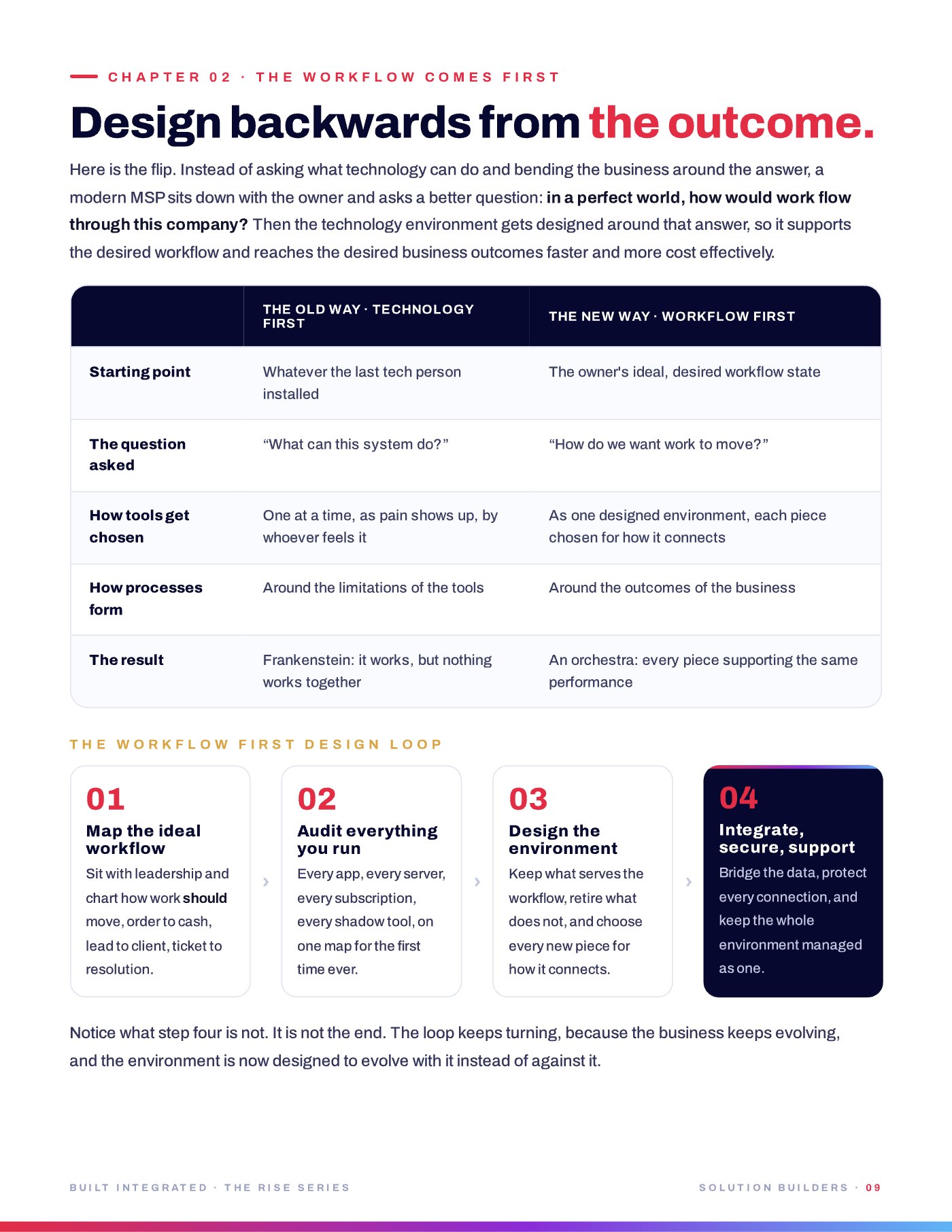
Most technology decisions run in the wrong order. A tool gets chosen, then the team is told to work the way the tool works. Workflow first design flips that. Start with the way the business actually wants to work, from the first customer call to the invoice, then design the technology environment around it. It sounds obvious. Almost nobody does it, because it requires drawing the workflow before shopping.
Tool first
- Buy the app, then adapt the process
- Each department owns its own system of record
- Integration is somebody's side project
- Security added at the end, one app at a time
Workflow first
- Draw how work should move, then choose tools
- One core system, everything else bridges to it
- Integration designed in, owned and documented
- Every connection protected by design
The design loop has four steps, and good systems integration services in the Twin Cities will run them with your team rather than for it.
- Map the workflow as it really happensNot the org chart. The actual path an order, a hire or a support ticket takes, including the spreadsheet steps nobody admits to.
- Remove the steps that exist only because of old limitsThe reprint, the retype, the weekly export. If the only reason is "the systems did not talk," it goes.
- Design the environment around what remainsChoose the core system, decide what bridges into it, and design infrastructure as one system rather than a collection of boxes.
- Protect every connectionEach integration is a door. Secure by design means each one has an owner, a permission scope and a log, so Integrated never undermines Secure.
This is project work, and it is why Solution Builders professional services exists: to get the design done and the project finished, with virtual CIO guidance to keep it tied to the business plan rather than to a vendor roadmap.
Data bridges: one source of truth for CRM and ERP
Your most valuable data is stranded across a dozen platforms. The customer's history is in the CRM, their invoices are in the ERP, their support tickets are in a help desk tool, their email is in Outlook and their real status is in a spreadsheet on someone's desktop. Each one is correct about its own slice. None of them is the truth.
The fix is a hub and spoke design. Pick the line of business system that should own the truth, usually the CRM for a services firm or the ERP for a manufacturer or distributor, and bridge every other platform into it. The spokes keep doing what they are good at. The core becomes the one place a decision can be made without a phone call.
| Spoke | What it holds | What the bridge does |
|---|---|---|
| Finance | Invoices, payments, margins | Customer balance and margin visible on the account record |
| Support | Tickets, response times | Open issues visible to sales before the renewal call |
| Marketing | Campaigns, leads, web activity | Leads land in the CRM with source attached, no export |
| Operations | Orders, inventory, scheduling | Order status flows to the account without a retype |
| Ecommerce | Online orders, customer accounts | Web orders create ERP orders automatically |
| Spreadsheets | Whatever did not fit anywhere else | Retired, or rebuilt as a report on the core |
The payoff is measured in decisions, not plumbing. McKinsey found that organizations with a real data culture are 23 times more likely to acquire customers, 19 times more likely to be profitable and 6 times more likely to retain customers. One source of truth for CRM and ERP data is how a company with 25 to 500 employees gets there without a data science team. The collaboration layer on top, Microsoft 365 configured as one environment, is where the bridged data becomes a dashboard someone actually opens on Monday morning.
The integrated enterprise and your first 90 days
Integration is a ladder, not a switch. Most companies we meet in the Twin Cities sit on the first rung and describe themselves as "mostly integrated" because two systems share a login. The honest version has four rungs.
| Rung | What it looks like | How decisions get made |
|---|---|---|
| Stitched | Exports, imports, retyping, spreadsheets as glue | Whoever has the latest file |
| Connected | Key systems share data on a schedule | Yesterday's numbers, mostly right |
| Integrated | One core, every spoke bridged, no human in the middle | Live numbers from one place |
| Orchestrated | Workflows automated across systems, AI acting on the data | The system flags the decision before you ask |
Every rung pays a dividend: time back from retyping, accuracy because there is one number, speed because the handoff is automatic, visibility because leadership sees live data, security because each connection has an owner, and AI readiness because an agent can only act on data it can reach. An integrated business is an AI ready business, which is why Integrated comes before Evolving in RISE.
- Days 1 to 30: map and planInventory every application, including the ones bought on a credit card. Draw the three workflows that matter most. Choose the core system. Decide the first two bridges.
- Days 31 to 60: bridge and connectBuild the first bridges into the core, retire the exports they replace, and give each connection an owner and a permission scope.
- Days 61 to 90: automate and measureAutomate the handoffs that used to be a person, then measure hours saved, errors removed and the number of spreadsheets retired.
IT infrastructure design in Minnesota: what to do this month
You can start the first thirty days without a consultant. These are the moves that surface the real project.
- Pull the credit card statements and list every software subscription the company pays for. Count the duplicates.
- Ask each department head for the spreadsheet they could not run the week without. That is your shadow IT map.
- Pick one workflow, order to cash or hire to onboard, and draw it on a whiteboard with every retype marked in red.
- Name the core system that should own the truth, and name the person who owns it.
- List every integration that exists today, who built it, and what happens when it breaks.
- Score yourself on the ladder and pick the first two bridges.
When the list is longer than your team has time for, that is the moment to bring in help. Solution Builders has designed infrastructure as one system for Minnesota businesses since 1995, from the I-494 corridor to Greater Minnesota. An 85 user manufacturer client eliminated more than 100 hours of monthly downtime, cut support tickets 60% and finished its full transformation in 90 days, and most of that work was integration, not hardware. For the longer argument, with the quickest wins and where they usually hide, read The Integrated Business.
Systems integration for Twin Cities companies
Solution Builders has designed technology as one system for Minnesota businesses from Bloomington since 1995. Our 50+ engineers run integration and infrastructure projects for companies with 25 to 500 employees across Minneapolis, St. Paul and the metro, from distributors on the I-494 corridor to manufacturers with a plant in Greater Minnesota and an office in town. Related services: Professional Services, IT Consulting, Microsoft 365, Cloud Migration. Contact us or book a 30 minute call.