Solution Builders team
Jump to a section
- RISE is four pillars in a deliberate order: Resilient, Integrated, Secure, Evolving. Fix the lowest letter first, not the most exciting one.
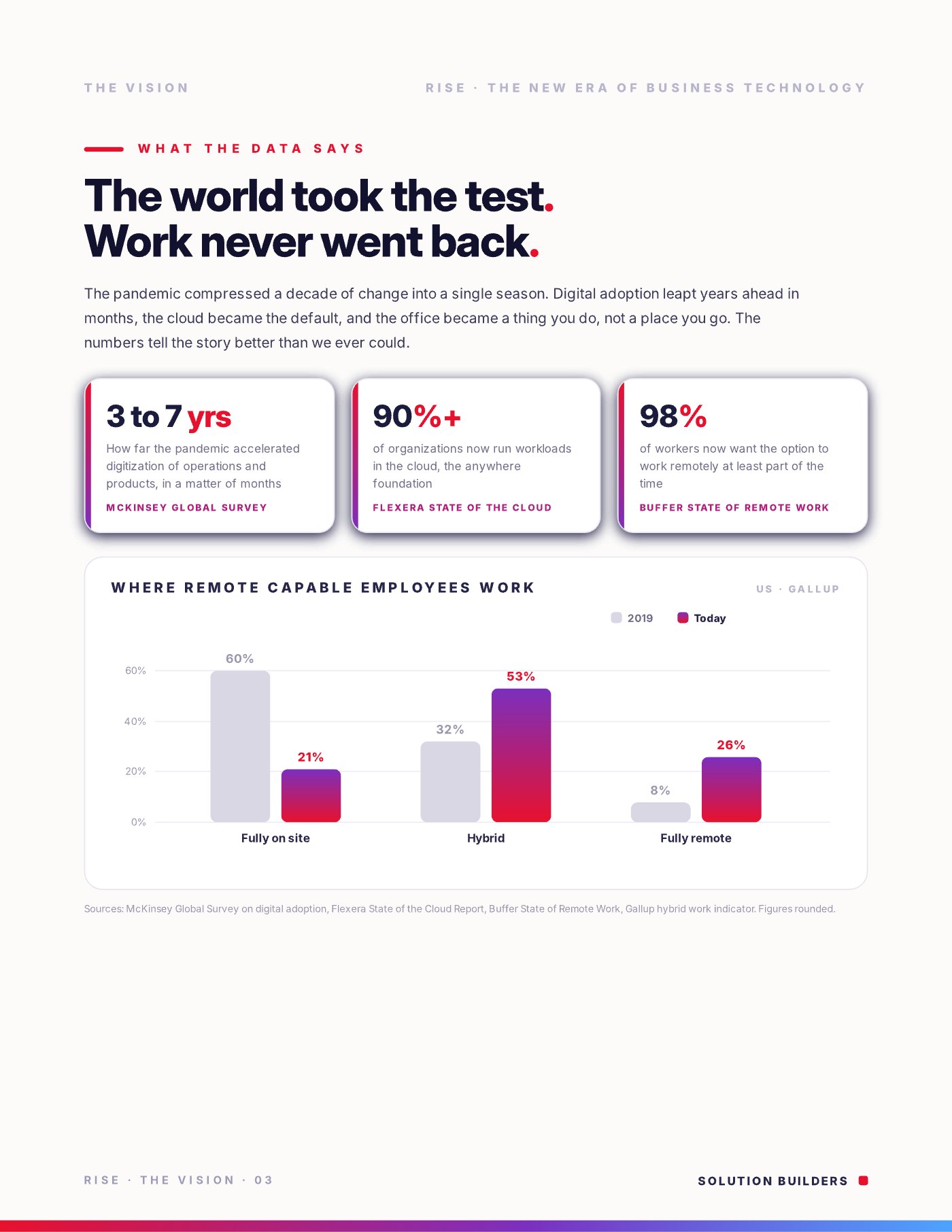
- The 2020 shift stuck. Hybrid work rose from 32% to 53% of remote capable employees, and 90% of organizations now run in the cloud.
- Standing still has a bill. 90% of leaders feel ready to recover from an attack, but only 28% of those hit recovered everything.
- A company with 25 to 500 employees applies RISE with one scoring meeting, one outcome per pillar and a 90 day plan reviewed quarterly.
The pop quiz every Twin Cities business took in 2020
Think back to March 2020. Offices from the North Loop to the I-494 corridor went dark in a matter of days. Customers still expected answers, and the Friday payroll run did not care that the building was empty. Every business took the same test at the same time, and nobody had studied for it.
Some companies froze. The server sat in a closet nobody could reach, the phone system lived on a desk, and the one person who knew the passwords was home with a sick kid. Others barely broke stride. They opened laptops, joined the morning huddle on video, and kept every promise they had made the week before. The difference was not luck or size. It was architecture.
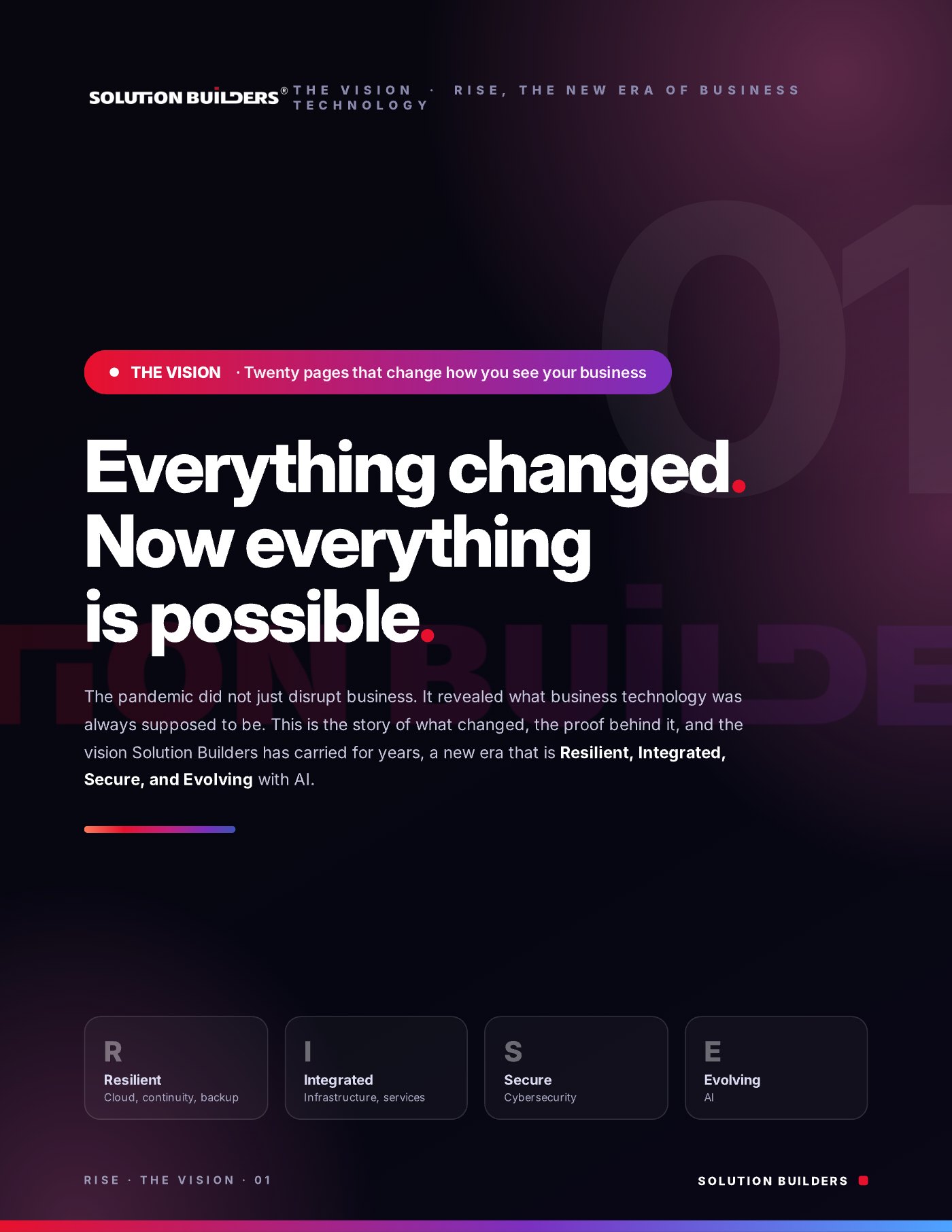
Here is the idea underneath the whole RISE framework. Your business is not a building or a server in a closet. It is a living system of people, data and workflows, and that system either bends or it breaks.
Nothing kills momentum like an interruption. The companies that recover fastest are the ones that planned to be interrupted.RISE: The New Era of Business Technology
A business technology strategy for Minnesota companies is not a list of products to buy. It is a decision about how your company behaves on its worst day, made while things are calm.
What the data says changed for good
The emergency ended. The behavior it forced did not. Gallup's tracking of remote capable employees shows fully on site work falling from 60% in 2019 to 21% today, while fully remote work climbed from 8% to 26%. McKinsey found the pandemic accelerated the digitization of operations and products by 3 to 7 years in a matter of months.
Four lessons fall out of those numbers, for a 40 person engineering firm in St. Paul as much as for a national brand.
- The office is optional. The business is not. Work has to follow people, not desks.
- Adaptation speed is a competitive weapon. The company that reconfigures in a week beats the one that takes a quarter.
- Flexibility attracts talent. More than half of remote capable employees now work hybrid, and the candidates you want expect it.
- The next disruption will look different. Nobody picks their crisis. An ice storm, a ransomware note and a dead server all ask the same question.
The stakes are not abstract. FEMA reports that 40% of small businesses never reopen after a natural disaster, and 25% of those that do reopen fail within a year. Ponemon puts the average cost of downtime for a modern business at about $9,000 per minute.
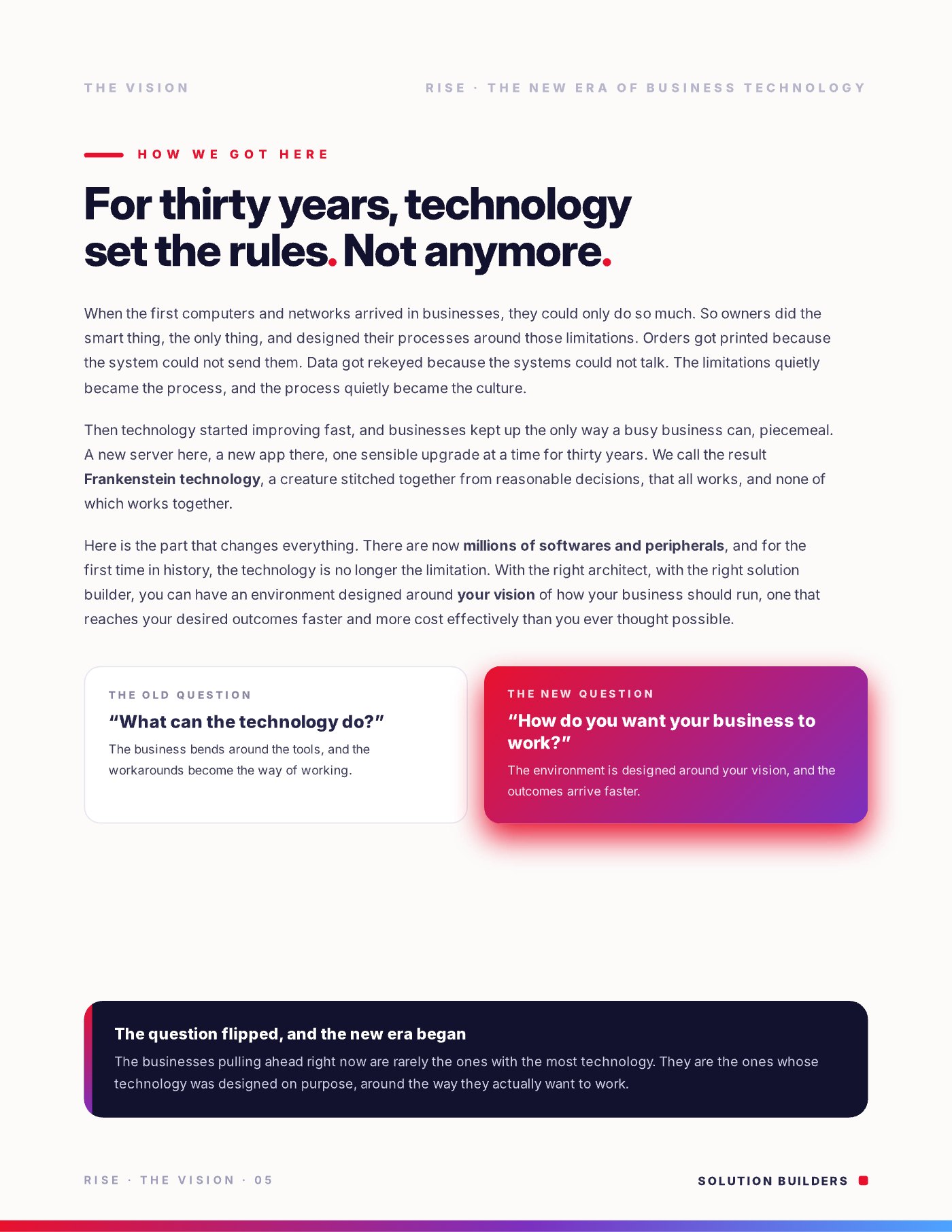
RISE: a business technology strategy for Minnesota companies in four pillars
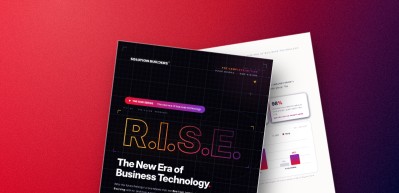
RISE stands for Resilient, Integrated, Secure and Evolving. It is the framework Solution Builders uses to design technology for growing companies, deliberately in that order. Each pillar is a question your leadership team can answer without an acronym.
| Pillar | The question it answers | What it covers | Proof it is working |
|---|---|---|---|
| Resilient | Can we operate when everything changes overnight? | Cloud, business continuity, tested backups | A bad day costs an hour, not a week |
| Integrated | Does our technology move as one system? | Integrations, infrastructure, professional services | One source of truth, nothing retyped |
| Secure | Is the floor solid under all of it? | Layered cybersecurity, compliance | Incidents are managed events, not existential ones |
| Evolving | Are we getting faster every quarter? | AI, Copilot, agents, automation | Hours back to the team, measured |
The order matters. Resilient comes first because nothing else works if the business cannot run. Integrated comes second because AI and security both depend on clean, connected data. Secure is the floor everything stands on. Evolving is last on purpose: AI on top of a shaky foundation is a fast way to make expensive mistakes.
Think of it as a technology roadmap for growing businesses rather than a product catalog. A company with 25 to 500 employees rarely has the budget to do everything at once, and RISE says what to do first and why. That is what separates managed IT services in the Twin Cities with a point of view from a help desk with a price list.
The operating pillars: Resilient and Integrated
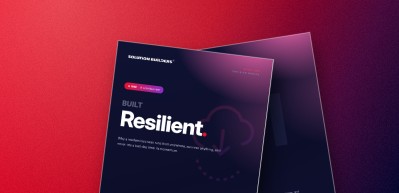
Resilient means the business runs from anywhere, at any time, on any device, with redundancy where it matters and backups it can trust. In practice that is a cloud migration done with intent, Microsoft 365 as the working environment, and a continuity plan with recovery targets the business agreed to. A 60 user architecture firm with multiple Twin Cities locations cut its infrastructure cost 38% with a cloud native migration, tripled remote productivity and ended up with zero on premises footprint. The full chapter is in RISE: Resilient.
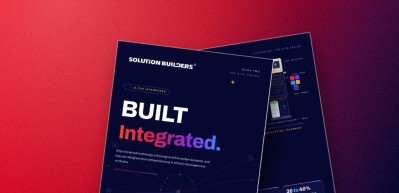
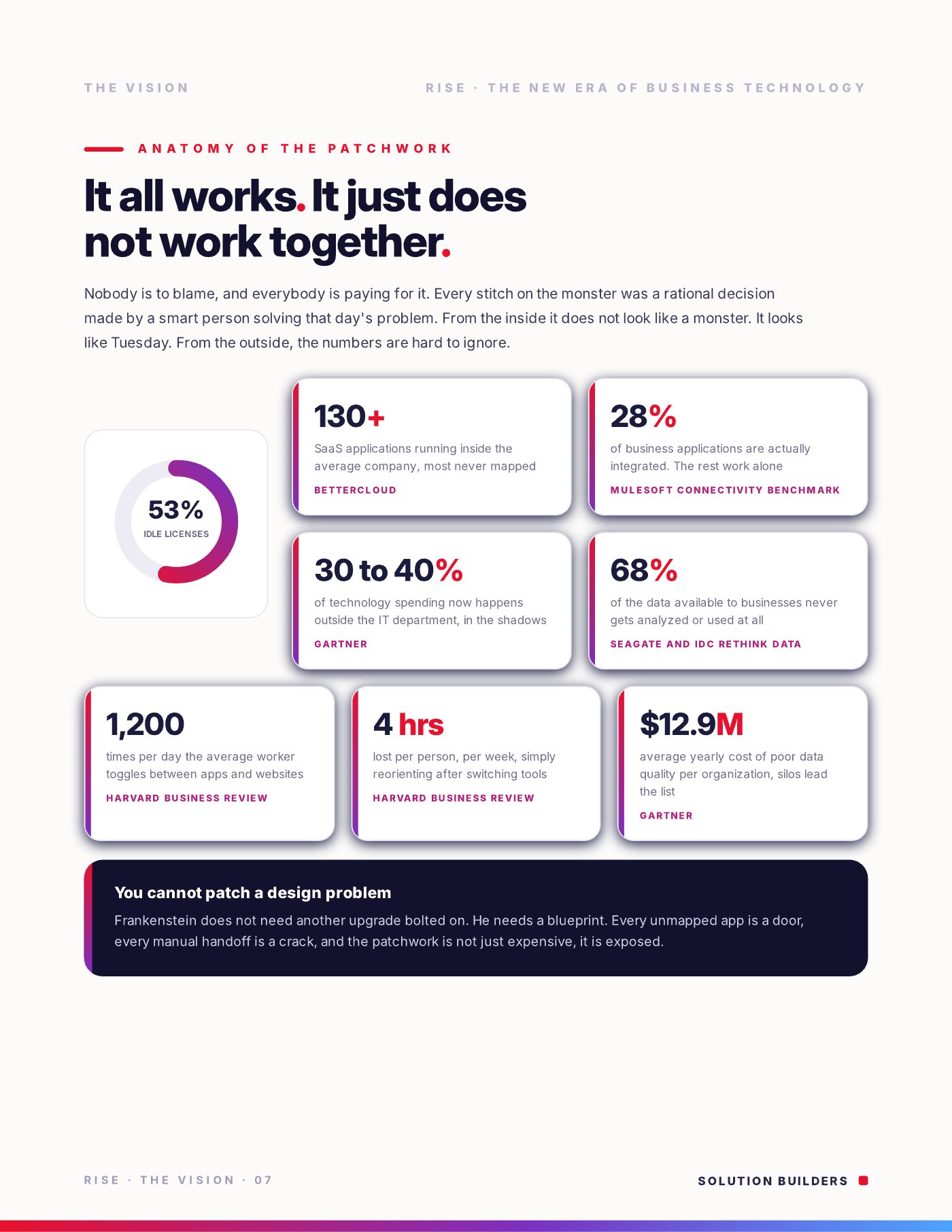
Integrated is the pillar most companies skip, and it is where the most money leaks. MuleSoft's Connectivity Benchmark finds that only about 28% of business applications are integrated with each other. McKinsey found data driven organizations are 23 times more likely to acquire customers and 19 times more likely to be profitable. This is the kind of project Solution Builders professional services exists to finish: infrastructure designed as one system and data bridges into your line of business core. The chapter is in RISE: Integrated.
If your building disappeared tonight, could your team work tomorrow?
Not "could IT restore the server eventually." Could sales call customers, could accounting run payroll, could the plant floor see its schedule? If any answer is a shrug, Resilient is your first pillar. If the answers involve three spreadsheets, Integrated is next.
The protecting and growing pillars: Secure and Evolving
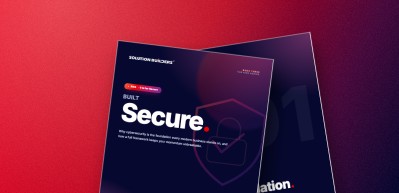
Secure is the floor. The companies that get hit hardest are rarely the ones with the weakest tools. They are the ones who treated security as a project with an end date. According to the Verizon 2025 Data Breach Investigations Report, 60% of breaches involve a human action, a click, a reply, a mistake. Multifactor authentication blocks more than 90% of account attacks. No single tool saves you. Layers do, which is why cybersecurity from Solution Builders is a framework with a 24/7 security operations center behind it. The chapter is in RISE: Secure.
Evolving is the pillar that pays for the other three. AI is not coming. It is already on payroll, in your inbox, your spreadsheets and your support queue, and it just made the leap from tools that answer to agents that act. The Intuit QuickBooks 2026 AI Impact Report found that 77% of US small and midsize businesses now use AI regularly and 43% credit it with revenue gains. The biggest barrier they name is privacy and security, at 36%, which is why Evolving comes after Secure. AI consulting from Solution Builders starts with governance, then Copilot, then the agents. The chapter is in The AI Advantage.
- Secure feeds Evolving. Copilot respects the permissions you already set, so permissions come before licenses.
- Integrated feeds Evolving. An agent can only act on data it can reach.
- Resilient feeds everything. Cloud first is the precondition for work from anywhere and for AI inside your apps.
Why waiting is the most expensive strategy
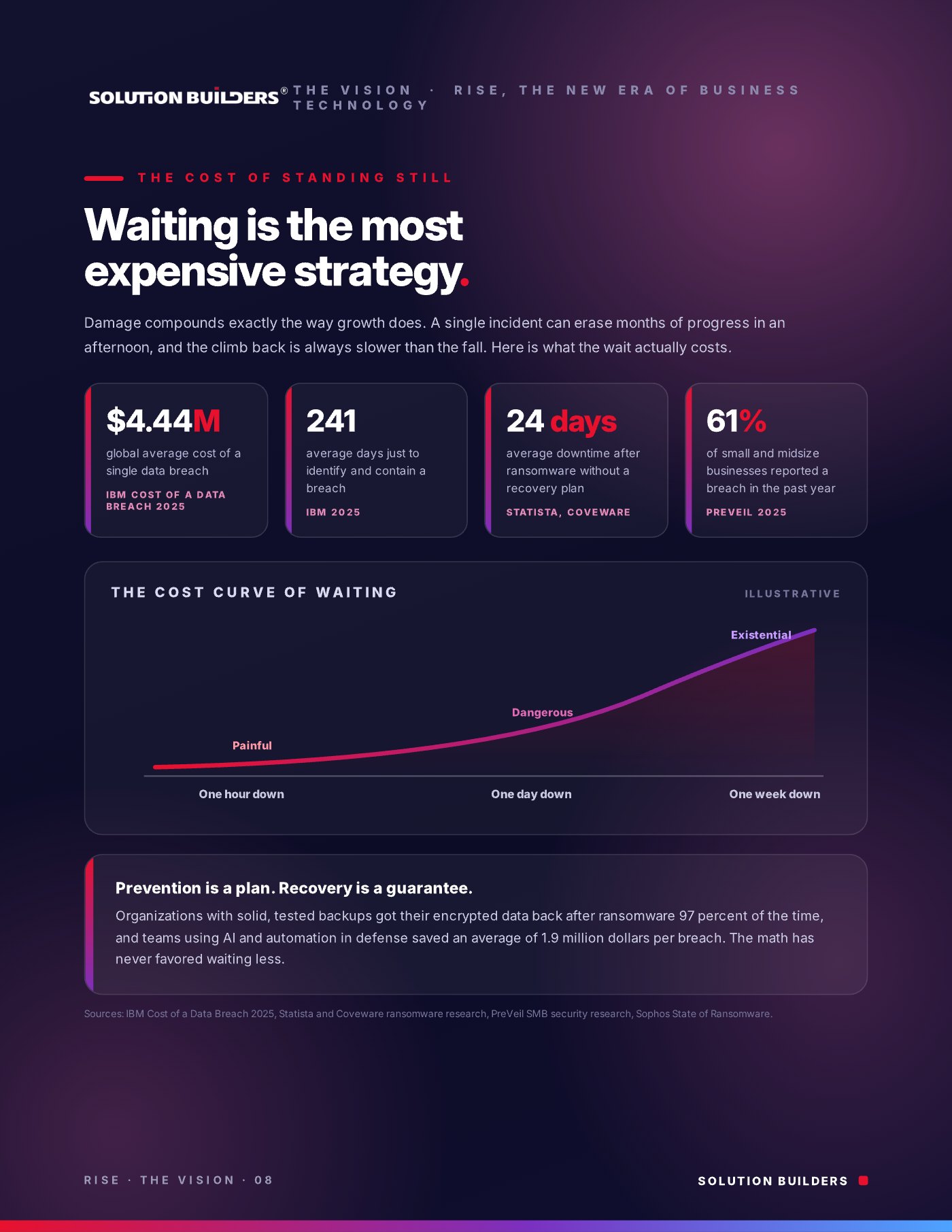
The quiet objection to all of this is "we are fine for now." Damage compounds the way growth does, and the bill for standing still rarely arrives as one line item. It shows up in the Veeam Data Trust and Resilience Report 2026, where 90% of 900 senior IT, security and risk leaders said they were confident they could recover from a cyber incident within their targets, while among organizations actually hit by ransomware only 28% fully recovered their data. It shows up as the Copilot pilot that stalls because nobody cleaned up file permissions first.
The company that waits
- Server in a closet, backups nobody has restored
- Twelve apps, one spreadsheet that holds the truth
- Security bought once, never tested
- AI banned, or used in secret on personal accounts
The company that built for it
- Cloud first, recovery timed and written down
- One source of truth feeding every team
- Layers, tested on a schedule, watched 24/7
- Copilot inside guardrails, hours measured
Solution Builders client data tells the same story in the other direction. An 85 user manufacturer eliminated more than 100 hours of monthly downtime, cut support tickets 60% and finished its transformation in 90 days. A 42 user accounting firm contained a live ransomware attack in 22 minutes, no ransom paid, 100% of its data recovered. Neither outcome came from a single purchase. They came from a design.
How a company with 25 to 500 employees applies RISE
You do not need a transformation budget to start. You need an honest score on each pillar and a first 90 days. This is the sequence we run with new clients from Bloomington to Greater Minnesota, and you can run the first three steps yourself.
- Score each pillar in one meetingGather leadership for 45 minutes. For each letter, ask the question from the table above and answer with a number from 1 (hope is the plan) to 4 (tested and measured).
- Fix the lowest letter first, in orderIf Resilient is a 1, nothing else matters yet. If Resilient is fine and Integrated is a 1, that is your project. Do not start with Evolving because it is the exciting one.
- Pick one measurable outcome per pillarRecovery time for a critical system, hours of retyping removed, multifactor coverage, hours returned per person per week.
- Run a 90 day planWith Solution Builders, week one is discovery and your Client Relationship Manager. Weeks two to four bring monitoring, backups, a security baseline and the help desk live. Day 45 is the first roadmap review mapped to RISE, and day 90 is the first quarterly business review.
- Review it every quarterRISE is a loop, not a launch. Each review rescores the four pillars and picks the next project.
If you want an outside read first, a 30 minute conversation with a Solution Builders engineer gets you a candid score on all four pillars and the first thing to fix.
Business technology strategy for Twin Cities companies
Solution Builders has designed technology for Minnesota businesses from Bloomington since 1995, next door to the Mall of America. RISE is how our 50+ engineers plan work for companies with 25 to 500 employees in Minneapolis, St. Paul and across the metro, from manufacturers with a plant in Greater Minnesota to professional services firms downtown. Related services: Cloud Migration, Professional Services, Cybersecurity, AI Consulting. Contact us or book a 30 minute call.