Solution Builders team
Jump to a section
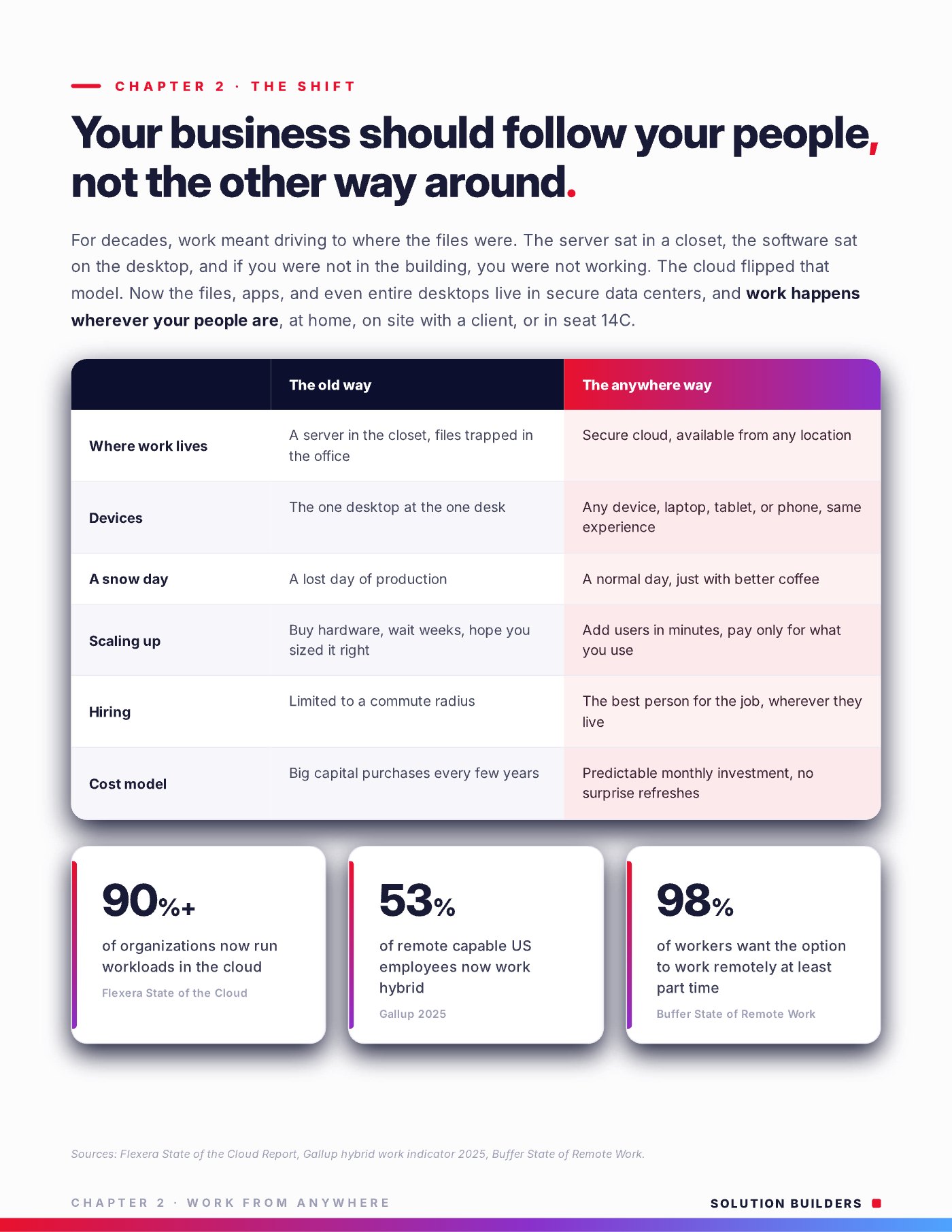
- Resilience is not a backup plan. It is a business that runs from anywhere, on any device, with redundancy where it matters.
- FEMA says 40% of small businesses never reopen after a disaster. Ponemon puts downtime at about $9,000 a minute.
- RTO is how fast you are back. RPO is how much data you can afford to lose. Agree on both before you buy anything.
- The 3, 2, 1 rule, immutable copies and a timed restore are the difference between a bad hour and a closed business.
What resilient IT infrastructure in Minneapolis has to survive
Every business in the Twin Cities has a story about the day things stopped. The January ice storm that took out the industrial park. The server that died the week before quarter close. The accountant who clicked a convincing invoice. What they share is not the cause. It is that the business could not work until someone fixed it, and every hour of that is momentum you do not get back.
The numbers are blunt. FEMA reports that 40% of small businesses never reopen after a natural disaster, and 25% of those that do reopen fail within a year. Ponemon puts downtime at about $9,000 per minute. And confidence runs ahead of reality: in the Veeam Data Trust and Resilience Report 2026, 90% of 900 senior IT, security and risk leaders were confident they could recover from a cyber incident within their targets, while among organizations actually hit by ransomware only 28% fully recovered their data.
Disruption is a when, not an if, and it comes in five shapes. What matters is what a business designed for it does instead.
| How a business gets knocked down | What usually happens | What a designed business does |
|---|---|---|
| Natural disaster | Office is dark, nobody can work | Team works from home by 9 a.m. |
| Hardware failure | Days waiting on a part and a restore | Workloads already run in the cloud |
| Cyberattack | Backups encrypted along with everything else | Immutable copy restored, contained in minutes |
| Human error | Deleted folder, no version to go back to | Versioning and a tested restore |
| Building unavailable | Phones ring to an empty desk | Calls follow people on any device |
The answer is almost never a single product. It is a business designed to keep operating. That is the R in RISE, and it is the first thing Solution Builders builds for every client, because nothing else works if the business cannot run.
A work from anywhere IT setup, not a VPN workaround
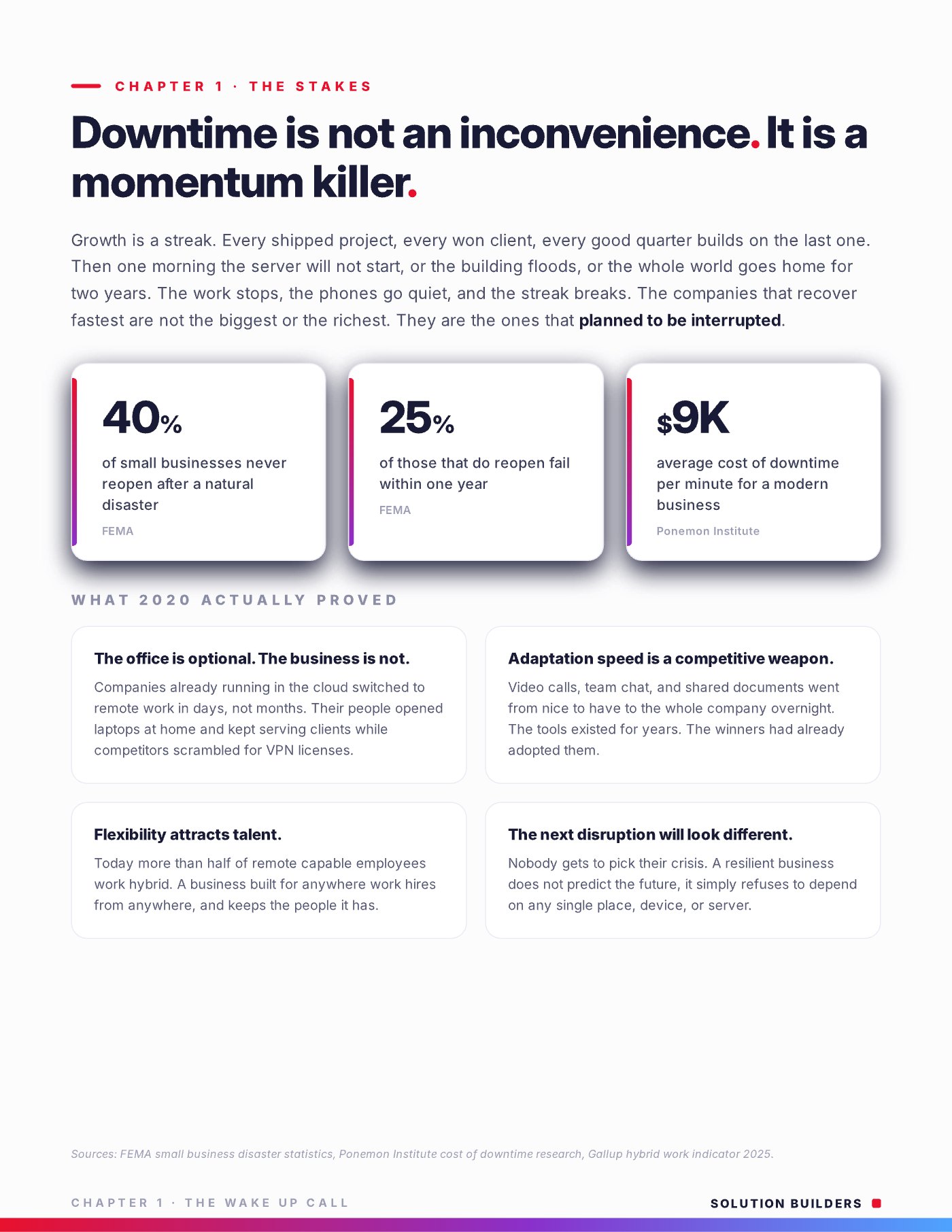
The office became a thing you do, not a place you go. Gallup's tracking shows 53% of remote capable employees now work hybrid, and Buffer's State of Remote Work found 98% of workers want the option to work remotely at least part of the time. A business that can only function inside its own walls is now the exception, and it is the fragile one.
The anywhere principle is simple: every person, every app and every file should be reachable from any device with a login and an internet connection, with the same security everywhere. The old way bolted a VPN onto an office network and hoped. The anywhere way moves the office into the cloud and makes the building optional.
Office first
- Files on a server in a closet
- VPN that drops when the power does
- Desk phones that ring to nobody
- Security that only works inside the building
Cloud first
- Files in Microsoft 365, versioned and shared
- Identity based access from any network
- Calls that follow people on any device
- Same protection at home, on site, on the road
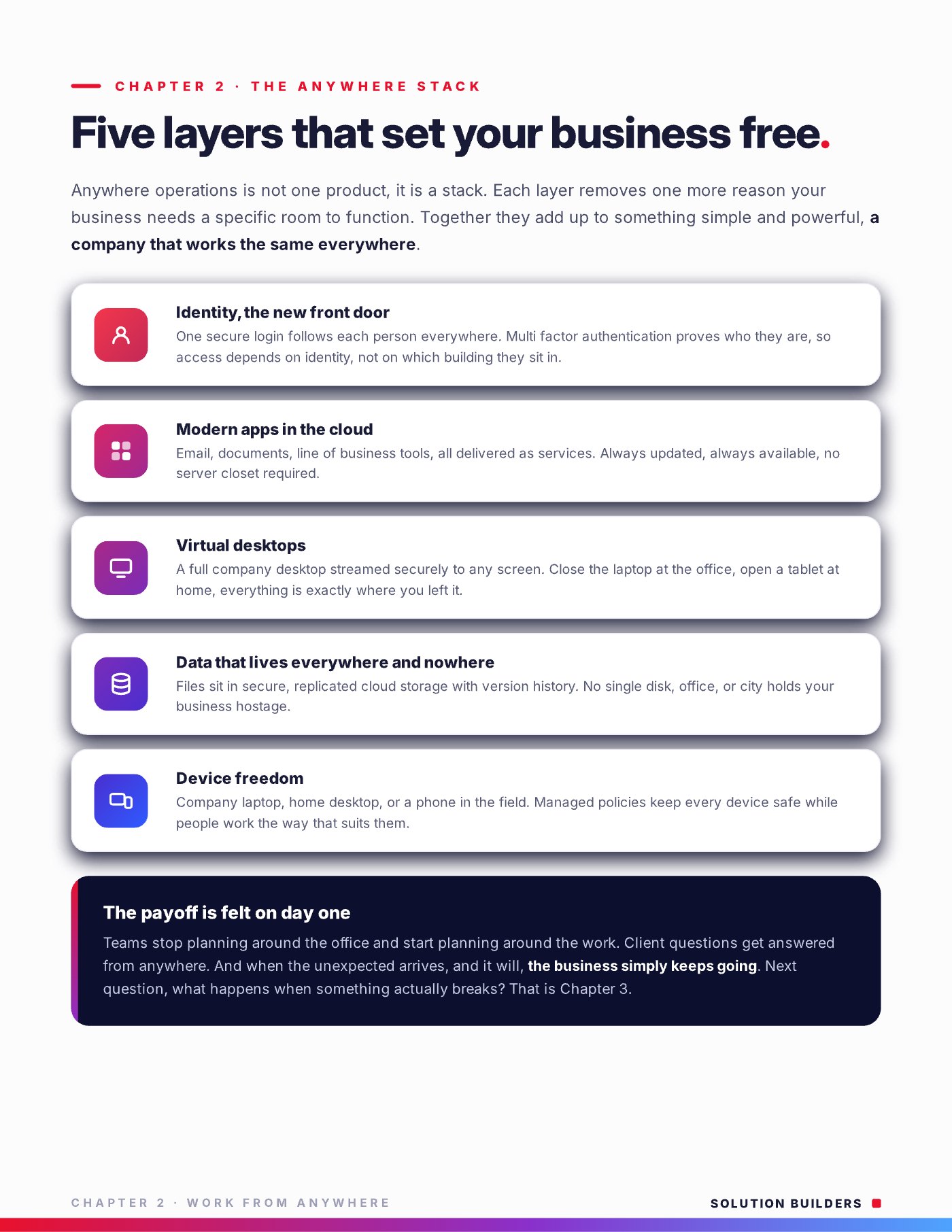
The anywhere stack for a cloud first small business in the Twin Cities is mostly things you may already license.
- Microsoft 365. Email, files, Teams and the apps, with versioning built in. A Microsoft 365 environment set up properly is the foundation of everything below.
- Entra ID. One identity for every app, with multifactor authentication and access rules that follow the person.
- Intune. Device management that keeps laptops patched, encrypted and compliant wherever they are.
- Virtual desktops. For the line of business application that still wants to live on a server, run it in the cloud and reach it from anything.
- A cloud phone system. Your main number rings on a laptop, a cell phone or a headset at a kitchen table.
A 60 user architecture firm with multiple Twin Cities locations made exactly this move with a cloud native migration from Solution Builders: infrastructure cost down 38%, remote productivity tripled, zero on premises footprint.
Always on: RTO and RPO decoded
Backup is where most companies think resilience lives, and where the expensive surprises hide. Two numbers settle almost every backup conversation, and both belong to the business, not to IT. RTO, recovery time objective, is how fast you are back. RPO, recovery point objective, is how much data you can afford to lose. A four hour RTO with a 15 minute RPO for your ERP means a different design, and a different price, than a two day RTO for the archive share. Set those targets with the business before you buy anything.
Then build layers of redundancy, because any single copy will eventually fail. The rule has not changed in decades: three copies of your data, on two different media types, one copy off site. Add two modern requirements. One copy must be immutable, so nobody, including an attacker with admin rights, can change or delete it. And every copy must be tested by restoring it. Sophos reported in 2025 that 97% of organizations with solid backups recovered their encrypted data, and 53% were back within a week.
- PlanWrite the RTO and RPO for each critical system in a document leadership has read.
- ProtectBack up servers, cloud workloads and Microsoft 365 to an immutable, off site copy that meets the RPO.
- TestRestore one server and one mailbox end to end every quarter. Time it against the RTO.
- ImproveFix whatever missed, then run the loop again, because the business changed since last quarter.
Having a backup is not the same as having a backup that works
Backups fail silently all the time: a full disk, a misconfiguration, a job that quietly stopped months ago. The only backup you can trust is one you have restored yourself. If nobody can name the date of the last test restore, that is the first item on the list.
This is the core of data backup and disaster recovery from Solution Builders, where the restore test is routine. For a recovery test you can run this week, read The Business Continuity Playbook.
Connected everywhere: one conversation across every device
Resilience also means communication that follows people instead of desks. Most growing companies in Minnesota have accumulated a chat app, a meeting app, a phone system, a file share and three group texts, and on a bad day nobody knows which one is the real channel. App sprawl is a resilience problem, because the moment the office is unreachable the conversation has to continue somewhere everyone can find.
Unified communications fixes that by putting chat, meetings, calling and files in one place, usually Microsoft Teams with a cloud phone system behind it. The company's main number rings on a laptop or a cell phone. A customer call becomes a chat thread with the file attached. The morning huddle happens on video whether the team is in the North Loop office, at a plant in Greater Minnesota or at home with the kids. Collaboration compounds when the context never gets lost between tools.
- One channel for the bad day. Decide now where the company talks when email is down or the building is closed, and make sure it lives in the cloud.
- Calls that follow people. A cloud phone system means the front desk works from anywhere and voicemail arrives as email.
- Every location on one network. For companies with a plant and a metro office, SD-WAN keeps sites connected over two internet links so one carrier outage does not take a location offline.
- Files that live with the conversation. Teams and SharePoint keep documents versioned and shared, so the deleted folder has a version to go back to.
Communication that follows people instead of desks is the difference between a company that pauses and a company that keeps its promises.RISE: Resilient
Resilient by design: protecting a business with no walls
Once the business runs from anywhere, the old perimeter is gone. There is no firewall at the front door because there is no front door. The perimeter moved to identity: who you are, what device you are on, and whether that combination makes sense right now. A sign in from a managed laptop in Bloomington at 9 a.m. is normal. The same account from an unmanaged device in a country you do not do business with at 3 a.m. is not, and the system should block it before a human ever sees the alert.
Smart access rules make that automatic. Conditional access in Entra ID can require multifactor authentication everywhere, block sign ins from places your people never are, and allow personal devices only to the apps that are safe on a personal device. That is device freedom with guardrails: people work on what they like, and the company still controls the data.
The resilience maturity ladder is the quickest way to score where you stand. Most companies with 25 to 500 employees sit on the second rung and do not know it.
| Rung | What it looks like | What a bad day costs |
|---|---|---|
| Reactive | Server in a closet, backups untested, VPN as the plan | Days |
| Protected | Backups exist, some cloud, no written targets | A day or two |
| Designed | Cloud first, RTO and RPO agreed, restores tested | Hours |
| Resilient | Identity based access, redundancy everywhere, continuity loop running | Minutes, and the customer never notices |
Moving up a rung is a project, not a purchase. It is the kind of project Solution Builders has run for Minnesota businesses from Bloomington since 1995: cloud migration, backup and disaster recovery, Microsoft 365 and SD-WAN, designed together so the business bends without breaking.
Business continuity planning in Minnesota: what to do this week
None of this requires a budget cycle to begin. Run the readiness test with your leadership team: if the building disappeared tonight, could your team work tomorrow morning? Then work through the list.
- Write the RTO and RPO for your three most critical systems and get the owners to sign off.
- Find the date of the last test restore. If nobody knows, schedule one for this month and time it.
- Confirm at least one backup copy is immutable and off site, and that Microsoft 365 is included.
- Decide the one channel the company uses on a bad day and tell everyone where it is.
- Turn on multifactor authentication everywhere and block sign ins from countries you do not work with.
- List every application that still only runs inside the building and decide which ones move to the cloud first.
- Score yourself on the maturity ladder and pick the one project that moves you up a rung.
If you want a second set of eyes, a Solution Builders engineer will walk through your continuity plan in 30 minutes and show you what to fix first. The conversation is free, the plan is yours either way, and our 50+ engineers are a short drive from anywhere in the Twin Cities when a bad day calls for someone on site.
Resilient IT infrastructure for Twin Cities companies
Solution Builders has built resilient technology for Minnesota businesses from Bloomington since 1995. Our 50+ engineers design cloud first environments, tested backups and continuity plans for companies with 25 to 500 employees in Minneapolis, St. Paul and across the metro, including manufacturers with a plant in Greater Minnesota and an office near the I-494 corridor. Related services: Cloud Migration, Data Backup and Disaster Recovery, Microsoft 365, SD-WAN. Contact us or book a 30 minute call.