Solution Builders team
Jump to a section
- Reactive IT is the most expensive kind. Emergency pricing, duplicate tools, unused seats and surprise refreshes never show up as a line item.
- A virtual CIO is six documents, not a title: roadmap, budget, risk register, vendor strategy, lifecycle plan and a quarterly review that ends in decisions.
- Sort every dollar into run, grow or transform. Run creeping up while the other two shrink is the signature of a reactive budget.
- Every purchase names its goal and its metric, scores on the matrix and lands on a 12 quarter roadmap refreshed every 90 days.
Reactive vs proactive IT: reactive never looks expensive, only urgent
A reactive IT budget is not a budget. It is a record of emergencies. Each purchase made sense on the day it was made, which is the problem: that day always had the least time, the fewest options and the highest price. Walk into most companies with 25 to 500 people in the Twin Cities and the pattern is the same. Virtual CIO services in Minneapolis exist to break that pattern, and the first job is simply to show it.
Five patterns show up again and again when we review a new client's spend from the last year.
- Emergency replacements. Expedited hardware, overtime and two days of downtime, because nothing had a planned end date.
- Duplicate tools. Sales buys a scheduling app, operations buys another, and both overlap with the Microsoft 365 licenses you already pay for.
- Surprise refreshes. Windows 10 left support in October 2025 and a third of the fleet could not run Windows 11. The date was public for four years.
- Renewal autopilot. Contracts renew because the notice window passed. Seat counts never shrink and the vendor does your planning.
- Vendor driven roadmaps. The next project is whatever the last salesperson pitched well. The business goal gets written after the purchase order, if at all.
Here is the tell. Sort last year's IT spend into two piles: things you decided to buy and things you had to buy. If the second pile is bigger, you have a reactive budget, whatever the spreadsheet is called. In our reviews of new client budgets, only about a tenth of a reactive year's spend follows a plan. We wrote about what that costs in The Real Cost of IT Headaches.
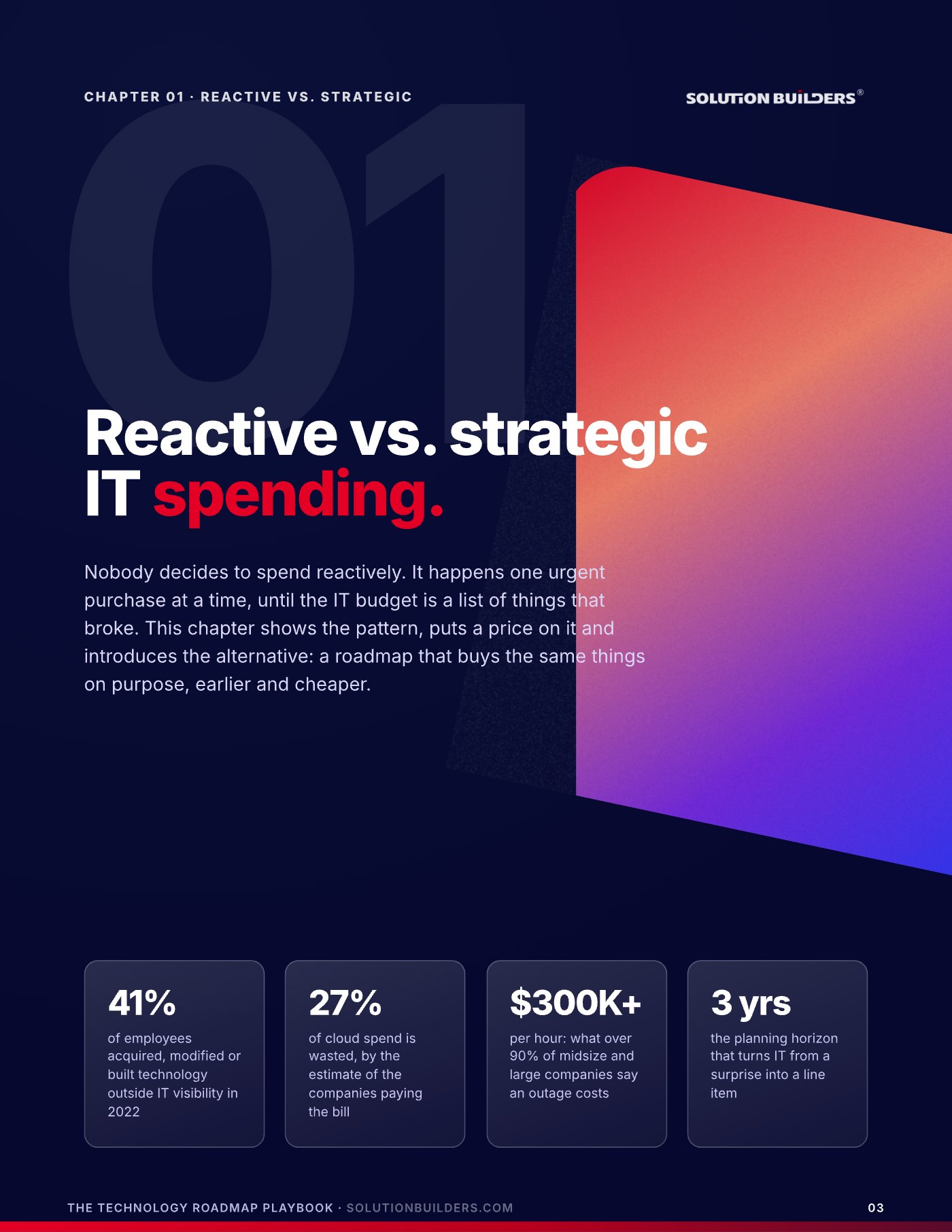
The same dollars go further on a roadmap
A strategic budget does not have to spend more. It spends the same money earlier, in bulk, on standard equipment, with the goal written down first. The difference is fewer emergencies, fewer tools and a leadership team that is never surprised. Reactive IT is not cheaper. It just sends the invoice later.
How most companies buy technology
- Purchases triggered by failures and sales calls
- Each department picks its own tools
- Refreshes found the quarter they are due
- IT only asks for money in emergencies
How a roadmap buys the same things
- Purchases scheduled three years out
- One standard per category, reviewed quarterly
- Refreshes budgeted a year ahead, bought in bulk
- A plan once a year, a scorecard every quarter
The savings hide in places that are not line items: emergency pricing, duplicate licenses, unused seats and the downtime between failure and fix. That is why reactive budgets look smaller than they are. Three purchases, two ways, make it concrete.
| Purchase | Reactive | On the roadmap |
|---|---|---|
| Aging file server | Dies, replaced in 72 hours, data lost | Moved to SharePoint in Q2, retired |
| Laptop fleet | Replaced as they fail, six models | A quarter of the fleet a year, one model |
| Collaboration tools | Teams, Slack and Zoom, all half used | One platform, two retired, seats reclaimed |
An 85 user manufacturer in Greater Minnesota that Solution Builders took through a 90 day transformation put it simply afterward: step one was a standard, not a purchase. One laptop model, one identity, one collaboration platform. Support tickets fell 60% and more than 100 hours of monthly downtime disappeared, not because they spent more, but because every dollar finally had a reason.
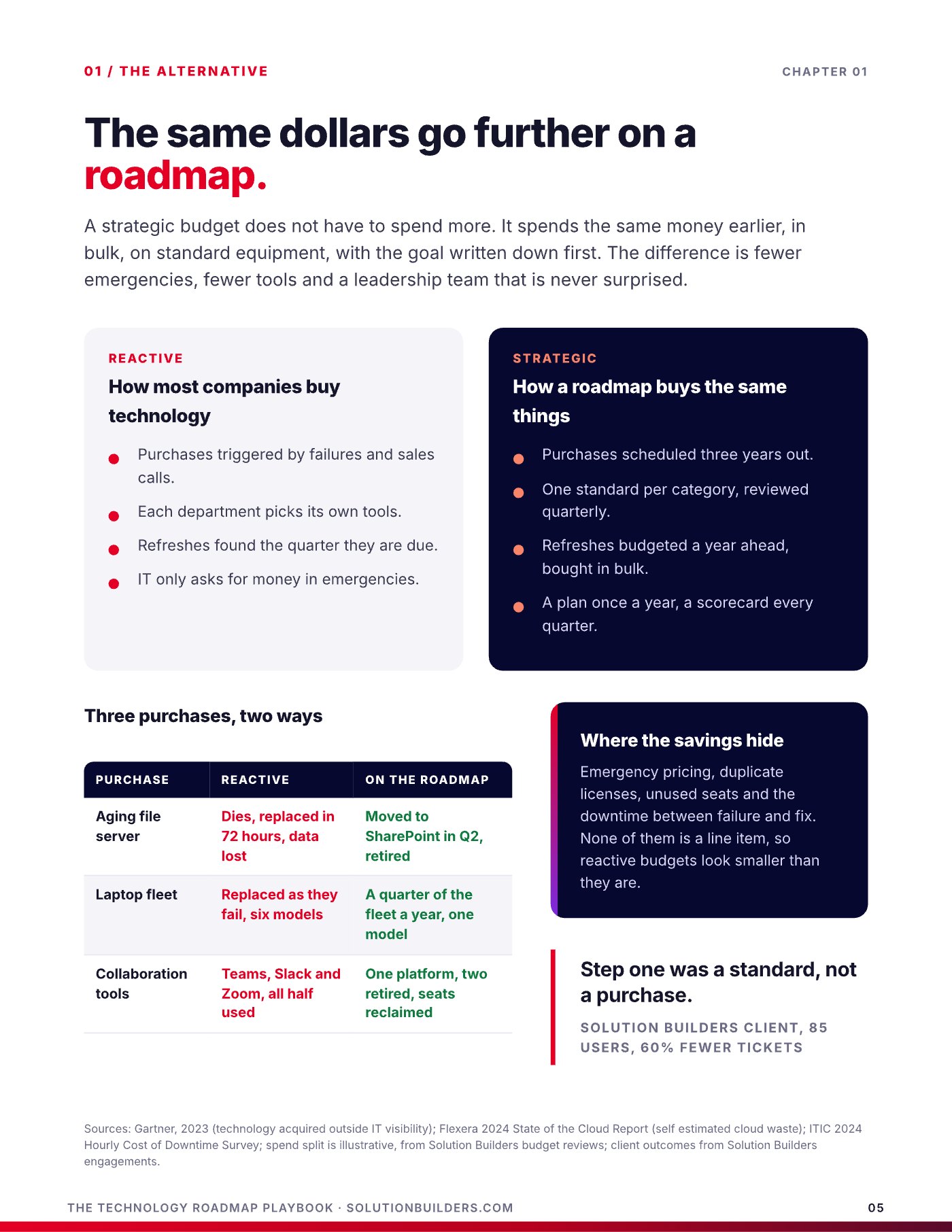
What virtual CIO services in Minneapolis actually deliver
A virtual CIO is a fractional technology executive: senior strategy a few days a month, without the full time salary. The title gets used loosely, so here is the test. Strip away the business card and a real vCIO owns six documents, updated every quarter, in writing. If the person you pay for strategy cannot put these six on the table, you are paying for account management and calling it strategy.
- The three year roadmapEvery planned project, refresh and retirement on one page, sequenced by dependency and dated by quarter. Updated every 90 days.
- The budget and forecastA run, grow, transform budget for this year and a forecast for the next two, with every known renewal already in it.
- The risk registerA ranked list of what could hurt the business, from an aging firewall to payroll running on one server, each with an owner.
- Vendor strategyWhich vendors you standardize on, which contracts renew when, and who negotiates. Renewals get decided 90 days out, never the week of.
- Lifecycle managementEvery device, server and license with a purchase date and a planned end date, so nothing retires by surprise.
- The quarterly business reviewNinety minutes with your leadership team: what changed, what is at risk, what we decide next. Decisions are written down and tracked.
Not your help desk, not a salesperson, not a project manager
A vCIO decides what should be built and why. Engineers decide how. A strategist paid to sell hardware is a salesperson with a nicer title, so ask whether the person has a sales quota for your account. The right answer is zero, and 180 days of notice on every renewal, refresh and end of support date.
That is the shape of the IT consulting and virtual CIO practice at Solution Builders: a named strategist on every account, backed by 50+ engineers so the plan and the build are one team. A vCIO is measured by the surprises that did not happen.
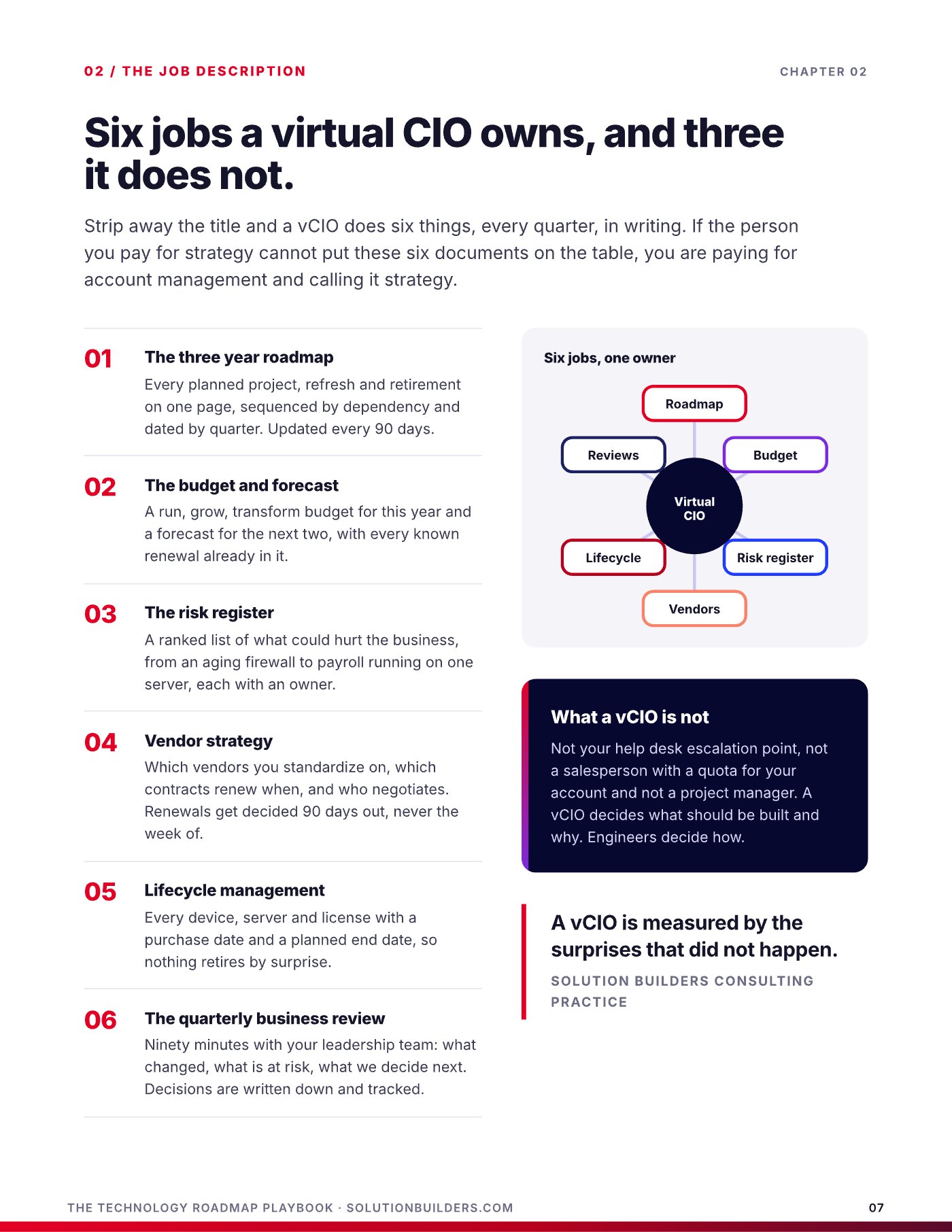
Four reviews a year, each one ending in a decision
The quarterly business review is where the roadmap meets reality. It is not a status report. It is a 90 minute working session where the vCIO brings the data and your leadership team leaves with decisions. The rhythm across a year: Q1 plan, approving the year and locking the refresh calendar. Q2 check, projects against plan and spend against budget. Q3 budget, drafting next year from the roadmap with the CFO. Q4 reset, scoring the year and moving the dates that need moving.
| Minutes | Topic | What you walk out with |
|---|---|---|
| 0 to 10 | Scorecard | Uptime, tickets, security posture and spend against plan |
| 10 to 30 | Risk register | Top five risks and which ones need a decision today |
| 30 to 55 | Roadmap | Done, in flight and next. Dates confirmed or moved |
| 55 to 75 | Budget and renewals | Spend against plan, every renewal in the next 180 days |
| 75 to 90 | Decisions | Written down with an owner and a date |
IT strategy consulting in the Twin Cities comes in many flavors, and the review is where you can tell the real thing from an account manager with a new business card.
- They bring numbers unasked. Spend against plan and the risk trend arrive before you ask for them.
- They talk you out of purchases. A strategist who never says no works for the vendor.
- They own documents, not decks. The roadmap changes when reality does.
- They know your CFO. If finance has never met your strategist, you do not have one.
If you already have an internal IT lead, the vCIO sits beside them rather than above them, bringing the roadmap and the vendor negotiating power while your person keeps the day to day. That is how our Co-Managed IT clients use the role, and it is why Solution Builders holds a 98% client satisfaction score, measured on every ticket.
IT budget planning in Minnesota: run, grow, transform
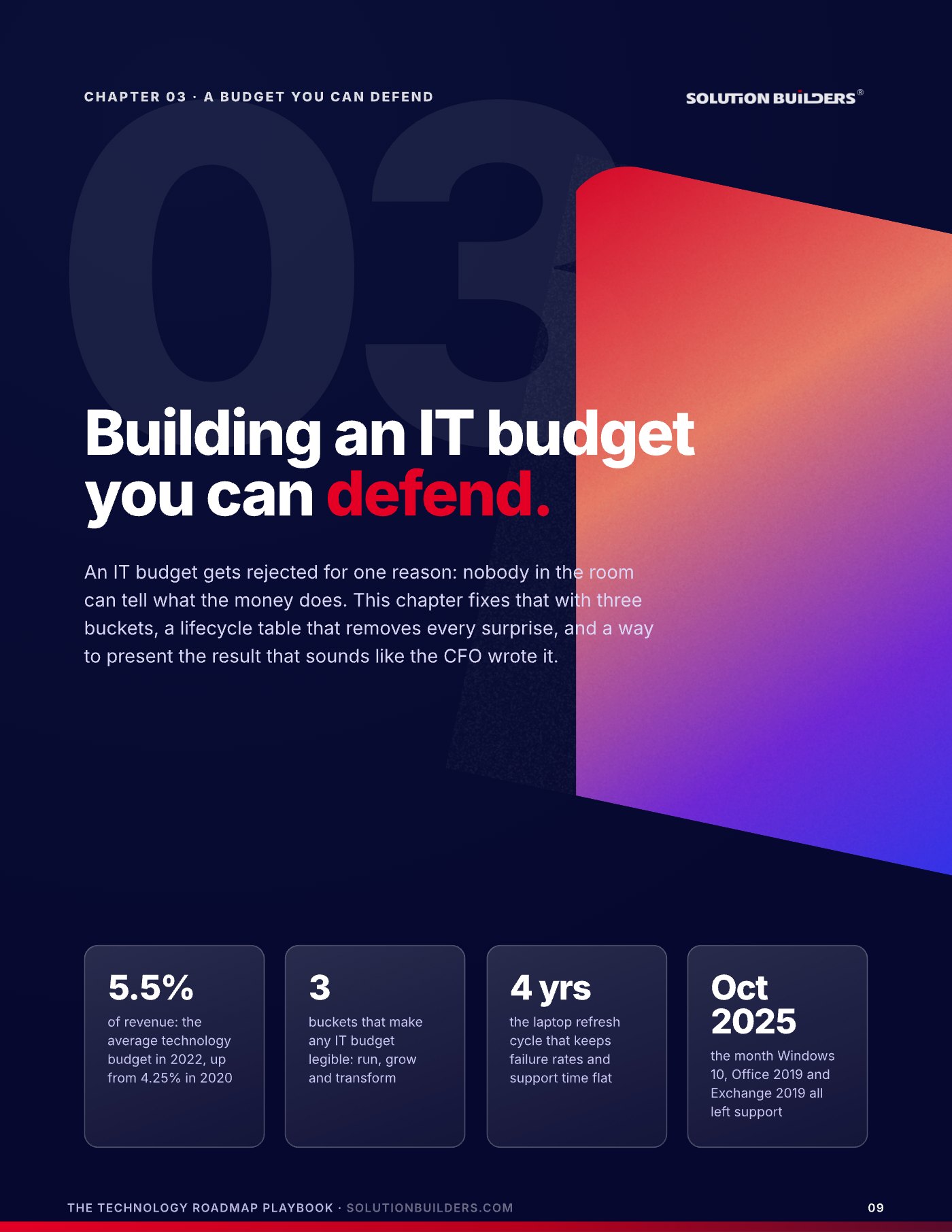
An IT budget gets rejected for one reason: nobody in the room can tell what the money does. Three buckets fix that. Deloitte's 2023 Global Technology Leadership Study put the average technology budget at 5.5% of revenue, up from 4.25% in 2020, but the split between the buckets matters more, because the trend tells you whether IT is a cost or an investment.
| Bucket | What it pays for | The question it answers |
|---|---|---|
| Run | Licenses, support, security, backup, connectivity, scheduled refreshes | Is the business safe and working today? |
| Grow | Capacity for more people and sites: integrations, automation, cloud scale | Can we handle next year's growth at this headcount? |
| Transform | New ways of operating: AI, analytics, new revenue lines | What will make us different in three years? |
In our budget reviews a reactive budget runs about 82% run, 13% grow and 5% transform. A typical midsize firm sits near 70, 20 and 10, and by year three of a roadmap the split moves toward 58, 27 and 15. Run is not the enemy. Unpredictable run is. Shrink it by standardizing on one laptop model and one collaboration platform, retiring servers on a schedule, and moving to fixed monthly fees your CFO can forecast.
Predictable run comes from a lifecycle table written three years ahead: laptops every four years, servers and firewalls every five, switches and Wi-Fi every five to seven. Replace a quarter of each category every year and the refresh line never spikes. The end of support dates are already public: Windows 10 ended in October 2025, SQL Server 2016 ends in July 2026 and Windows Server 2016 in January 2027. Projects on those dates are delivered by senior engineers from our professional services team, scheduled from the roadmap rather than the deadline.
- Lead with the businessOpen with the three goals the budget serves, not the hardware list.
- Show the trend, then the envelopeRun flat, grow and transform rising. Then ask for a three year envelope.
- Put a risk next to every deferralName the risk and the quarter it becomes an emergency.
Every technology decision names its goal and its metric
Technology aligned to strategy is a phrase everyone nods at and almost nobody can show on paper. McKinsey's global survey on digital transformations found only 16% of companies said theirs improved performance in a way that lasted, and Harvard Business Review research found just 55% of middle managers could name even one of their company's top five priorities. Alignment is a table, not a feeling: goal, capability, project, metric. A blank column means the project waits.
| Business goal | Capability needed | Project | Metric |
|---|---|---|---|
| Open a second location in 2027 | Same systems in any building | Cloud file and identity migration | New site live in 30 days, no servers |
| Win regulated customers | Prove security controls on demand | CMMC or SOC 2 readiness | Assessment passed, RFPs answered in days |
| Cut order to cash from 14 to 7 days | ERP, CRM and accounting share a record | Integration and automation | Days from order to invoice |
| Keep the plant running | No single point of failure | Redundant network, immutable backup | Downtime under two hours a quarter |
| Free the team from busywork | AI on governed company data | Copilot pilot with 20 users | Hours saved per user at day 90 |
Score each project on impact and ease, one to five each, with the CFO, the COO and IT in the same room, then plot them. Top right goes first. Bottom left never, however good the demo was. The matrix does not pick projects. It ends arguments. Sorted onto a calendar, that list becomes a 12 quarter roadmap in four phases: stabilize, standardize, integrate, evolve. Before any purchase, ask six questions.
- Which goal on the alignment table does this serve? If none, it waits.
- What metric will move, and who measures it 90 days after go live?
- Where does it sit on the matrix? Bottom left is a no.
- What does it replace or retire? Adding a tool without removing one grows run cost forever.
- Is the dependency ahead of it done? Copilot before data governance is a pilot designed to fail.
- What does it cost over three years, including people time and the refresh after it?
What to do this quarter
Three moves, in order. A technology roadmap for a small business starts with a sort, not a purchase.
- Run the two pile testSort last year's IT spend into decided and forced. Count how many of the six questions were answered in writing before your last big purchase. Write both numbers down.
- Build the lifecycle tableEvery device, server and license with a purchase date and a planned end date. Mark anything that reaches end of support in the next 18 months. That list is your first roadmap.
- Get an outside readA Technology Strategy Snapshot with Solution Builders is a free 30 minute conversation about where your IT spend goes today. You leave with the three reactive patterns costing you the most. Book a time or call (952) 854 8188.
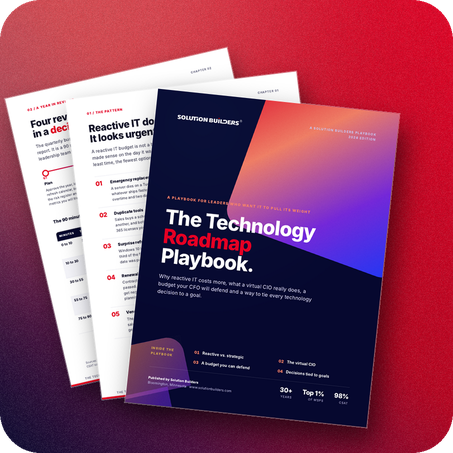
The roadmap is not a document. It is a standing decision about what gets funded next, and once the projects on it are sequenced, delivering them well is its own discipline. That is the subject of our IT Project Success Playbook.
IT strategy for growing companies across the Twin Cities
Solution Builders has planned technology for Minnesota businesses from Bloomington since 1995. Our IT consulting practice puts a named virtual CIO at the leadership table of companies with 25 to 500 people in Minneapolis, St. Paul and across the metro, backed by 50+ engineers and a 98% client satisfaction score. Related services: IT Consulting, Co-Managed IT, Professional Services, Cybersecurity. Contact us or book a 30 minute call.