Solution Builders team
Jump to a section
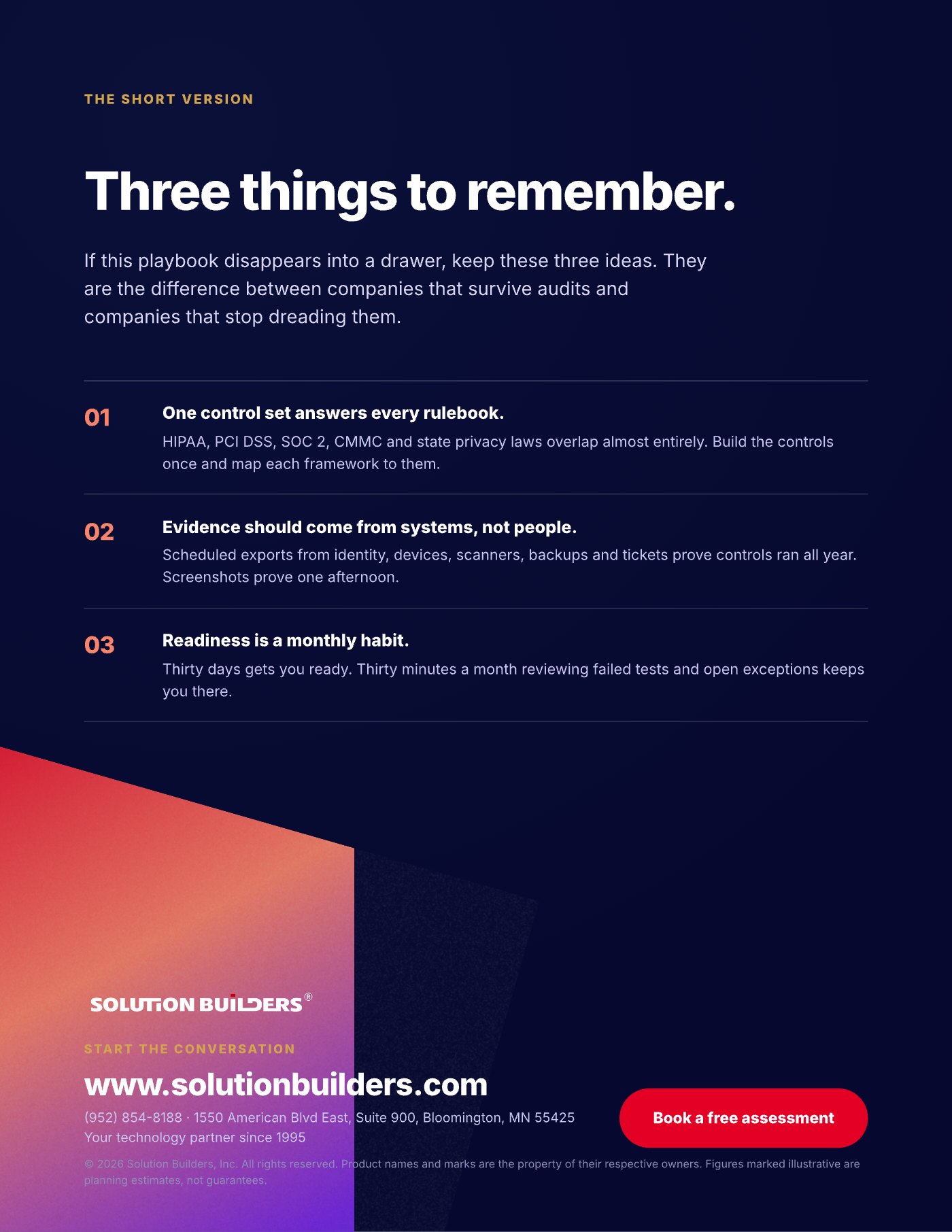
- HIPAA, PCI DSS, SOC 2 and CMMC ask for the same six control families. Build the controls once and map each rulebook to them.
- Pick one backbone, CIS Controls v8 or NIST CSF 2.0, and never write your own framework. Auditors, insurers and your next hire already know both.
- Evidence should come from systems, not people. Scheduled exports from identity, devices, scanners, backups and tickets prove a control ran all year.
- Auditors grade five things: scope, true policies, dated evidence, documented exceptions and proof that someone looks. Fire drills deliver one.
- Thirty days gets you ready. A 30 minute monthly review of failed tests and open exceptions keeps you there.
Why compliance still runs on adrenaline in the Twin Cities
Picture a 120 person medical device supplier on the I-494 corridor. They answer to HIPAA because of a hospital contract, PCI DSS because they take cards, a SOC 2 request from their largest customer, a cyber insurance questionnaire and, since July 31, 2025, the Minnesota Consumer Data Privacy Act. Five rulebooks, five vocabularies, and the same three people answering all of them between their real jobs. That is the normal state of compliance at companies with 25 to 500 employees across Minneapolis and St. Paul, and it is why the word "audit" makes shoulders rise.
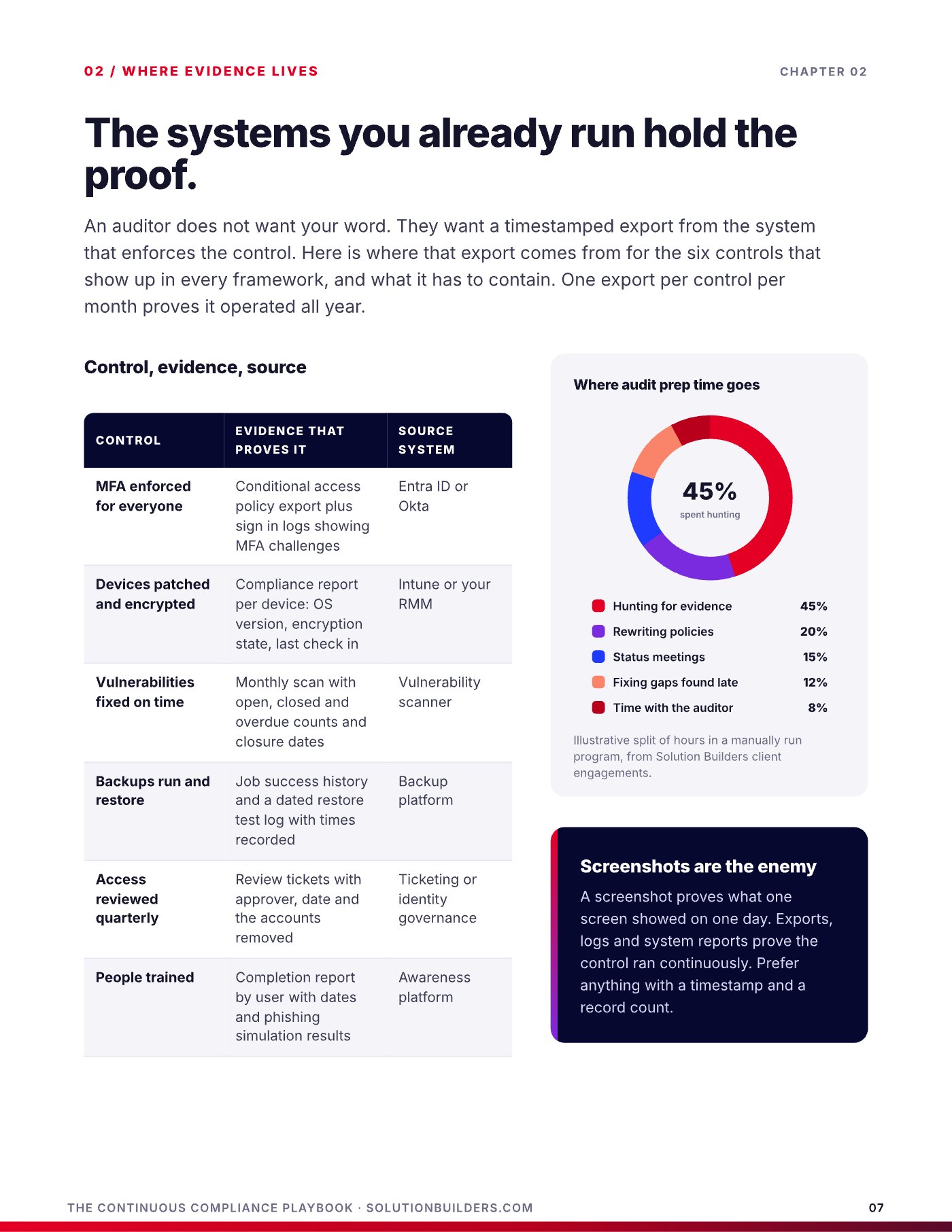
The fire drill is expensive in ways that never show up on an invoice. The Ponemon Institute and Globalscape study on the true cost of compliance found that noncompliance costs organizations about 2.7 times what staying compliant costs. In Solution Builders client engagements, roughly 45% of audit prep hours go to hunting for evidence that already exists somewhere, and another 20% to rewriting policies the night before the auditor arrives. Time with the actual auditor is the smallest slice.
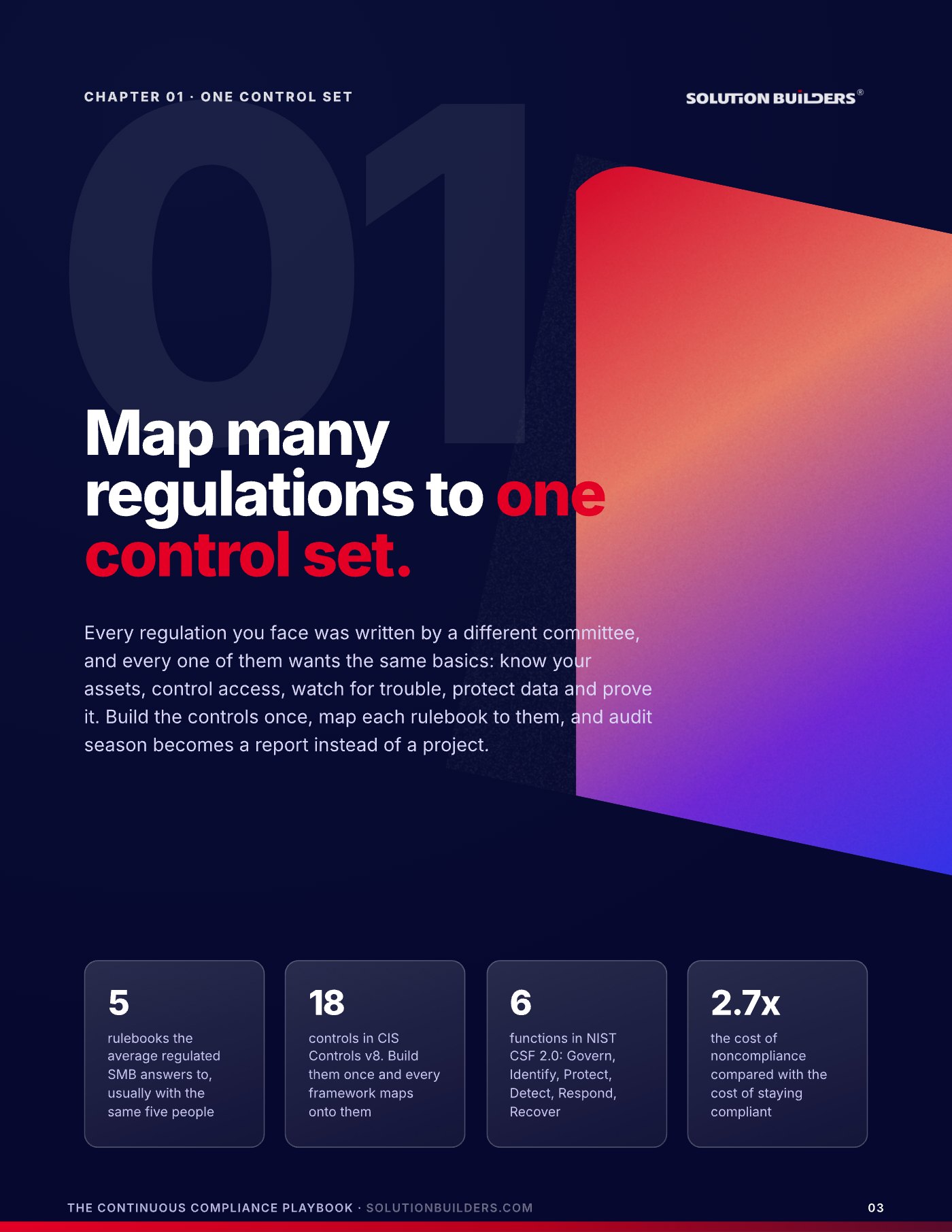
Here is what most companies miss. Every regulation they face wants the same basics: know your assets, control access, watch for trouble, protect data and prove it. Build those controls once, map each rulebook onto them, and audit season becomes a report you open instead of a project you dread. That is the model behind regulatory compliance support from Solution Builders, and this article walks through it the way we do with clients.
Map every regulation to one control set
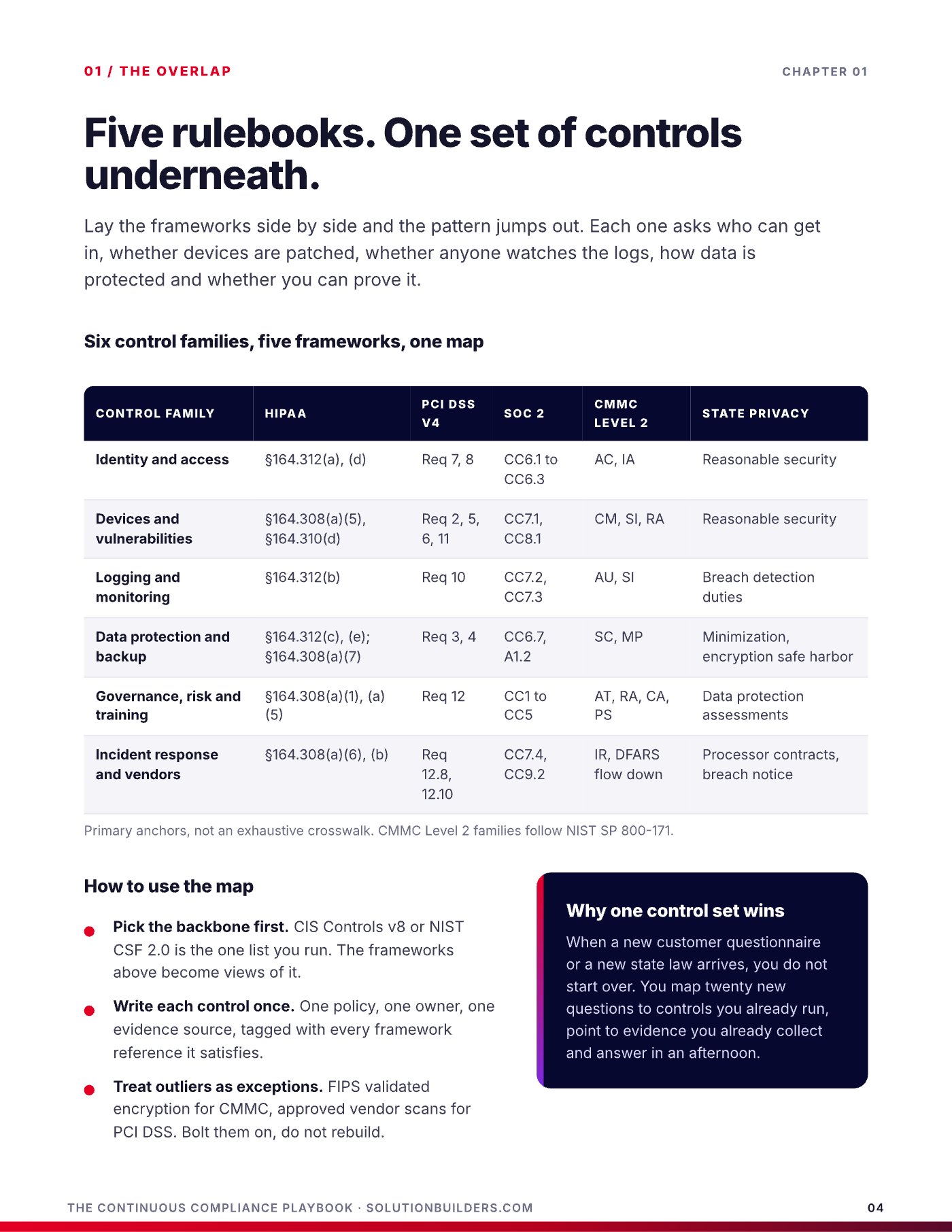
Lay HIPAA, PCI DSS, SOC 2 and CMMC side by side and the pattern jumps out. Each one asks who can get in, whether devices are patched, whether anyone watches the logs, how data is protected and whether you can prove any of it. The words differ. The six control families underneath do not.
| Control family | HIPAA Security Rule | SOC 2 | CMMC Level 2 |
|---|---|---|---|
| Identity and access | Access control and authentication standards | CC6.1 to CC6.3 | AC and IA families |
| Devices and vulnerabilities | Workstation and device controls, security awareness | CC7.1, CC8.1 | CM, SI and RA families |
| Logging and monitoring | Audit controls | CC7.2, CC7.3 | AU and SI families |
| Data protection and backup | Encryption, integrity and contingency planning | CC6.7, A1.2 | SC and MP families |
| Governance, risk and training | Risk analysis and workforce training | CC1 to CC5 | AT, RA, CA and PS families |
| Incident response and vendors | Incident procedures, business associate contracts | CC7.4, CC9.2 | IR family plus DFARS flow down |
PCI DSS v4 follows the same shape: Requirements 7 and 8 for access, 10 for logging, 3 and 4 for data protection, 12 for governance and vendors. State privacy laws, including Minnesota's, ask for "reasonable security," breach detection and processor contracts, which land in the same rows. These are primary anchors rather than an exhaustive crosswalk, but they are enough to run on.
- Pick the backbone first. CIS Controls v8 or NIST CSF 2.0 is the one list you run. Every framework above becomes a view of it.
- Write each control once. One policy, one owner, one evidence source, tagged with every framework reference it satisfies.
- Treat outliers as exceptions. FIPS validated encryption for CMMC, approved vendor scans for PCI DSS. Bolt them on, do not rebuild around them.
The payoff shows up the day a new customer questionnaire lands. You map twenty new questions to controls you already run, point to evidence you already collect and answer in an afternoon. A Minneapolis accounting firm that gets its first SOC 2 request from a client is not starting a project. It is producing a report.
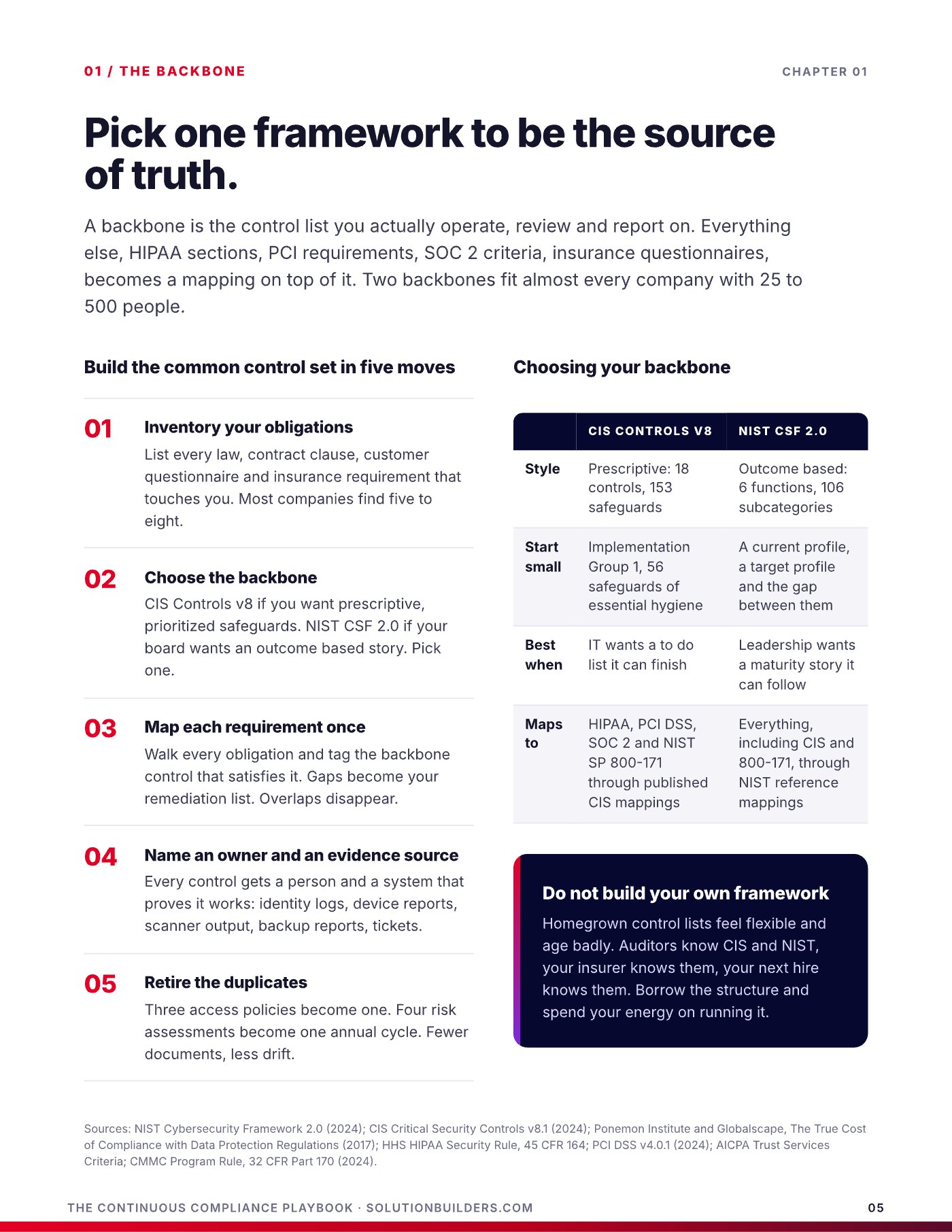
Pick one backbone: CIS Controls v8 or NIST CSF 2.0
A backbone is the control list you actually operate, review and report on. Everything else, HIPAA sections, PCI requirements, SOC 2 criteria, insurance questionnaires, becomes a mapping on top of it. Two backbones fit almost every company with 25 to 500 people, and the right one depends on who needs to read it.
| CIS Controls v8 | NIST CSF 2.0 | |
|---|---|---|
| Style | Prescriptive: 18 controls, 153 safeguards | Outcome based: 6 functions, 106 subcategories |
| Start small | Implementation Group 1, 56 safeguards of essential hygiene | A current profile, a target profile and the gap between them |
| Best when | IT wants a to do list it can finish | Leadership wants a maturity story it can follow |
| Maps to | HIPAA, PCI DSS, SOC 2 and NIST SP 800-171 through published CIS mappings | Everything, including CIS and 800-171, through NIST reference mappings |
Once you have chosen, build the common control set in five moves. Most of this is meetings and documents, which is exactly why it never gets done without a deadline.
- Inventory your obligationsList every law, contract clause, customer questionnaire and insurance requirement that touches you. Most companies find five to eight.
- Choose the backboneCIS if you want prescriptive, prioritized safeguards. NIST CSF if your board wants an outcome based story. Pick one and write the reason down.
- Map each requirement onceTag the backbone control that satisfies each obligation. Gaps become your remediation list. Overlaps disappear.
- Name an owner and an evidence sourceEvery control gets a person and a system that proves it works: identity logs, device reports, scanner output, backup reports, tickets.
- Retire the duplicatesThree access policies become one. Four risk assessments become one annual cycle. Fewer documents, less drift.
One warning. Do not build your own framework. Homegrown control lists feel flexible and age badly. Auditors know CIS and NIST, your insurer knows them, your next IT hire knows them. Borrow the structure and spend your energy on running it.
Automate evidence so it collects itself all year
Audit prep is miserable for one reason: evidence is gathered by hand, after the fact, by people who have other jobs. A SOC 2 Type II report covers a 12 month window, and the evidence has to exist for every one of those months. CMMC Level 2 has 110 practices, each needing proof that it works rather than a promise that it will. The systems you already run know the answers.
| Control | Evidence that proves it | Source system |
|---|---|---|
| MFA enforced for everyone | Conditional access policy export plus sign in logs showing MFA challenges | Entra ID or Okta |
| Devices patched and encrypted | Compliance report per device: OS version, encryption state, last check in | Intune or your RMM |
| Vulnerabilities fixed on time | Monthly scan with open, closed and overdue counts | Vulnerability scanner |
| Backups run and restore | Job history plus a dated restore test log with times recorded | Backup platform |
| Access reviewed quarterly | Review tickets with approver, date and the accounts removed | Ticketing or identity governance |
| People trained | Completion report by user plus phishing simulation results | Awareness platform |
Turning it on takes four steps. Connect those five systems to a compliance platform or a shared evidence library. Define what passing means with a number: MFA coverage 100%, patch age under 14 days, restore tested within 90 days, pass or fail with no judgment calls. Route every failed test to a ticket with an owner and a due date, so compliance work becomes normal IT work. Then review the exceptions monthly, 30 minutes, one list, and escalate anything older than 90 days.
Screenshots are the enemy
A screenshot proves what one screen showed on one day. Exports, logs and system reports prove the control ran continuously. Prefer anything with a timestamp and a record count. IBM's Cost of a Data Breach Report 2024 found breach costs averaged $2.22 million lower where security automation was used extensively, and the same automation makes evidence flow.
Automation moves the work from collecting to fixing, which is the part that makes you safer, and total hours usually fall by more than half. It is also why our managed cybersecurity services for Twin Cities companies and our compliance practice run on the same tooling: the controls that stop attackers are the controls auditors ask about.
What auditors actually want to see
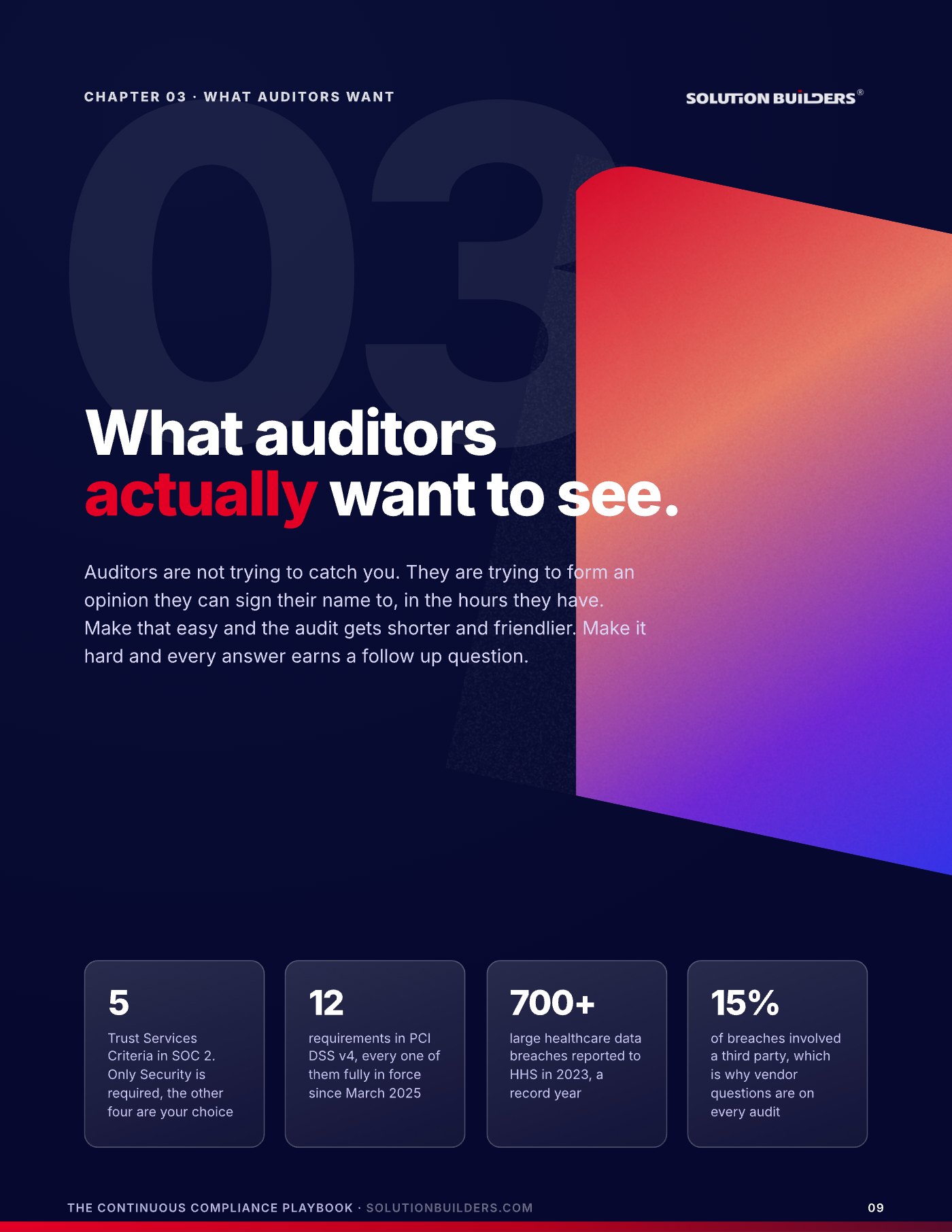
Auditors are not trying to catch you. They are trying to form an opinion they can sign their name to, in the hours they have. Make that easy and the audit gets shorter and friendlier. Whatever the framework, they grade the same five things, and companies in fire drill mode usually deliver only the third one, in a folder of screenshots.
- ScopeWhat systems, people, locations and data are in the audit, and what is deliberately out. A tight, defensible scope is the single biggest time saver.
- Policies that match realityWritten rules that describe what you actually do. Auditors test the gap between the document and the practice. A short, true policy beats a long borrowed one.
- Evidence with datesSystem generated proof that each control operated across the whole period, not on the day you remembered to check.
- Exceptions, documentedA legacy server without MFA is a finding. The same server with a risk acceptance, a compensating control and an expiry date is a managed exception.
- Proof of monitoringEvidence that someone looks: alert reviews, monthly exception meetings, ticket trails. This is what separates a program from a project.
Underneath every question is one: if something went wrong, would you have known, and would you have acted? When the auditor asks "can you restore from backup?" they are listening for whether the answer comes from a system ("quarterly restore drill, the last one took 3 hours 40 minutes, here is the log") or from memory ("backups run nightly").
The fire drill
- Evidence gathered in a three week scramble before the auditor arrives
- Policies rewritten the night before to match what actually happens
- Findings are surprises, discovered by the auditor
- Everyone involved quietly dreads next year
Continuous compliance
- Evidence exports on a schedule, so audit prep is opening a folder
- Policies reviewed annually and short enough that people follow them
- Findings are known exceptions with owners and expiry dates
- The audit is a two day conversation, not a quarter long project
Before the kickoff call, send the scope first, name one point of contact and share the exception register early. Known gaps presented by you are managed risks. Found by them, they are findings. The HHS breach portal logged more than 700 large healthcare breaches in 2023, a record year, so a Twin Cities clinic or device maker should expect its vendor register to be the first thing a HIPAA reviewer asks for.
A 30 day path to audit readiness
Thirty days will not make you perfect. It will make you ready: a defined scope, a control map, evidence that flows and a rehearsal that found the gaps before the auditor did. Put a name next to every line.
Week 1: scope and inventory
- List every obligation: laws, customer contracts, insurance requirements, card brand rules, with the next audit or renewal date for each.
- Inventory systems, data stores and SaaS apps. Flag where regulated data (PHI, card data, CUI, personal data) actually lives.
- Draw the scope boundary between the systems that touch regulated data and the ones that do not.
- Name an executive sponsor and a program owner. Compliance without a sponsor loses every scheduling fight.
Week 2: policies and controls
- Pick the backbone, CIS Controls v8 or NIST CSF 2.0, and write the decision down with the reason.
- Map each obligation to backbone controls. Mark gaps red, partials amber, covered green.
- Assign one owner per control and collapse duplicate policies into one set a new hire would actually read.
- Book the monthly compliance review for the next 12 months. Thirty minutes, standing agenda.
Week 3: evidence and automation
- Schedule exports from identity, device management, scanner, backup and ticketing into one evidence library.
- Write a pass or fail test for each control, with a number: MFA coverage, patch age, scan closure, restore date.
- Route every failed test to a ticket with an owner and a due date.
- Start the exception register and turn on retention: keep evidence for the audit period plus one year.
Week 4: rehearsal and governance
- Run a half day mock audit. Someone outside the team asks the auditor questions from the previous section.
- Fix the quick wins. Anything under four hours of work gets done this week.
- Brief leadership: scope, control map, evidence status, open exceptions and the plan for the rest.
- Freeze the control map and policies as version 1.0, and put next quarter's restore test, access review and phishing simulation on the calendar.
Score yourself against the full 24 item list in the playbook. Zero to eight done is fire drill territory. Nine to sixteen means you know your gaps but evidence still depends on people remembering. Seventeen or more is audit ready, as long as the monthly review survives, because readiness decays. If your obligations include defense work, our CMMC compliance team runs this same 30 day structure against all 110 NIST SP 800-171 practices, and the Manufacturer's CMMC Playbook covers the specifics.
IT compliance services in Minneapolis: your next three moves
Three moves, in order, and none of them require a purchase.
- Count your rulebooksSpend 20 minutes with your leadership team listing every law, contract clause, questionnaire and insurance attestation that touches you. Most companies find five to eight, and at least one that nobody owned.
- Run the screenshot testOpen your last audit folder. Count how many items are screenshots versus exports with a timestamp and a record count. That ratio is your automation backlog, and it is usually humbling.
- Get an outside readA Compliance Readiness Snapshot with Solution Builders is a free 30 minute conversation. You leave knowing your obligations, your biggest gap and what to fix first, whether or not you ever work with us.
The best audit evidence is the evidence you would collect even if no auditor existed.Solution Builders Compliance Practice
Solution Builders has supported regulated Minnesota businesses from Bloomington since 1995, with 50+ engineers, a 24/7 security operations center and a SOC 2 Type II audit of our own, which means we have sat on your side of the auditor's table. Compliance lives in the S of our RISE framework, Secure, alongside cybersecurity, because they are the same controls viewed from two directions. If security is the bigger worry today, start with the SMB Cyber Resilience Playbook.
Compliance support for regulated companies across the Twin Cities
Solution Builders has supported regulated Minnesota businesses from Bloomington since 1995. Our compliance practice maps your obligations to one control set, automates the evidence and runs the monthly review for companies with 25 to 500 employees, from medical device suppliers and clinics in Minneapolis to accounting firms in St. Paul and defense suppliers across Greater Minnesota. Related services: Regulatory Compliance, Cybersecurity, CMMC Compliance, Data Backup and Disaster Recovery. Contact us or book a 30 minute call.