Solution Builders team
Jump to a section
- As of October 2026, third party certification is paused with no new date. DFARS 7012, all 110 controls, SPRS scores and affirmations are not.
- Most defense manufacturers land at Level 2: 110 NIST SP 800-171 controls, proven with written, dated artifacts rather than promises.
- The shop floor is the hard part: legacy CNC controllers, flat networks, tribal knowledge and vendors who inherit your level.
- If a contract mentions ITAR, EAR or CUI, GCC High is the safest Microsoft 365 foundation, and it covers only half the controls.
- Use the pause as runway: rescore without optimism, make SPRS true, finish the SSP, ask your primes and keep building toward Level 2.
Why CMMC compliance for Minnesota manufacturers did not pause
A 90 person precision machine shop south of Minneapolis supplies brackets to a tier one prime. In July the owner heard CMMC was "paused" and quietly moved it to next year's list. His prime has not sent a word either way. Meanwhile his contract still carries DFARS clause 7012, his SPRS score is three years old and two CNC controllers on the floor run Windows 7. That is the state of CMMC compliance for Minnesota manufacturers in October 2026: more confusion than before the pause, and exactly the same obligations underneath.
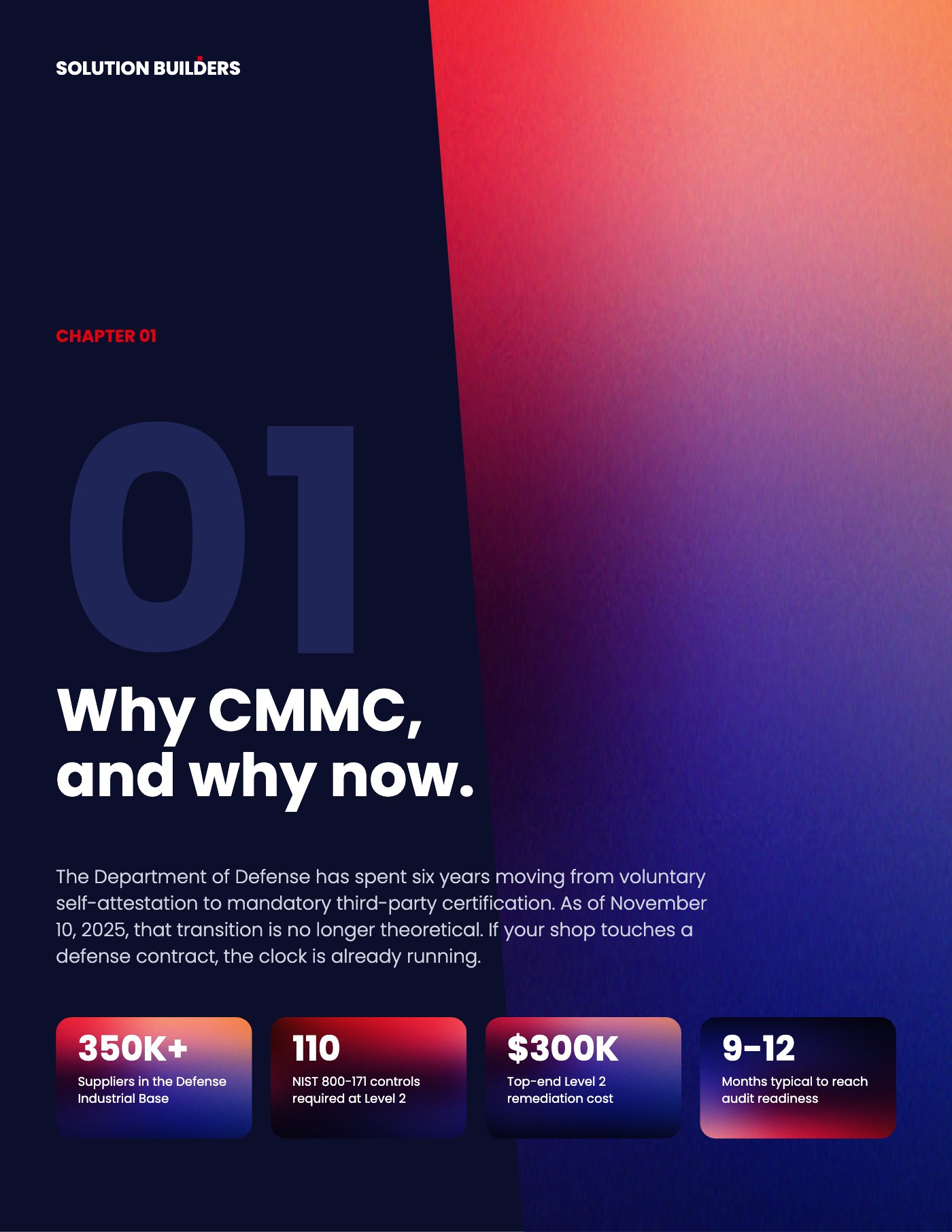
One thing to say plainly before anything else. The playbook this article is built on was written in early 2026, and its timeline chapter counts down to a November 10, 2026 deadline for third party certification. On July 13, 2026 the Department of War suspended that Phase 2 requirement while a Reform Task Force reviews the program. As of October 2026 there is no new date. That chapter is out of date. The other three, what CMMC is, why the shop floor is hard, which Microsoft cloud to run and how to pick a partner, are not. The timeline section below explains what changed.
The reason to keep moving is simple. CMMC exists because the Department of Defense spent nearly a decade letting contractors self attest to NIST SP 800-171 and then found that many had not done the work. The pause suspended the outside audit. It did not suspend the 110 controls, the contract clauses or the False Claims Act. CMMC compliance services from Solution Builders in Bloomington are built for shops in exactly this position, and this article is the playbook we walk through with them.
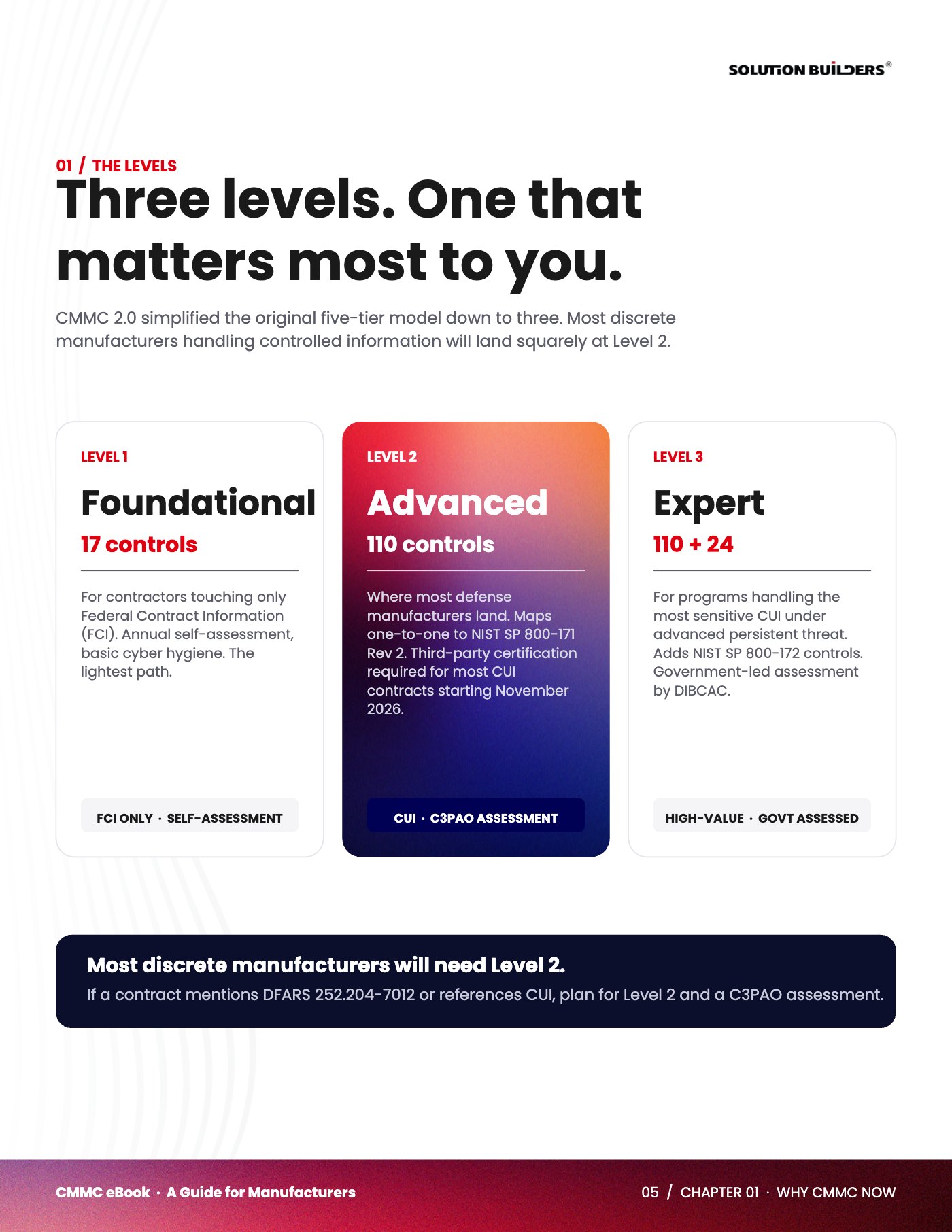
CMMC in plain English: three levels, one that matters to you
Before CMMC, defense contractors checked a box saying they followed NIST SP 800-171. CMMC adds independent verification through Certified Third Party Assessor Organizations, or C3PAOs. Three things matter more than the rest.
- It is tied to your contracts, not the calendar. CMMC becomes binding the moment it appears in a solicitation you want to bid on or an option year for a contract you already hold. The pause changed the government's schedule. It did not change where the requirement lives.
- It flows down the supply chain. If you supply a tier one prime, your prime is responsible for your compliance and is auditing its subs. Heat treaters, plating shops and precision machinists across the Twin Cities are in scope.
- It replaces promises with proof. Assessors give credit only for written, dated, version controlled artifacts. "If it is not documented, it does not exist" is the golden rule.
CMMC 2.0 simplified the original five tiers to three. Most discrete manufacturers handling controlled information land at Level 2.
| Level 1 | Level 2 | Level 3 | |
|---|---|---|---|
| Controls | 17 | 110, mapped one to one to NIST SP 800-171 | 110 plus 24 more |
| Data | Federal Contract Information only | Controlled Unclassified Information (CUI) | The most sensitive CUI |
| Assessment | Annual self assessment | C3PAO assessment, on hold as of October 2026 | Government led by DIBCAC, on hold |
| Who lands here | Contractors that never touch CUI | Most defense manufacturers | Programs under advanced persistent threat |
The practical test: if a contract mentions DFARS clause 7012 or references CUI, plan for Level 2 and build as if a C3PAO will eventually see it. CUI is the technical data, drawings, specifications and program details the government wants protected, and it is almost certainly on your file server, in your email and on at least one machine on the floor.
Why the shop floor is the hardest part
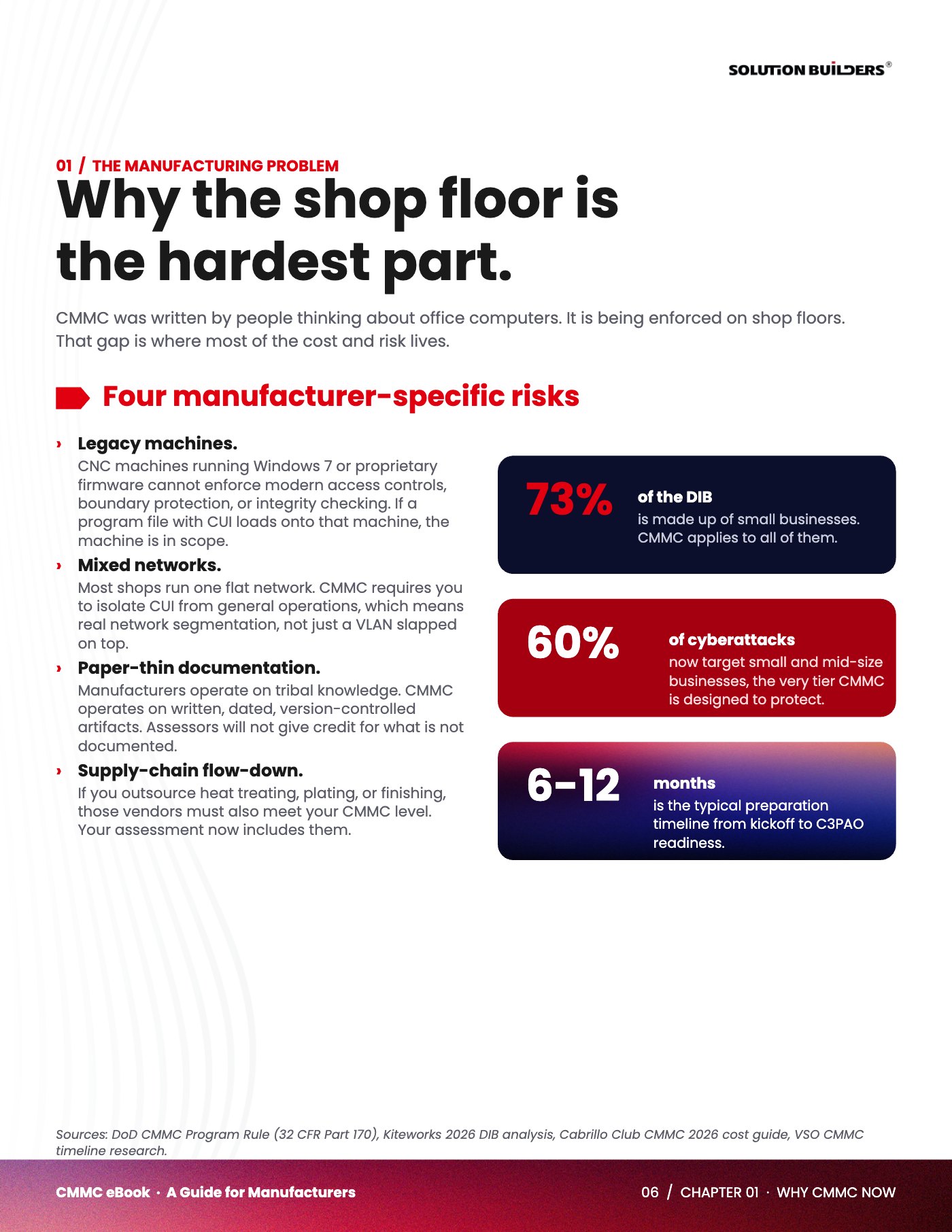
CMMC was written by people thinking about office computers. It is being enforced on shop floors, and that gap is where most of the cost and risk lives. A manufacturer with a plant in Greater Minnesota and an office in the metro usually has every one of these problems at once.
- Legacy machinesCNC machines running Windows 7 or proprietary firmware cannot enforce modern access controls, boundary protection or integrity checking. If a program file with CUI loads onto that machine, the machine is in scope.
- Mixed networksMost shops run one flat network. CMMC requires you to isolate CUI from general operations, which means real segmentation, not a VLAN slapped on top.
- Paper thin documentationManufacturers run on tribal knowledge. CMMC runs on written, dated, version controlled artifacts, and assessors will not give credit for what is not written down.
- Supply chain flow downIf you outsource heat treating, plating or finishing, those vendors must meet your CMMC level too. Your assessment now includes them.
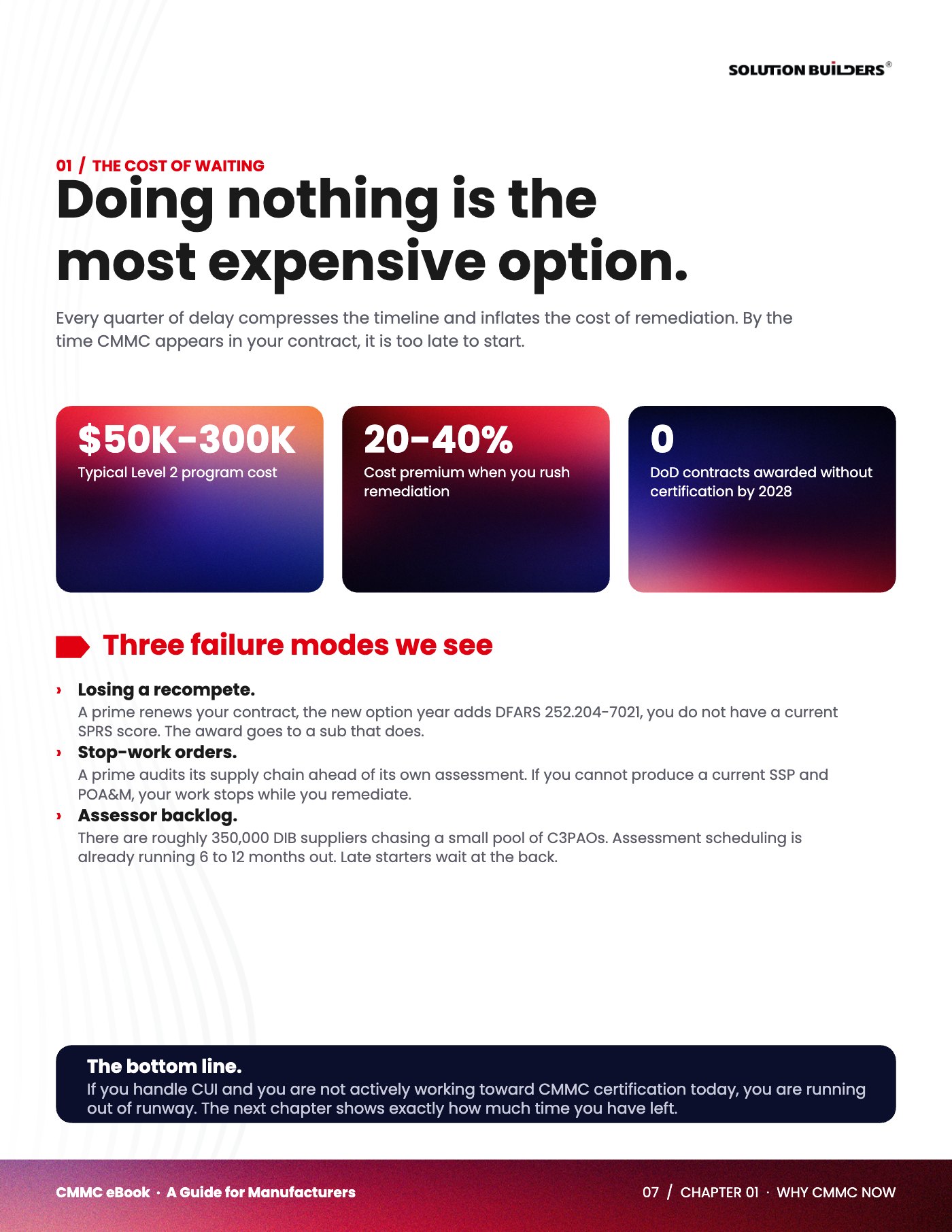
Delay compounds every one of these. The playbook puts a typical Level 2 program at $50,000 to $300,000 depending on where you start, with a 20 to 40% premium when remediation is rushed. Three failure modes show up again and again: losing a recompete because a new option year adds the DFARS 7021 clause and your SPRS score is stale; a stop work order when a prime audits its supply chain and you cannot produce a current System Security Plan; and the assessor backlog, with fewer than 100 authorized C3PAOs serving the entire supply chain.
Doing nothing is the most expensive option
Every quarter of delay compresses the timeline and inflates the cost of remediation. By the time CMMC appears in your contract it is too late to start, and the pause has not changed that. The shops that treat the extra time as runway will be the ones still winning defense work when the dates return.
The timeline chapter predates the pause. Here is what changed
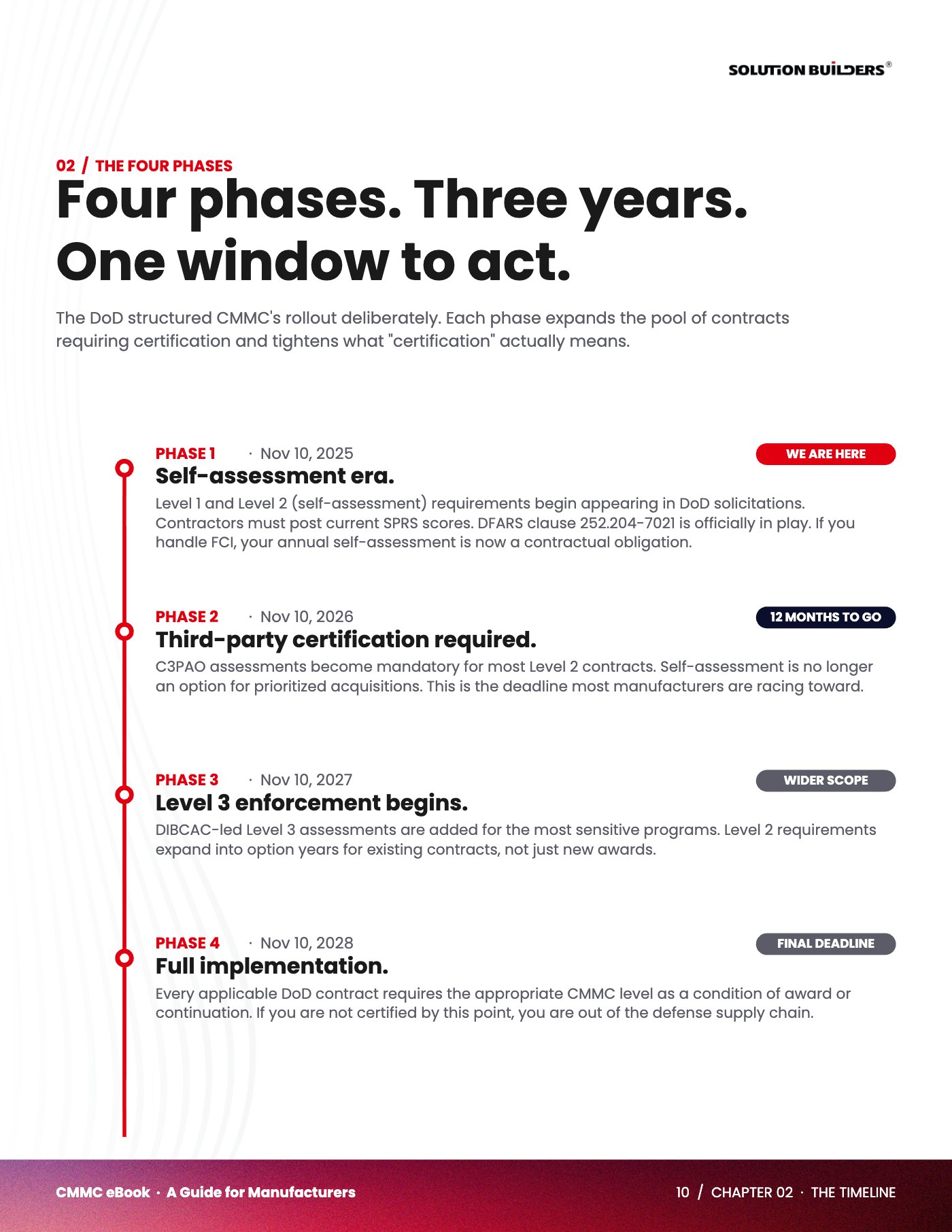
The playbook's second chapter walks through a four phase rollout: Phase 1 self assessments from November 10, 2025, Phase 2 mandatory C3PAO certification from November 10, 2026, Level 3 enforcement from November 2027 and full implementation by November 2028. It then works backward from a Q3 2026 readiness date. That chapter was accurate when it was written. It is no longer the schedule.
- November 10, 2025: Phase 1 beginsSelf assessment requirements start appearing in defense solicitations and contracts. This happened, and it is still in force.
- July 13, 2026: Phase 2 is suspendedTwo Department of War memoranda pause mandatory third party certification and launch a 60 day review of the program.
- September 3, 2026: the pause reaches contractsContracting officers are directed to remove third party assessment requirements from solicitations.
- September 11, 2026: the review closesThe task force delivers its recommendations. As of October 2026 the report has not been made public.
- November 10, 2026: the original Phase 2 dateOn hold. No replacement date has been announced.
The suspension is narrow. It covers the outside audit, not the security work underneath it.
What paused
- Mandatory third party certification as a condition of award
- Government led Level 3 assessments
- The November 10, 2026 start date
- CMMC waivers during the review
What did not pause
- DFARS 7012 and all 110 NIST SP 800-171 controls
- Phase 1 self assessments and a current, accurate SPRS score
- An annual affirmation signed by a senior official
- 72 hour incident reporting and False Claims Act exposure
- Whatever your prime contractors still require
One more wrinkle. Program managers can still require a third party assessment on a specific contract, and some primes have kept their own supplier deadlines. Ask before you cancel anything. The full status, with sources, is in the CMMC Pause Brief.
Use the pause to get ahead
Here is the reframe. The playbook told you to work backward from Q3 2026: scope and gap analysis, design and budget, build and migrate, document and train, a mock assessment, then the C3PAO. Every one of those steps is still right. The pause removed the date that was forcing them into twelve crowded months, and that is a gift if you use it. The suppliers who keep moving will be first in line when the dates return, in a queue that is already long.
Five moves to make with the time, in this order.
- Rescore yourself without optimismCheck all 110 controls against what is really in place today, not what is planned. One point is lost for each unimplemented control, and a score below 88 may bar a contract award.
- Make your SPRS score trueIf the number on file is higher than reality, fix the number or fix the gap, then affirm it. A senior official signs that affirmation, and the False Claims Act applies to it.
- Get the paper trail in orderA current System Security Plan, a CUI data inventory with network and data flow diagrams, and a plan of action with dates. POA&M items must close within 180 days or a conditional status expires.
- Ask your primes what they expectMost subcontractors have heard nothing. Do not assume silence means the requirement is gone. Get the answer in writing.
- Keep building toward Level 2Readiness takes 6 to 12 months. Run the quarter by quarter plan on your own schedule, with a mock assessment at the end, so the C3PAO visit is a formality whenever it comes.
GCC High vs commercial Microsoft 365, answered
Microsoft offers three versions of Microsoft 365: Commercial, GCC and GCC High. They are not three flavors of the same product. They run on different infrastructure, are staffed by different people and meet different compliance frameworks. Most contractors discover the difference after the wrong tenant is deployed, and rebuilding a CUI environment from scratch costs six figures and six months.
| Commercial | GCC | GCC High | |
|---|---|---|---|
| Infrastructure | Global Azure | Azure Commercial, United States | Azure Government, US only |
| Operators | Global staff | May include non US staff | Screened US citizens only |
| FedRAMP level | Moderate | Moderate | High |
| DFARS 7012 | Insufficient | With configuration | Yes, designed for it |
| CMMC Level 2 CUI | Not appropriate | Conditional | Yes |
| ITAR and EAR data | No | No | Yes |
| Relative cost | Baseline | About 10 to 20% premium | About 30 to 50% premium |
GCC High is expensive, so picking it when you do not need it wastes money. Not picking it when you do can blow up your assessment. Five signals point straight to it.
- Your contract mentions ITAR or EAR. Export controlled technical data, including CAD files and drawings, must be restricted to US persons.
- Your contract requires US person support for incident forensics under paragraph (f) of DFARS 7012.
- You handle CUI Specified, the categories with extra handling rules written into statute.
- Your prime names GCC High in its supplier directives. Lockheed, Boeing, Northrop and RTX increasingly do.
- You expect CUI work within 24 months. Switching tenants later is a six figure migration.
Two cautions. GCC High is a foundation, not a certification. Microsoft handles roughly half the technical controls in NIST SP 800-171 (the platform, data residency, screened operators, encryption) and you and your partner handle the rest (conditional access, MFA, Intune, logging, incident response, the SSP). A badly configured GCC High tenant fails an assessment as fast as the wrong cloud. And the move from Commercial is a full tenant migration, not an upgrade: 90 to 150 days done well, using an enclave model that puts only CUI users in GCC High and shrinks the assessment boundary. Our Microsoft 365 team starts every one of those migrations for Twin Cities defense suppliers with the enclave design.
Choosing a CMMC consultant in Minneapolis who can get you certified
Most general purpose IT shops cannot get a manufacturer to CMMC Level 2. The certifications, tooling and documentation discipline are not in their playbook. There is a sharper reason to be careful: when you outsource IT, that partner becomes part of your assessment boundary. Their security posture is now your security posture. If they cannot prove their own controls, you cannot prove yours. That is what defense contractor IT support in the Twin Cities has to mean, and these six questions find out whether it does.
- Do you carry SOC 2 Type II? Ask for the report. Read the auditor's name and the period covered.
- How many CMMC Level 2 environments do you operate today? Real numbers, not "we have helped clients."
- Can you show me a redacted SSP you authored? If they have never written one, they will not write yours well either.
- Do you have engineers with CCP or CCA credentials? Certified CMMC Professionals and Assessors signal real depth.
- Are you a Registered Practitioner Organization? RPOs are listed by the Cyber AB and bring an auditable pedigree.
- What is your GCC High deployment experience? Tenant migrations, not license resales.
Solution Builders runs CMMC for manufacturers from Bloomington in four phases that mirror RISE: Readiness (a gap assessment against all 110 controls, CUI scoping and a roadmap), Implementation (GCC High build out, enclave architecture, identity and endpoint hardening), SSP and Evidence (we author the plan and keep it current) and Examination (a mock assessment, remediation and a seat at the table during the real one). A client typically sees a reviewed gap assessment by day 30, a staged GCC High tenant by day 60 and migration under way with the SSP in draft by day 90. The 24/7 security operations center behind it is the same one that contained a ransomware attack at a 42 user client in 22 minutes.
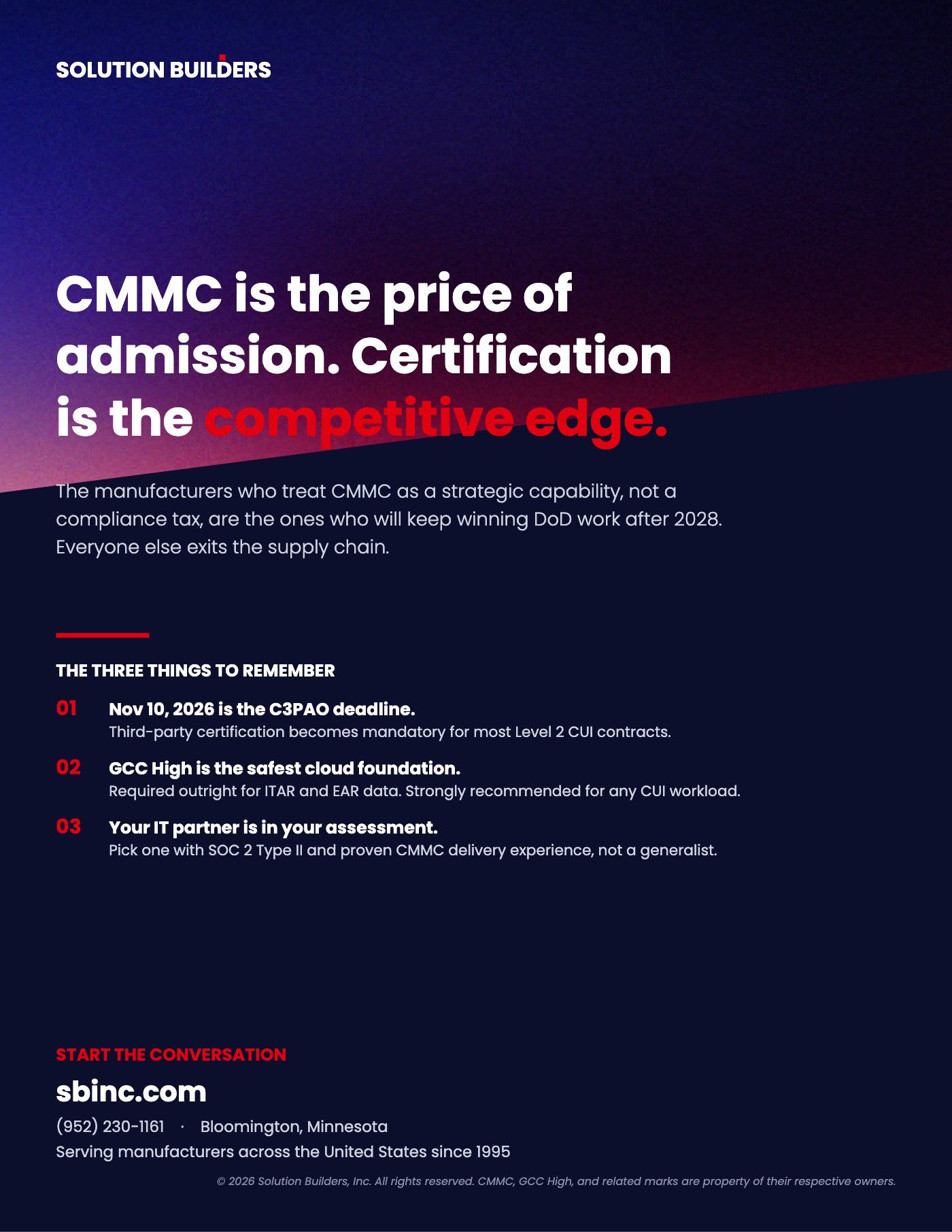
CMMC is the price of admission. Certification is the competitive edge.The Manufacturer's CMMC Playbook
What to do this quarter
Three moves, none of which require a purchase.
- Pull your contractsSearch every active contract and purchase order for DFARS 7012, 7021 and the letters CUI. Each hit is a Level 2 obligation that did not pause.
- Rescore and affirmWalk the 110 controls with your IT lead, write down the honest score, compare it with what is in SPRS, and fix whichever one is wrong.
- Get an outside readA CMMC Readiness Snapshot with Solution Builders is a free 30 minute call. We review your contracts, tell you whether you are a Level 1 or Level 2 shop and what to do first, whether or not you ever work with us.
The manufacturers who treat CMMC as a capability rather than a compliance tax are the ones who will keep winning defense work when the dates come back. Everyone else is betting that silence from their prime means the requirement went away. General information, not legal advice: talk to counsel about your specific contracts.
CMMC support for defense suppliers across Minnesota
Solution Builders has worked with Minnesota manufacturers from Bloomington since 1995. Our CMMC practice runs gap assessments, GCC High migrations, System Security Plans and mock assessments for defense suppliers with 25 to 500 employees, from machine shops along the I-494 corridor to plants in Greater Minnesota with an office in the Twin Cities. Related services: CMMC Compliance, Microsoft 365, Cybersecurity, Regulatory Compliance. Contact us or book a 30 minute call.