Solution Builders team
Jump to a section
- Co-managed IT adds a bench, a toolset and a night shift to the team you already have. It does not replace anyone.
- Your systems need attention 168 hours a week. One in house engineer covers about 40. Headcount is the wrong starting point.
- Write one owner per function, help desk through strategy, before day one. Shared ownership is a polite name for no ownership.
- Key person risk is a system problem: a vault, ten runbooks and a bench that knows your network beat hoping nobody takes vacation.
- The hours do not disappear. They move to the ERP upgrade, the security roadmap and the conversations with the business.
Why IT director burnout is a math problem
The IT director at a 220 person manufacturer in the west metro has three people, including herself. She should be planning the ERP upgrade. At 4:45 p.m. she is resetting a password, because the help desk is also her. After six the alerts land in an inbox nobody reads until morning. The firewall migration has been "next quarter" for three quarters because nobody in house has done one. None of that is a talent problem. It is arithmetic, and co-managed IT services in Minneapolis exist to fix the arithmetic without replacing the people.
Here is the math. There are 168 hours in a week, and your systems need someone watching for all of them. One full time engineer realistically staffs about 40, and a three person team maybe 60 once vacations, meetings and the occasional sick day are counted. On call rotations add reach, not attention. Meanwhile the specialties a modern environment needs, security operations, cloud, networking, compliance, Microsoft 365 and backup, are the hardest roles to hire: ISC2's 2024 Cybersecurity Workforce Study put the global shortfall of security professionals at 4.8 million.
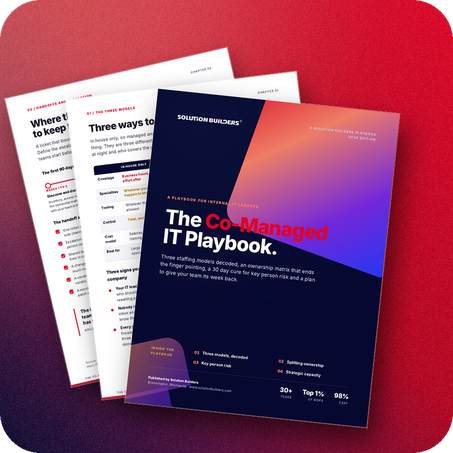
Most IT leaders hear "managed services" and picture being replaced. That is one model, and it is not this one. Co-managed IT adds a bench, a toolset and a night shift to the team you already have, with a written split of who owns what. The internal team keeps priorities, vendors, the roadmap and the relationship with the business. Co-Managed IT from Solution Builders in Bloomington is built on that split, and this article is the playbook we work through with internal teams at companies with 25 to 500 employees across the Twin Cities.
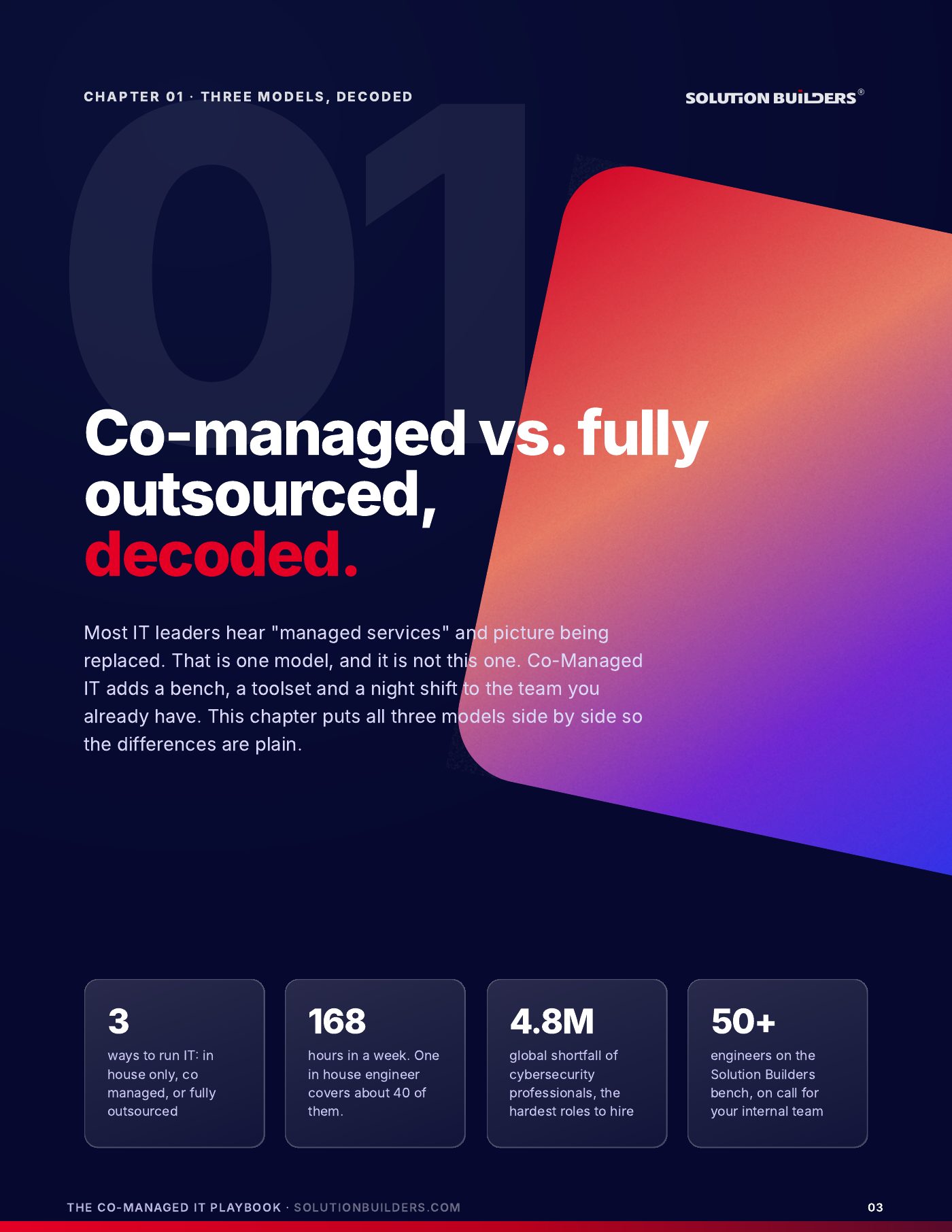
Co-managed vs fully outsourced, decoded
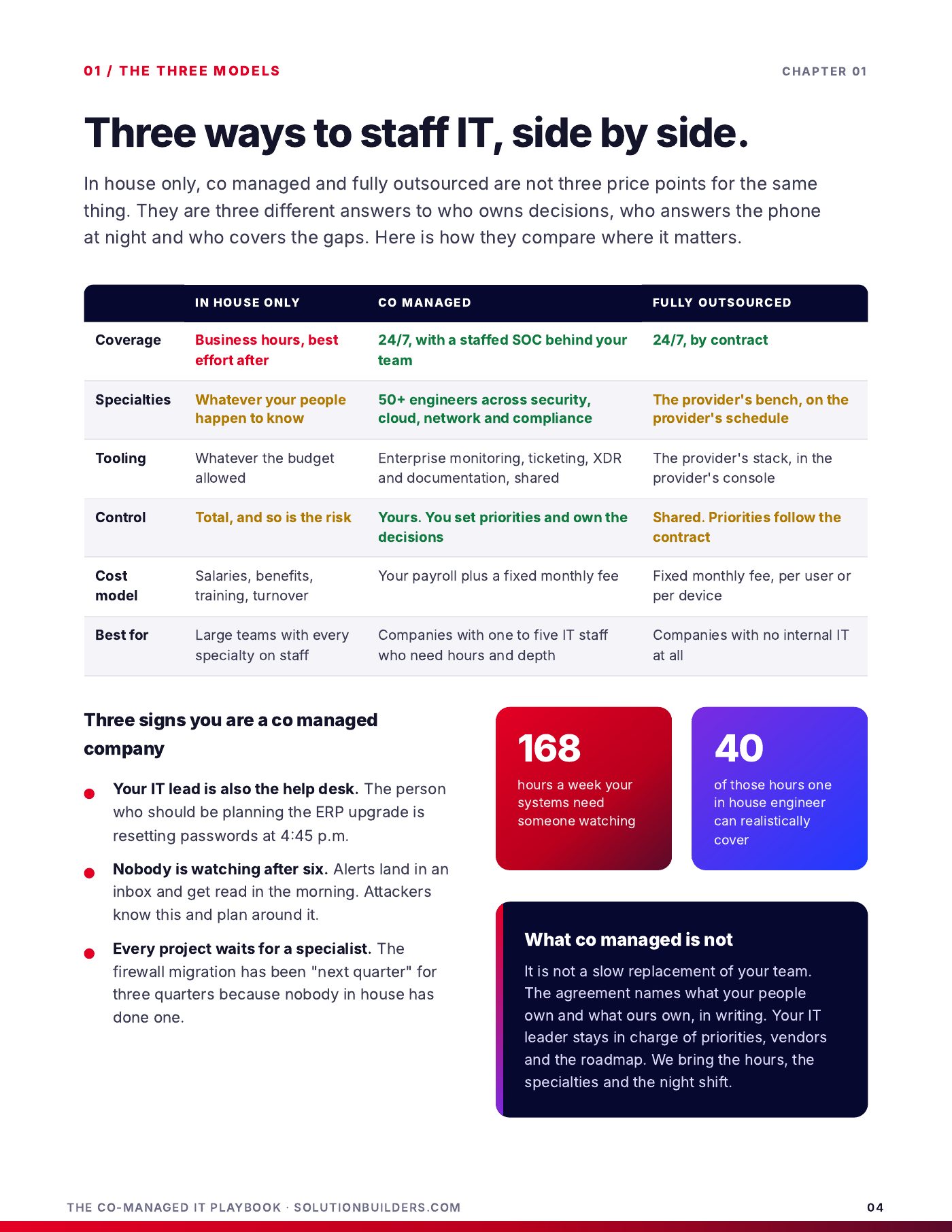
In house only, co-managed and fully outsourced are not three price points for the same thing. They are three different answers to who owns decisions, who answers the phone at night and who covers the gaps. Here is how they compare where it matters.
| In house only | Co-managed | Fully outsourced | |
|---|---|---|---|
| Coverage | Business hours, best effort after | 24/7, with a staffed SOC behind your team | 24/7, by contract |
| Specialties | Whatever your people happen to know | 50+ engineers across security, cloud, network and compliance | The provider's bench, on the provider's schedule |
| Tooling | Whatever the budget allowed | Enterprise monitoring, ticketing, XDR and documentation, shared | The provider's stack, in the provider's console |
| Control | Total, and so is the risk | Yours. You set priorities and own the decisions | Shared. Priorities follow the contract |
| Cost model | Salaries, benefits, training, turnover | Your payroll plus a fixed monthly fee | Fixed monthly fee, per user or per device |
| Best for | Large teams with every specialty on staff | One to five IT staff who need hours and depth | Companies with no internal IT at all |
Headcount is the wrong starting point for choosing. Start with the hours your business needs covered (nights and second shift included), the specialties it needs on call at a senior level, and the single points of failure: who alone can restore the ERP, change the firewall or call the phone vendor? Most teams count three or four. Then decide what you want to keep. Strategy, vendors, the help desk, the relationship with the business: what you keep is the shape of the agreement.
- Your IT lead is also the help desk. The person who should be planning the ERP upgrade is resetting passwords at 4:45 p.m.
- Nobody is watching after six. Alerts land in an inbox and get read in the morning. Attackers know this and plan around it.
- Every project waits for a specialist. The firewall migration has been "next quarter" for three quarters because nobody in house has done one.
If two of those three sound familiar, you are a co-managed company whether or not anyone has said it out loud. Fully outsourcing would cost you the priorities, the vendor history and the option to bring work back in house. Co-managed costs none of those, which is why most internal IT leaders in Minneapolis and St. Paul choose it once they see the comparison written down.
How to split ownership cleanly
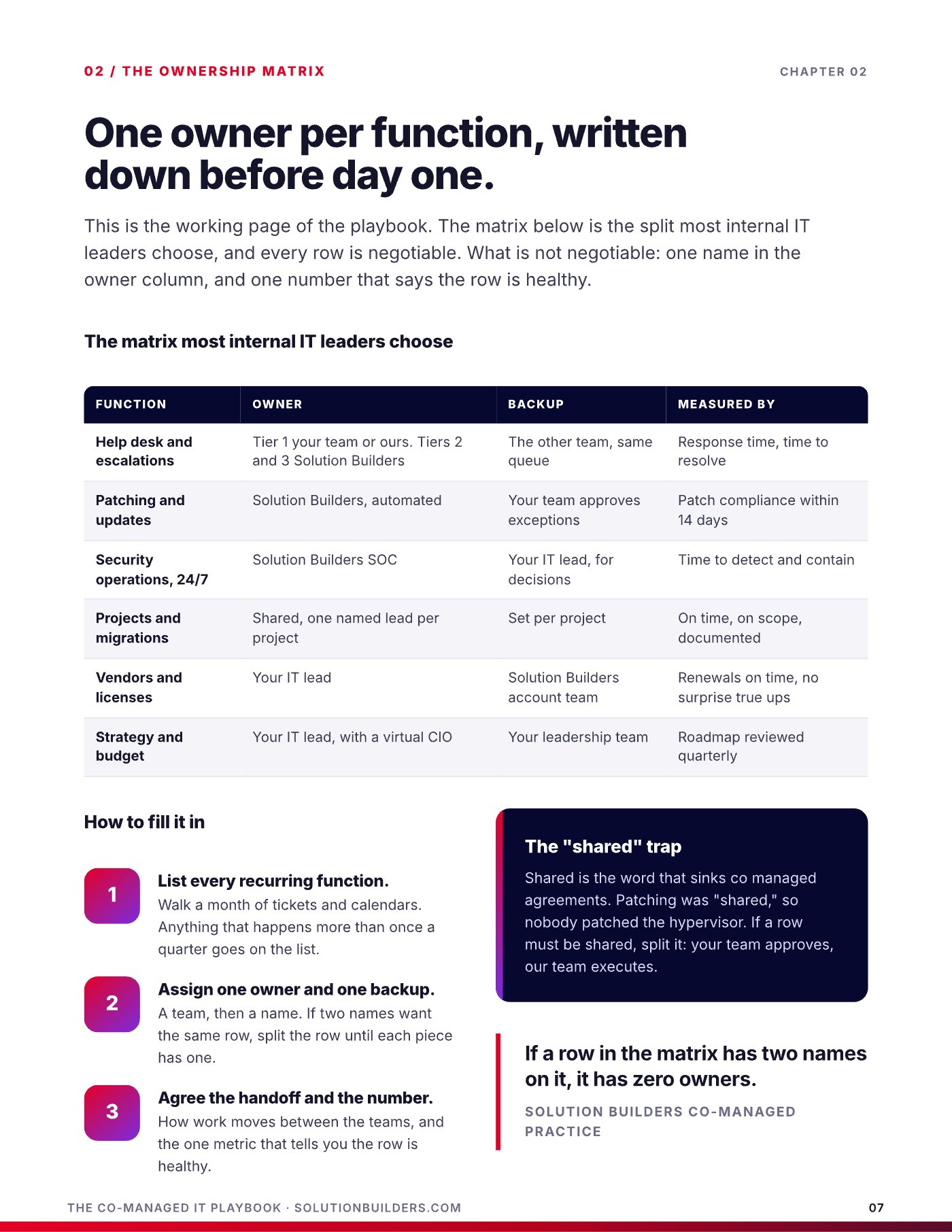
Co-managed arrangements fail for one reason: two teams who each think the other one has it. The fix is boring and powerful. Write down every recurring function, give each one a single owner and a backup, and review the list every quarter. This is the matrix most internal IT leaders choose, and every row is negotiable. What is not negotiable: one name in the owner column, and one number that says the row is healthy.
| Function | Owner | Backup | Measured by |
|---|---|---|---|
| Help desk and escalations | Tier 1 your team or ours, Tiers 2 and 3 Solution Builders | The other team, same queue | Response time, time to resolve |
| Patching and updates | Solution Builders, automated | Your team approves exceptions | Patch compliance within 14 days |
| Security operations, 24/7 | Solution Builders SOC | Your IT lead, for decisions | Time to detect and contain |
| Projects and migrations | Shared, one named lead per project | Set per project | On time, on scope, documented |
| Vendors and licenses | Your IT lead | Solution Builders account team | Renewals on time, no surprise true ups |
| Strategy and budget | Your IT lead, with a virtual CIO | Your leadership team | Roadmap reviewed quarterly |
Filling it in takes an afternoon. Walk a month of tickets and calendars, and anything that happens more than once a quarter goes on the list. Assign a team, then a name. If two names want the same row, split the row until each piece has one owner. Then agree the handoff and the number: how work moves between the teams, and the one metric that tells you the row is healthy.
"Shared" is the word that sinks co-managed agreements
Patching was "shared," so nobody patched the hypervisor. If a row must be shared, split it: your team approves, our team executes. A row in the matrix with two names on it has zero owners, and the business finds out which row it was at the worst possible moment.
Where the handoffs happen, and the first 90 days
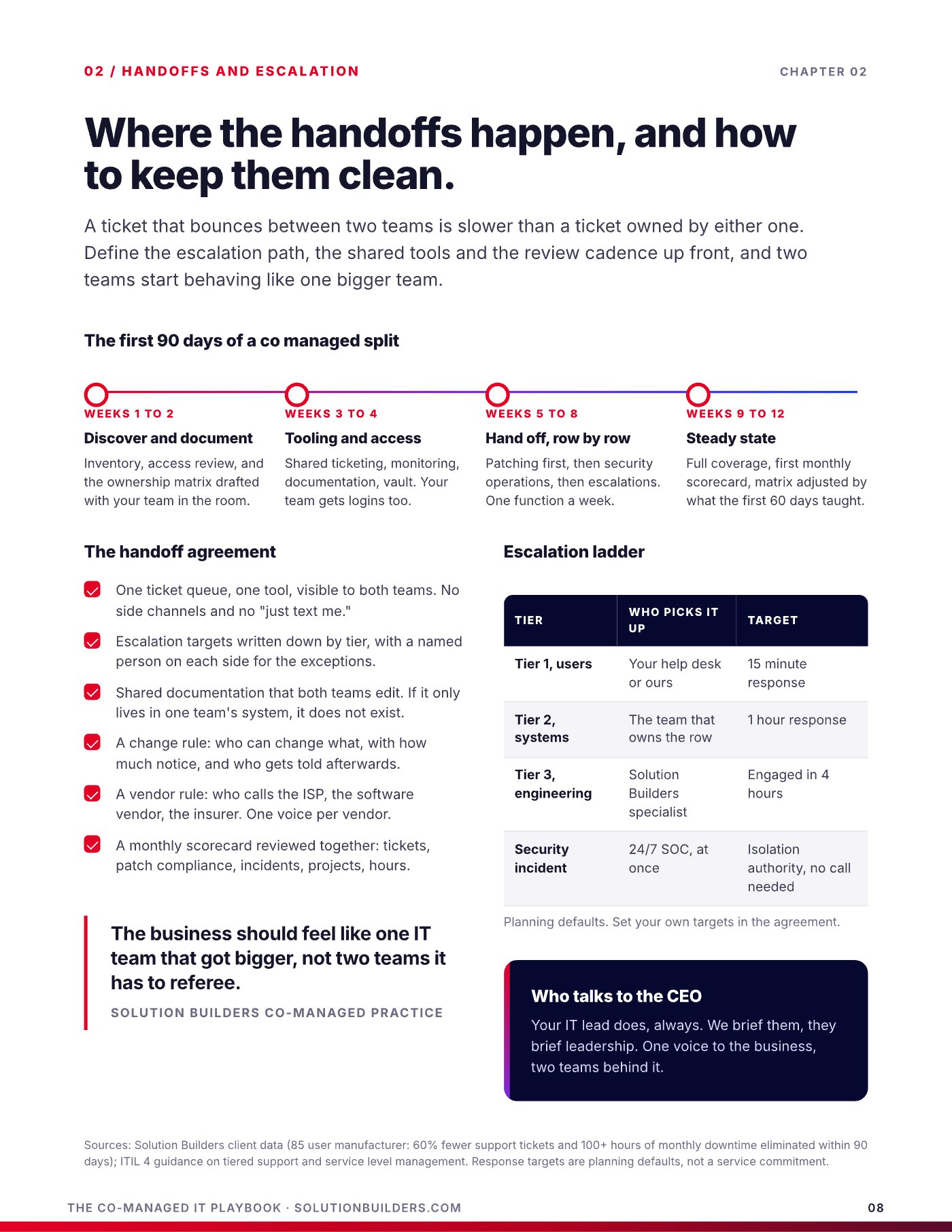
A ticket that bounces between two teams is slower than a ticket owned by either one. Define the escalation path, the shared tools and the review cadence up front, and two teams start behaving like one bigger team. The business should feel like one IT department that got larger, not two teams it has to referee.
- Weeks 1 to 2: discover and documentInventory, access review, and the ownership matrix drafted with your team in the room, not sent to them afterward.
- Weeks 3 to 4: tooling and accessShared ticketing, monitoring, documentation and password vault. Your team gets logins to all of it too.
- Weeks 5 to 8: hand off, row by rowPatching first, then security operations, then escalations. One function a week, so nothing falls between the teams.
- Weeks 9 to 12: steady stateFull coverage, the first monthly scorecard, and the matrix adjusted by what the first 60 days taught.
The escalation ladder is written down before day one. As planning defaults: Tier 1 user requests get a 15 minute response, Tier 2 system issues get an hour from the team that owns the row, and Tier 3 engineering gets a Solution Builders specialist within four hours. A security incident goes straight to the 24/7 security operations center, which has isolation authority with no call needed. The 22 minute ransomware containment at a 42 user client happened while nobody internal was awake.
- One ticket queue, one tool, visible to both teams. No side channels and no "just text me."
- Escalation targets written down by tier, with a named person on each side for the exceptions.
- Shared documentation that both teams edit. If it only lives in one team's system, it does not exist.
- A change rule: who can change what, with how much notice, and who gets told afterward.
- A vendor rule: who calls the ISP, the software vendor, the insurer. One voice per vendor.
- A monthly scorecard reviewed together: tickets, patch compliance, incidents, projects, hours.
And one rule that never changes: your IT lead talks to the CEO, always. We brief them, they brief leadership. One voice to the business, two teams behind it.
Eliminating key person risk in 30 days
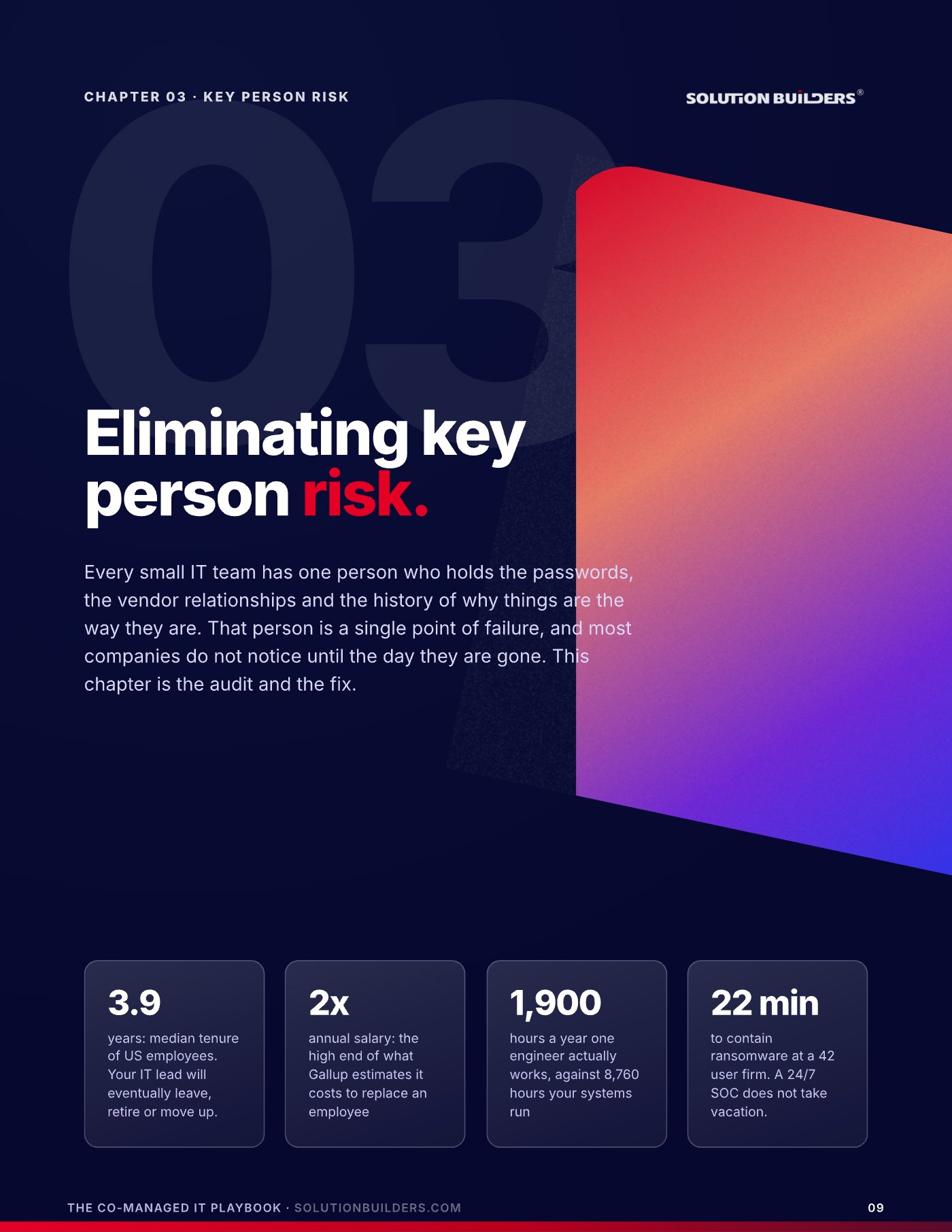
Every small IT team has one person who holds the passwords, the vendor relationships and the history of why things are the way they are. Call him Dave. Dave is not the problem. Dave built everything. The problem is that the business stops the day Dave is on a beach, in a hospital or at a competitor. The Bureau of Labor Statistics put median US employee tenure at 3.9 years in its January 2024 data, and Gallup estimates replacing an employee costs one half to two times their salary. Your IT lead will eventually leave, retire or move up.
Run the audit with your IT lead in the room, not about them. Key person risk hides in six places: credentials (admin passwords, MFA devices, the domain registrar, the backup portal), vendor relationships (who else has the account numbers), undocumented systems (the script that runs the payroll export, the server nobody may reboot), tribal knowledge, recovery steps (can anyone else restore the ERP database tonight) and approval authority. Four to six items at risk means you are one resignation from a crisis. The cure is not a second person, who becomes the second key person. It is systems.
- Week 1: vault everythingEvery credential into a shared vault with MFA, roles and break glass access for two leaders.
- Week 2: document the environmentNetwork diagram, asset list, vendor sheet with account numbers, admin access map and the ten runbooks that matter: restore a server, restore a mailbox, onboard, offboard, patch, fail over.
- Week 3: cross coverA bench engineer shadows your IT lead, then runs the top five tasks supervised. Gaps get written down.
- Week 4: test itYour IT lead takes a day off, really off, no laptop and no calls. The bench runs the queue. Whatever stalls is next month's list.
The vacation test is the whole audit in one move. Send your IT lead away for two weeks with no laptop. Everything that breaks, stalls or waits for them is key person risk, now visible and ready to fix. The fix protects Dave's vacation too.
Scale IT support without hiring: what 15 hours a week buys
Nobody hires an IT director to reset passwords. Yet that is where the week goes when the same three people own the help desk, the patching, the projects and the strategy. Across Solution Builders co-managed engagements, about 70% of a typical internal IT week goes to tickets, maintenance and firefighting before the split, and strategy gets the scraps. After the split the team size has not changed. The work has.
Where the week goes
- Tickets: about 45% of hours
- Maintenance and firefighting: about 25%
- Projects: about 22%
- Strategy: about 8%
Where the week goes
- Tickets: about 15% of hours
- Maintenance and firefighting: about 10%
- Projects: about 45%
- Strategy: about 30%
Those shares are illustrative planning figures from client engagements, and they work out to roughly 15 reclaimed hours a week per internal engineer. The hours do not disappear. Tickets still get answered and patches still get applied, by a team built to do them at scale. Your people get the work that needed them all along: the ERP upgrade that kept slipping, quarterly access reviews, a day each quarter shadowing operations and finance, a three year roadmap, and time to learn something. Teams that have time to learn are the teams that stay.
Finance does not buy hours. Finance buys outcomes with a number attached, so build the case on one page.
| Line | How to measure it | Example |
|---|---|---|
| Hours reclaimed | Hours per week back, times loaded hourly cost | 3 engineers, 15 hours, 48 weeks: 2,160 hours a year |
| Downtime avoided | Downtime hours before and after, times cost per hour | 100+ hours a month to near zero, 85 user manufacturer |
| Tickets | Monthly volume and time to resolve | 60% fewer tickets in 90 days |
| Coverage | Hours per week with someone actively watching | From 40 hours to 168 |
| Projects delivered | Roadmap projects shipped on time versus prior year | Three in two quarters, after a year of none |
| Risk retired | Single points of failure closed, audit findings cleared | From five key person dependencies to zero |
Lead with the number the CFO already believes, which is usually what an hour of downtime costs the plant or the billing team. Baseline for two weeks with the team logging time by category, price the hour, name the risk in plain sentences, then report the same four numbers every quarter. The projects line is where professional services and co-managed support meet: the bench delivers the migration, your team keeps the knowledge.
Co-managed IT services in Minneapolis: your next three moves
Three moves, in order, and none of them require a contract.
- Count the hours and the specialtiesWrite down the hours your business needs IT reachable each week, the hours your team can staff, and the six specialties with a senior name next to each. The gaps are the agreement.
- Draft the matrix with your teamSix rows: help desk, patching, security operations, projects, vendors, strategy. One owner, one backup, one number per row. Bring it to the next budget conversation.
- Get an outside readA Co-Managed Fit Call with Solution Builders is a free 30 minute conversation with your IT lead in the room. You leave with a draft ownership matrix and a candid read on fit, whether or not you ever work with us.
Nobody hired your IT director to reset passwords. The split gives them their job back.Solution Builders Co-Managed Practice
Solution Builders has worked alongside internal IT teams in Minnesota from Bloomington since 1995, with 50+ engineers, a 24/7 security operations center, a 5 minute average help desk response and month to month terms, because a bench should keep earning its place. Co-Managed IT runs across the whole RISE framework, from backup and continuity to security and AI guidance. For the decision from the IT leader's chair, read the IT Leader's Guide to Co-Managed IT.
Co-Managed IT for internal teams across the Twin Cities
Solution Builders has worked alongside internal IT teams in Minnesota from Bloomington since 1995. Our 50+ engineers, 24/7 security operations center and shared tooling back one to five person IT teams at companies with 25 to 500 employees in Minneapolis, St. Paul and across the metro, from manufacturers on the I-494 corridor to multi-location firms with a plant in Greater Minnesota. Related services: Co-Managed IT, Cybersecurity, Professional Services, IT Consulting. Contact us or book a 30 minute call.