Solution Builders team
Jump to a section
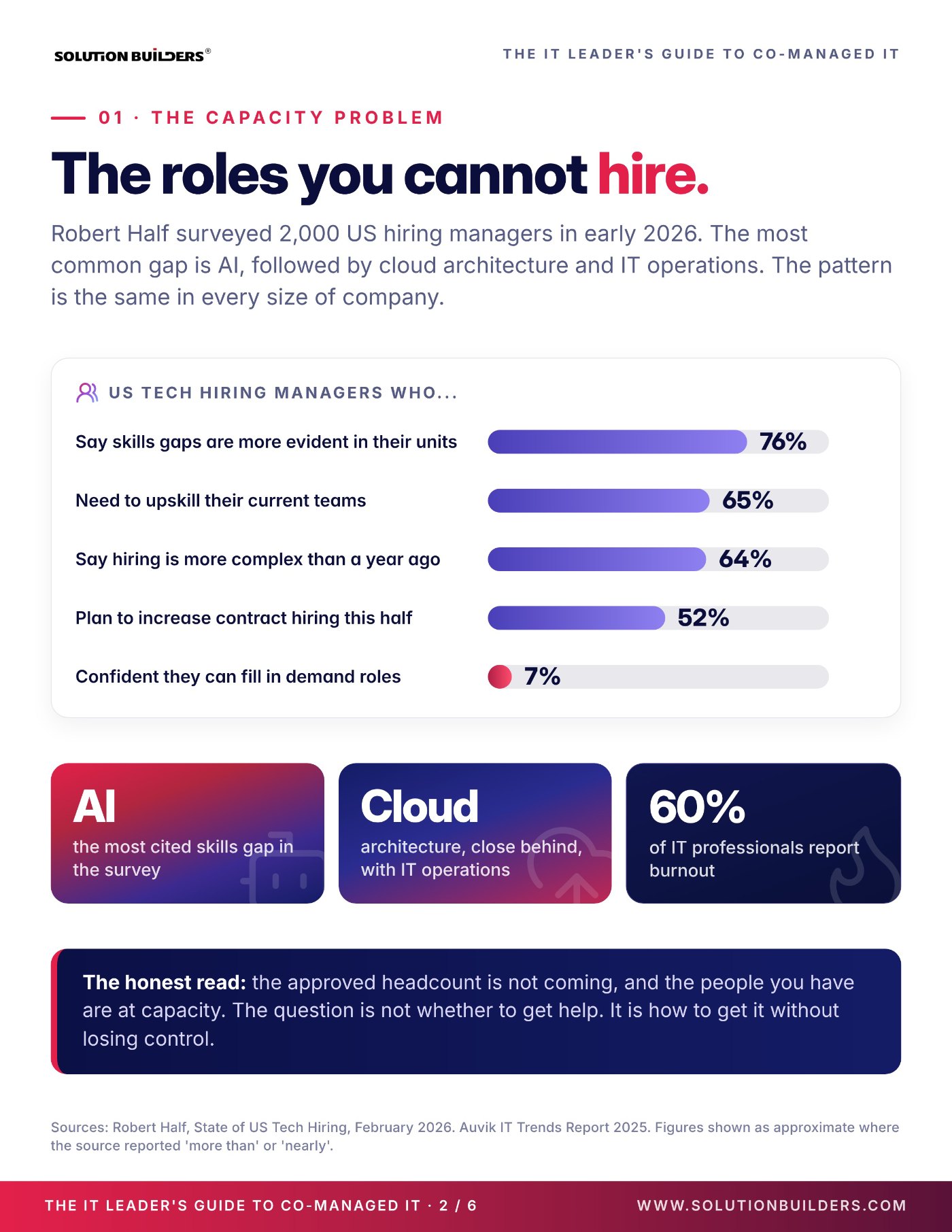
- Robert Half found only 7% of tech hiring managers can confidently fill in demand roles. The gaps: AI first, then cloud and IT operations.
- You do not need a full time cloud architect. You need one for the migration. The same logic applies to security and AI.
- Co-managed IT is three models, not one: overflow and after hours, a specialist retainer, and project capacity. Most engagements start with one.
- Control is structural. One shared dashboard, your documentation, written escalation paths and month to month terms belong in the agreement before the first ticket.
Why co-managed IT for IT directors in Minnesota starts with hiring
You run IT for a 200 person manufacturer in the metro or a 90 person firm in the North Loop. Your team is three people, or two, or you. The roadmap has a cloud migration, a security audit and a Copilot rollout on it, and it had the same three items last budget cycle. The requisition for a cloud engineer has been open since spring. Nobody qualified has applied at the salary you can offer.
That is the real reason co-managed IT for IT directors in Minnesota has become the fastest growing model at Solution Builders. Robert Half surveyed 2,000 US hiring managers for its State of US Tech Hiring report in February 2026. The most common skills gap was AI, followed by cloud architecture and IT operations, and the pattern held across every size of company.
The same survey found that roughly three quarters of hiring managers say skills gaps are more evident in their units, about two thirds need to upskill the teams they already have, and about half plan to increase contract hiring this half. Read those together and the conclusion is plain. The market has already decided that specialist skills will be rented, not hired. The only open question is on whose terms.
The IT staffing shortage in cybersecurity, cloud and AI, reframed
Most job descriptions for the roles you cannot fill describe a person you do not need full time. You need the outcome, for a defined window, with someone accountable for it. Reframe the three hardest gaps that way and the IT staffing shortage in cybersecurity, cloud and AI gets smaller fast.
- You do not need a full time cloud architect. You need one for the migration, then an operations team to run what was built. A cloud migration partner in the Twin Cities brings both, with the architect leaving documentation behind.
- You do not need a security team on payroll. You need a 24/7 security operations center and someone to run the audit. Managed security services put analysts behind your team around the clock for less than one analyst's salary.
- You do not need an AI engineer. You need Copilot rolled out with governance that holds, a few workflows automated where it counts, and a roadmap. That is an AI consulting engagement, not a hire.
Your engineers are doing help desk work
The Auvik IT Trends Report 2025 found that 58% of IT professionals spend half or more of the week on end user requests and 44% say workload limits their productivity. The specialist you are missing is often sitting on your team, buried under password resets. Capacity frees them before any retainer does.
Co-managed IT models: overflow, specialist retainer and project capacity
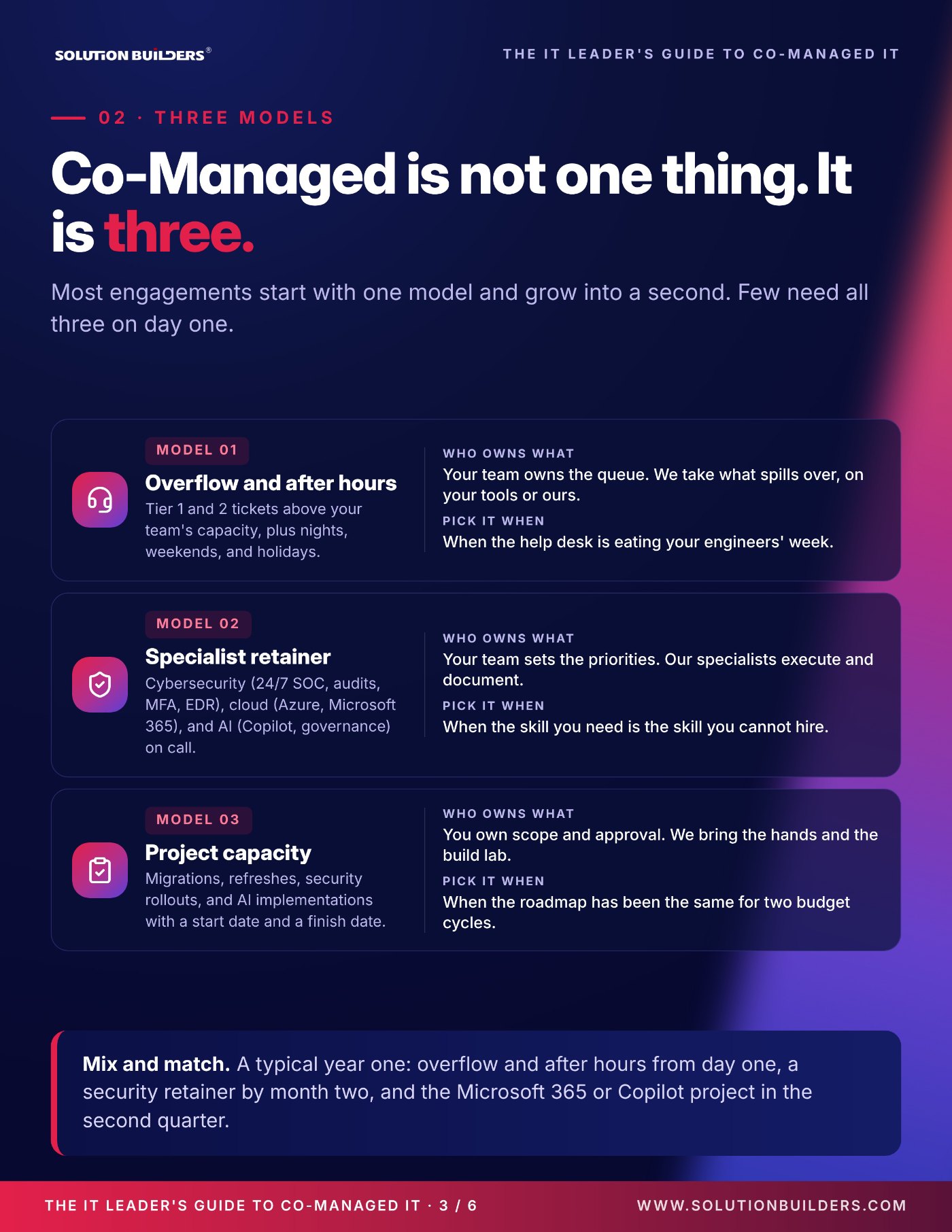
Co-managed IT is not one thing. It is three models, and the right proposal names which one you are buying. Most engagements start with one and grow into a second. Few need all three on day one.
| Model | What it covers | Who owns what | Pick it when |
|---|---|---|---|
| 01 Overflow and after hours | Tier 1 and 2 tickets above your capacity, plus nights, weekends and holidays | Your team owns the queue. We take what spills over, on your tools or ours. | The help desk is eating your engineers' week |
| 02 Specialist retainer | Cybersecurity (24/7 SOC, audits, MFA, EDR), cloud (Azure, Microsoft 365) and AI (Copilot, governance) on call | Your team sets priorities. Our specialists execute and document. | The skill you need is the skill you cannot hire |
| 03 Project capacity | Migrations, refreshes, security rollouts and AI implementations with a start and a finish date | You own scope and approval. We bring the hands and the build lab. | The roadmap has been the same for two budget cycles |
Specialist IT services on retainer in the Twin Cities is the model IT directors ask about most, because it maps directly to the three hiring gaps. The retainer is also where the 24/7 security operations center lives, which matters for any company that cannot staff a night shift.
A typical year one
Overflow and after hours from day one, so your engineers get their week back. A security retainer by month two, with the SOC watching and the audit scheduled. The Microsoft 365 or Copilot project in the second quarter, scoped by you, built by us, documented for both.
How to keep control of IT while adding capacity
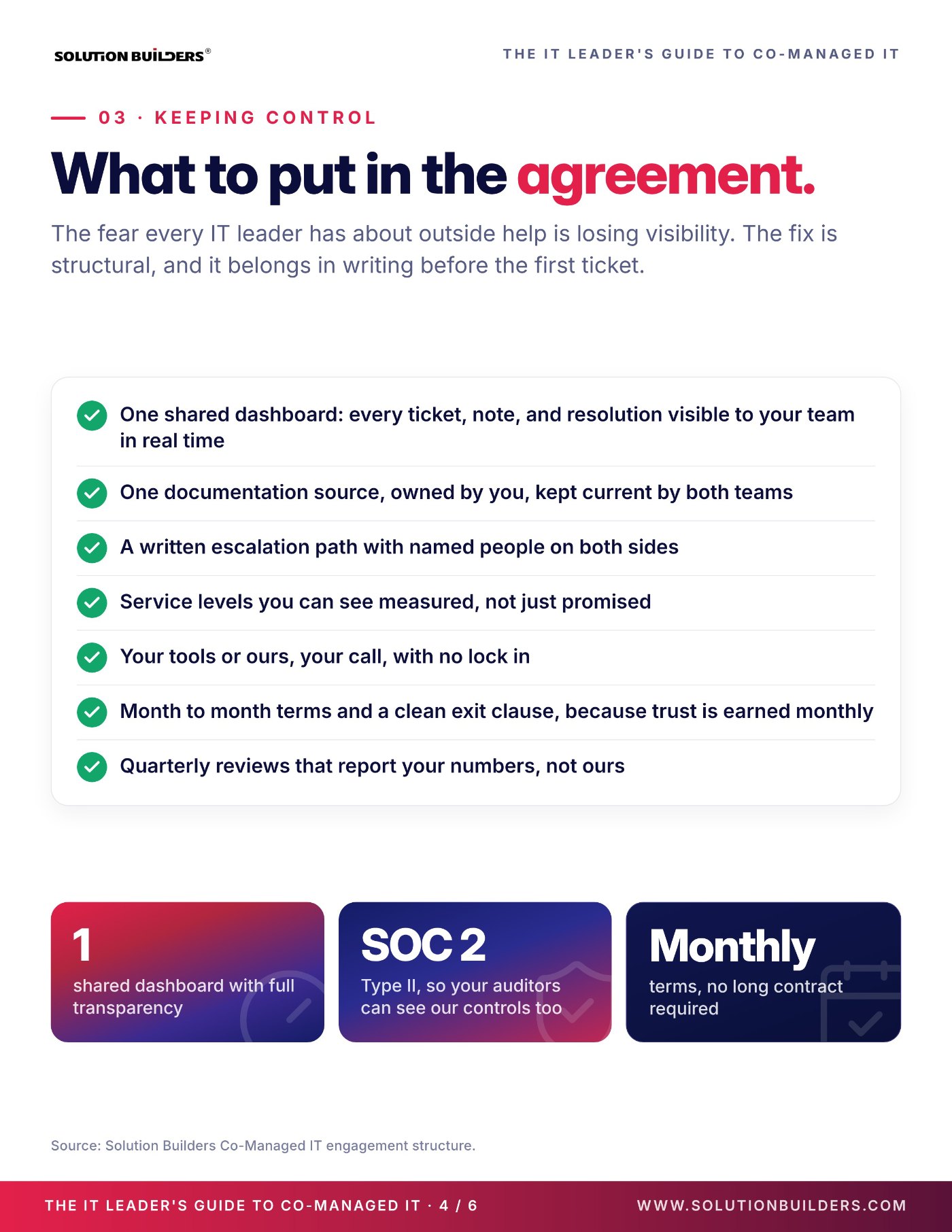
The fear every IT leader has about outside help is losing visibility. Someone else closes tickets you never saw, documentation drifts into a vendor's portal, and a year later you cannot leave because nobody on your side knows how anything works. The fix is structural, and it belongs in writing before the first ticket.
Put these in the agreement
- One shared dashboard: every ticket, note and resolution visible to your team in real time.
- One documentation source, owned by you, kept current by both teams.
- A written escalation path with named people on both sides.
- Service levels you can see measured, not just promised.
- Your tools or ours, your call, with no lock in.
- Month to month terms and a clean exit clause, because trust is earned monthly.
- Quarterly reviews that report your numbers, not ours.
That last line is the real test of a partner. A provider confident in its work will let you leave. One that needs a three year contract to keep you is telling you something about year two. Keep control of IT while adding capacity by making the exit easy and the visibility total, and the relationship will last for reasons that have nothing to do with the contract.
What changes in the first 90 days
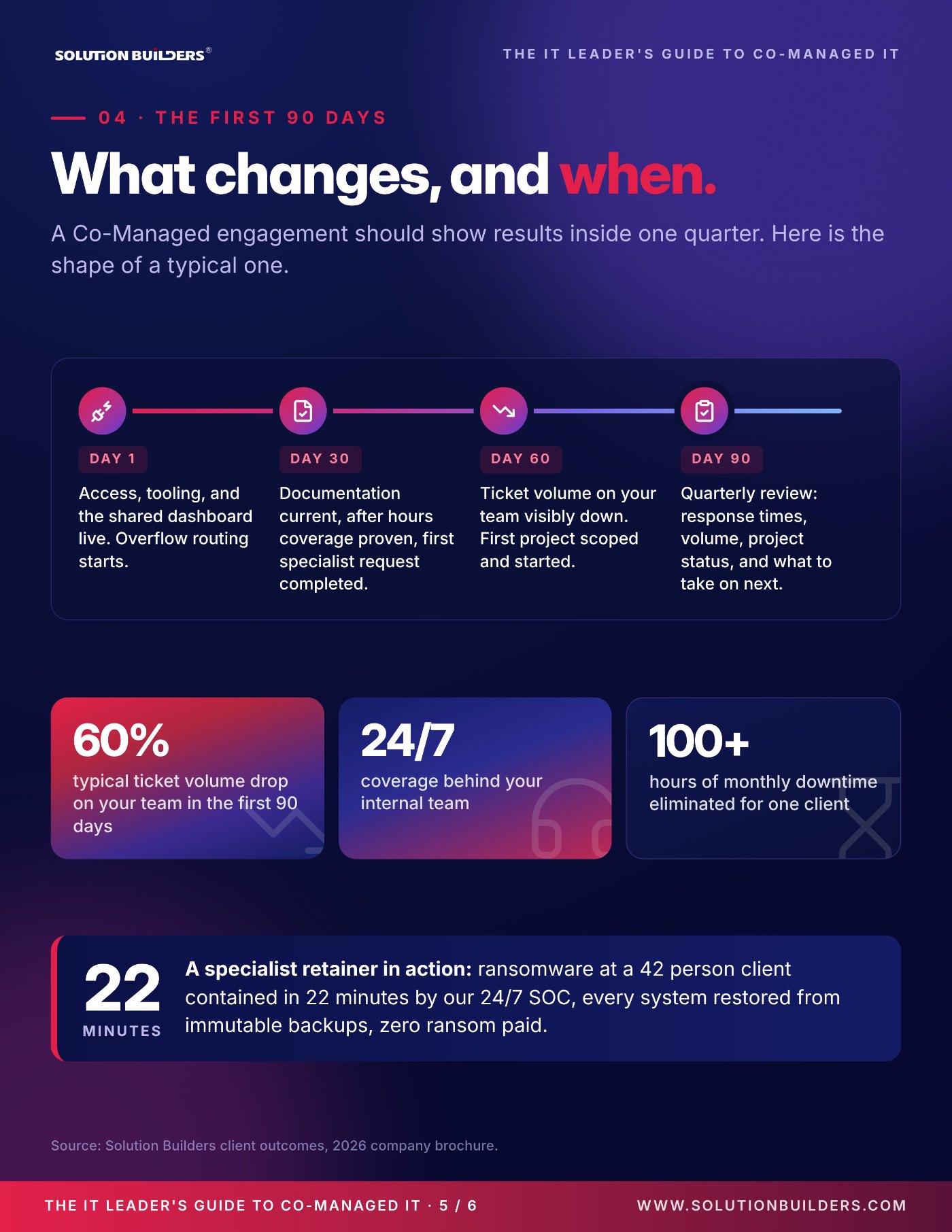
A co-managed engagement should show results inside one quarter. If a proposal cannot describe what day 30 looks like, it is a staffing contract with a nicer logo. Here is the shape of a typical one with Co-Managed IT from Solution Builders.
- Day 1Access, tooling and the shared dashboard are live. Overflow routing starts, so tickets above your capacity reach our team the same afternoon.
- Day 30Documentation is current, after hours coverage has been proven on a real night, and the first specialist request is completed.
- Day 60Ticket volume on your team is visibly down. The first project is scoped and started, with your scope and your approval.
- Day 90Quarterly review: response times, volume, project status and what to take on next.
The numbers behind that timeline come from real engagements. Ticket volume on the internal team typically drops 60% in the first 90 days. One 85 user manufacturer eliminated more than 100 hours of monthly downtime while keeping its IT lead in place, with 50+ engineers behind him, and the lead moved from firefighting to projects the business had shelved for years.
Ransomware at a 42 person client, contained in 22 minutes by the 24/7 SOC, every system restored from immutable backups, zero ransom paid. That is a specialist retainer in action.Solution Builders client outcomes, 2026
What to do next: pick the project that has waited longest
You do not need a strategy offsite to start. You need one honest list and one conversation.
- Write down what has waited the longestThe migration, the audit, the Copilot rollout. Note how many budget cycles each has survived and who on your team would have to drop daily support to do it.
- Count the hours going to tier 1One week of your engineers' time, sorted by ticket type. If half of it is password resets and printer calls, overflow is your first model.
- Decide what you will never hand overStrategy, budget, priorities, vendor and tool decisions, the roadmap. Write it down so the agreement can say it too.
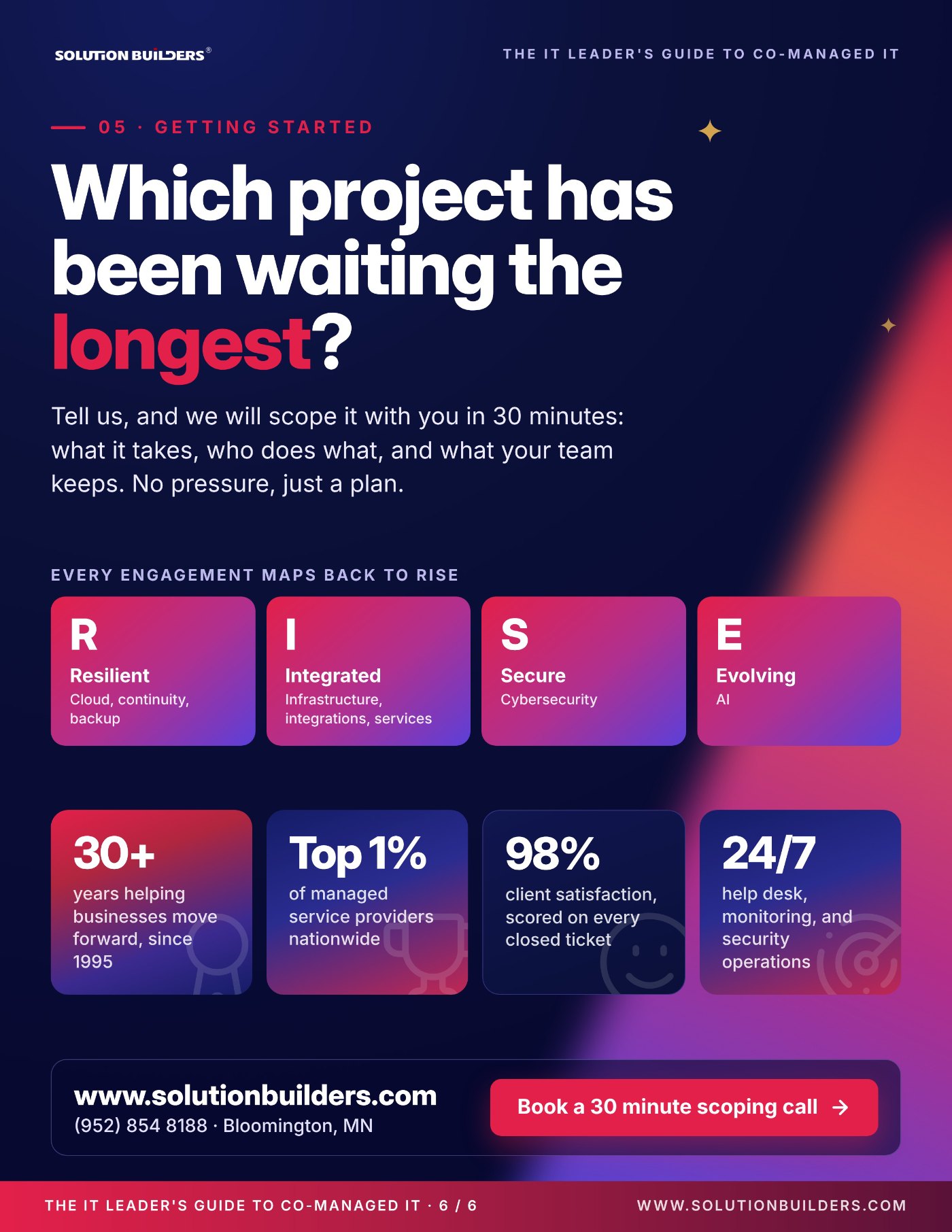
- Scope it in 30 minutesTell Solution Builders which project has waited the longest and we will scope it with you: what it takes, who does what, and what your team keeps. No pressure, just a plan.
Every engagement maps back to RISE, so the project you pick first will connect to the three outcomes that follow it. For the longer treatment, including the budget math and the questions to ask any partner, read The Co-Managed IT Playbook.
Co-managed IT for IT leaders across the Twin Cities
Solution Builders has backed internal IT teams from Bloomington since 1995. Our 50+ engineers, 24/7 security operations center and build lab give IT directors at companies with 25 to 500 employees in Minneapolis, St. Paul and across Minnesota the depth of a large department, from medical device manufacturers on the I-494 corridor to professional firms downtown. Related services: Co-Managed IT, Cybersecurity, Cloud Migration, AI Consulting. Contact us or book a 30 minute call.