Solution Builders team

Jump to a section
- Growth lands on infrastructure first: systems feel harder to scale, pricier to manage and less flexible long before anything actually breaks.
- Seven questions define what a migration is for; answer them before choosing any platform, and write the answers down.
- Azure answers them with on demand scale, usage based cost tools, multiple migration paths, governed data and AI inside the same environment.
- Migration is rarely the goal. Phased, hybrid moves that remove one limit at a time are, and the first phase should fit in 90 days.
Why an Azure migration in Minnesota starts with questions, not servers
The second shift at a medical device supplier on the I-494 corridor. A third office for a St. Paul engineering firm. An acquisition that doubles a Bloomington distributor overnight. Growth looks different at every company, but it lands in the same place first: infrastructure. Systems that once worked well feel harder to scale, pricier and less flexible, and leaders start asking questions they never needed at 40 people.
Those questions define what a migration is for. An Azure migration in Minnesota that starts with "what are we trying to stop being limited by?" succeeds. One that starts with "we should probably be in the cloud" stalls. The research backs the instinct.
Below are the seven questions we hear most from owners, CFOs and IT directors at companies with 25 to 500 employees, what each is really asking, how Azure answers it, and our view.
How far can our systems scale, and what does flexibility cost
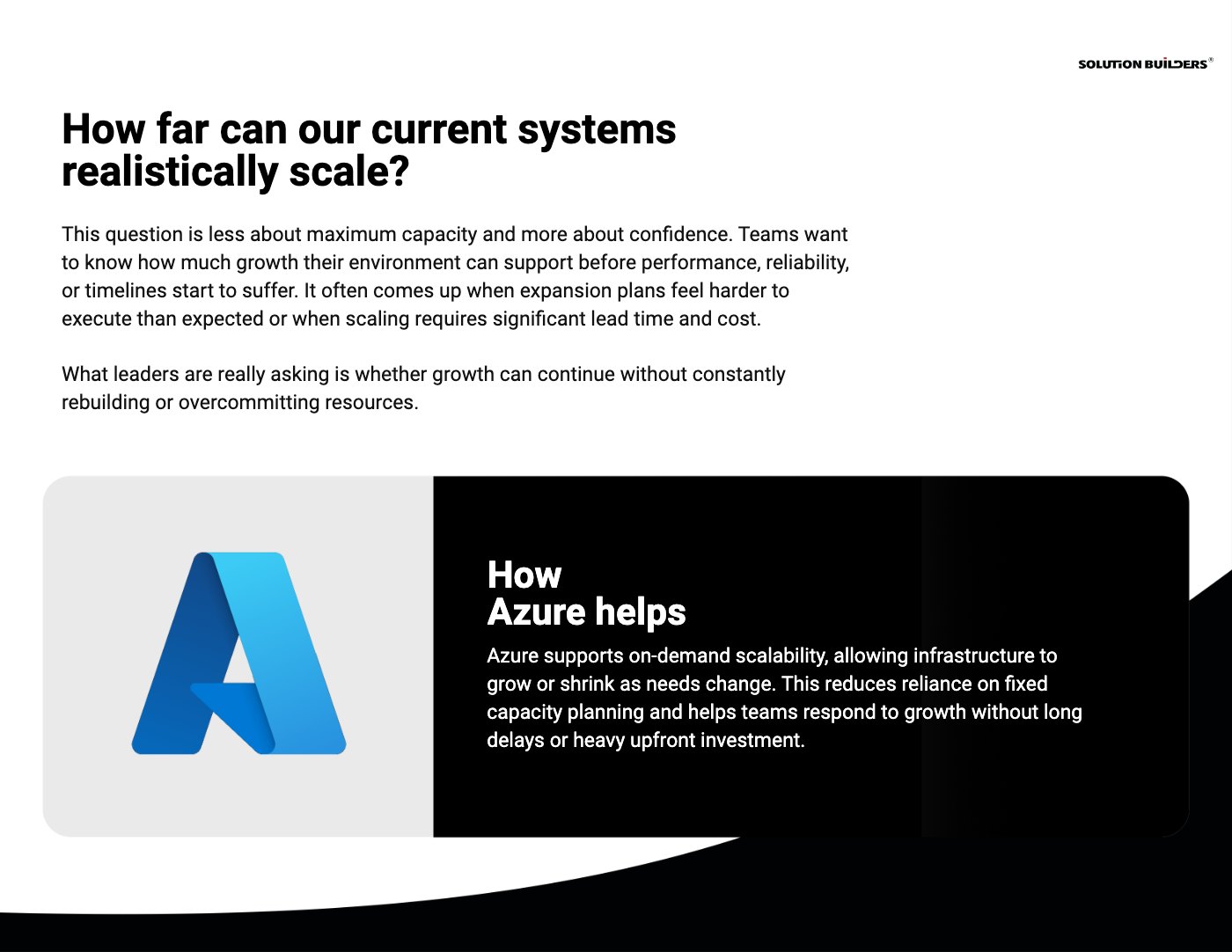
Question 1: How far can our current systems realistically scale?
What leaders are really asking: not "what is the maximum capacity" but "can I say yes with confidence?"
How Azure helps: capacity becomes on demand. Infrastructure grows for a launch or a seasonal peak and shrinks afterward.
Question 2: What does flexibility look like without overcommitting?
What leaders are really asking: leaders want to adapt, IT wants to avoid lock in, and both are right.
How Azure helps: modular, phased approaches. Modernize selectively, keep a hybrid environment as long as it makes sense, adjust over time.
Buy for the peak you fear
- Six to nine month hardware runway
- Paid for all year, used in Q4
- Every yes waits on IT
Pay for the peak you have
- Scale up in hours, down in minutes
- Costs follow usage
- Yes first, capacity follows
The Solution Builders view: size the first phase to the next 18 months of the business plan, not the next decade, because the plan will change.
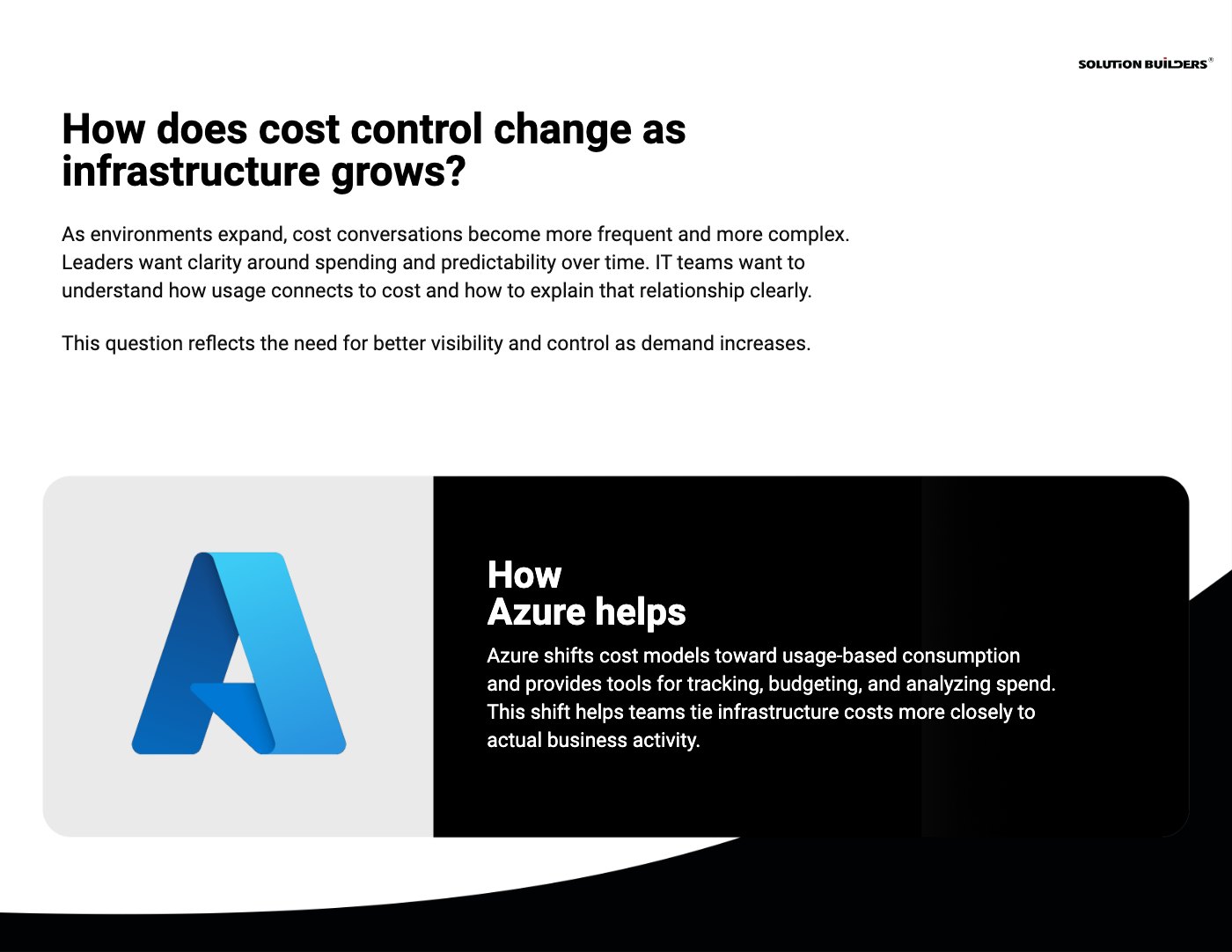
How does cloud cost control change as infrastructure grows
What leaders are really asking: "will this be predictable?" Cost conversations get more frequent as infrastructure grows. Leaders want predictability, IT wants to tie usage to cost, and one surprise invoice damages trust.
How Azure helps: usage based consumption with built in tools for tracking, budgeting and analyzing spend by department, project and workload.
The Solution Builders view: tools are half of cloud cost control. Habits are the other half, and these are the six we put in place for every Twin Cities client before the first workload moves.
- Tag every resource with an owner, a department and a project on day one.
- Set a budget and an alert threshold per department, reviewed monthly.
- Reserve capacity for steady workloads such as file servers.
- Shut down development and test environments nights and weekends.
- Run a rightsizing review every quarter and shrink what is oversized.
- Give the CFO a monthly one page report that ties spend to usage.
What a phased cloud migration really means for a Twin Cities company
What leaders are really asking: "do we have to move everything?" No. Migration is about deciding what to move, what stays and how to reduce disruption. A phased cloud migration in the Twin Cities usually keeps a few things on premises on purpose, at least for a while.
How Azure helps: multiple paths, and you can use more than one.
| Path | Best for | Watch out for |
|---|---|---|
| Lift and shift | Servers that work fine and need a better home | Carrying old cost habits into the cloud |
| Replatform | Databases, file servers, backup | Testing integrations before cutover |
| Gradual modernization | Line of business apps that limit the business | Scope creep; modernize one at a time |
| Stay for now | Plant floor systems, tightly coupled legacy apps | Set a review date so "for now" is not forever |
The Solution Builders view: map dependencies first, move the workload with the best ratio of benefit to risk (often backup, then files), prove it, repeat. Our cloud migration team runs the sequence as small, reversible moves, and the full method is in The Smart Cloud Migration Playbook.
How should we think about data and applications as we scale
Question 5: data as the business scales
What leaders are really asking: "why is it so hard to get a straight answer?" Access, governance and usability get harder as data spreads, just as data becomes central to decisions.
How Azure helps: centralized data platforms, analytics and governance, so every number comes from one place with one set of rules.
Question 6: applications that keep up
What leaders are really asking: "is this app holding us back?" Older applications were built for the company you were, and every change takes a specialist who is harder to find each year.
How Azure helps: modern application development and integration, so a legacy app can be connected, extended or gradually replaced without a big bang rewrite.
- Your data has outgrown its home when the monthly report takes a week of exports and somebody's spreadsheet is the real system of record.
- Your applications have outgrown theirs when one person understands the integration and is nervous about vacation.
The Solution Builders view: this is the I in RISE, Integrated. Data and applications are one design question, because most friction lives in the handoffs between systems.
Where does AI fit into our infrastructure plans
What leaders are really asking: "how do we do this without creating a mess?" Curiosity and caution, both warranted. AI has to align with data, security and governance or it becomes a separate experiment that never reaches the business. The Intuit QuickBooks 2026 AI Impact Report found 77% of US small and midsize businesses now use AI regularly, while privacy and security remains the biggest barrier at 36%.
How Azure helps: AI capabilities that integrate with the infrastructure and governance you already have: the same identities, data boundaries and monitoring. AI becomes part of the environment rather than a side project with its own rules.
AI is a reason to fix the foundation, not a reason to skip it
Every useful AI project we have delivered for a Minnesota company sat on top of clean identity, governed data and a secured cloud. The companies that get value fastest answered questions one through six first, which is why we pair AI consulting with infrastructure work rather than selling it separately.
What to do next: build a friction map before any migration
Azure comes up because it lets a business scale more easily, manage costs with clarity and adapt without adding complexity, in partial, phased and hybrid steps. Migration is rarely the goal by itself. It is a way to remove limits, gradually.
- Write down the seven answersOne sentence each, from the leadership team, before anyone from IT or a vendor is in the room. Where the answer is "we do not know," that is friction.
- Map the environmentEvery system, its owner and its dependencies. This map is worth more than any migration tool.
- Rank the limitsWhich of the seven costs the most this quarter? That is the first phase, small enough to finish in 90 days.
- Get an outside assessmentSolution Builders can assess where friction exists today and how Azure could support the business: a free 30 minute conversation with an engineer from our Bloomington office. Our virtual CIO service then carries the plan forward quarter by quarter.
Azure migrations for growing companies across Minnesota
Solution Builders has planned and run infrastructure for Minnesota businesses from our Bloomington headquarters since 1995. Our 50+ engineers handle Azure migrations for companies with 25 to 500 employees in Minneapolis, St. Paul and Greater Minnesota, from medical device suppliers on the I-494 corridor to firms with a plant up north and an office in the North Loop. Related services: Cloud Migration, IT Consulting, AI Consulting. Contact us or book a 30 minute call.