Solution Builders team

Jump to a section
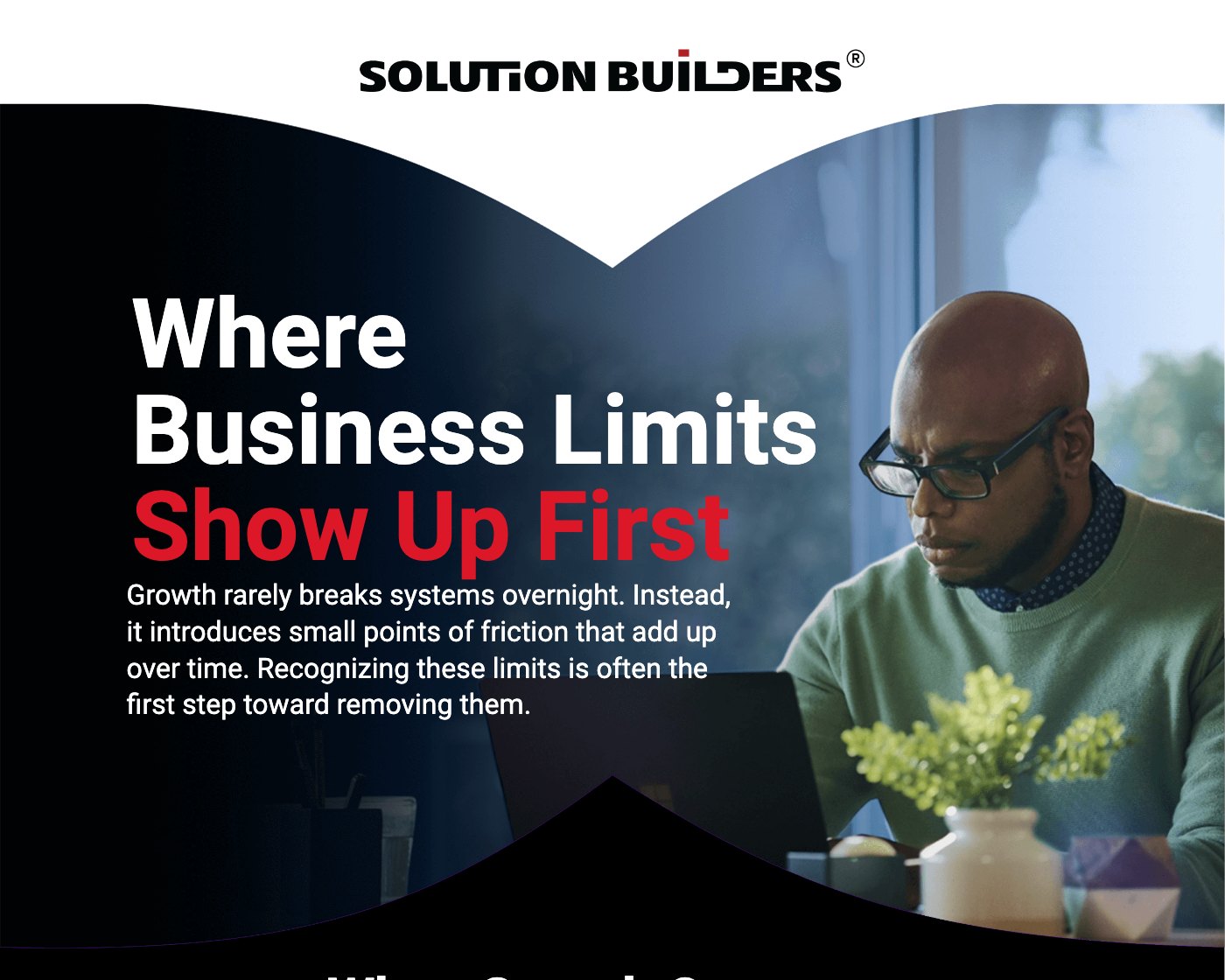
- Growth rarely breaks systems overnight. It adds friction: slower launches, unexplained costs, a maintenance heavy week and a hybrid setup nobody wants to touch.
- Each limit has a published reason: 45% cite complexity (Deloitte), 77% have too many tools (Cisco), 45% of budgets go to maintenance (CIO Journal).
- Azure answers all four with on demand capacity, usage based cost visibility, automated operations and a hybrid design that moves one workload at a time.
- Run the six question self check before the next hire, office or system. Three or fewer yes answers means the foundation needs attention.
Signs your business has outgrown its IT rarely look like failures
Nobody will walk into your office and announce that the infrastructure is done. Growth rarely breaks systems overnight. It introduces small points of friction that each look reasonable on their own: a project that needs "a few more weeks," a cloud bill that went up again, an IT lead who is always busy, a hybrid setup nobody wants to touch because everything connects to everything.
That is what the signs your business has outgrown its IT actually look like for a Twin Cities company with 25 to 500 employees. Not an outage. A hesitation. The medical device supplier on the I-494 corridor that delays a second shift because the ERP "might not handle it." The firm in downtown Minneapolis that stops hiring in Rochester because a remote office takes six weeks to onboard.
A limit is a signal, not a failure
Systems that were right for 40 people are not wrong at 120. They are at the edge of what they were designed to do. Treating that edge as information, not as somebody's fault, lets a leadership team act early instead of after the outage. The four limits below arrive in a fairly predictable order.
Limit one: growth outpaces your ability to scale
You are ready to move, but your environment is not. This is the first limit most growing Minnesota companies hit, and it is less about capacity than confidence. Can you say yes to the new contract, the second location or the acquisition without first asking IT whether the systems can take it?
You may notice
- New projects take longer to launch. Every initiative starts with a quote, a server and a wait.
- Capacity planning feels like guesswork. You buy for the peak you fear and pay for it all year.
- Growth creates hesitation instead of momentum. "Can we handle it?" gets asked before "should we?"
Why this is so common: 45% of organizations cite increased system complexity as a primary obstacle to efficient IT operations, according to the Deloitte Insights 2025 Technology Industry Outlook. Complexity compounds: every workaround added at 60 people is still there at 150.
IT infrastructure scaling in Minnesota used to mean a capital project and a six to nine month runway. On Microsoft Azure, capacity is something you turn up for the busy season and back down in February, which is why a cloud migration planned around growth answers this limit better than another rack in the closet.
Limit two: unpredictable IT costs that nobody can explain
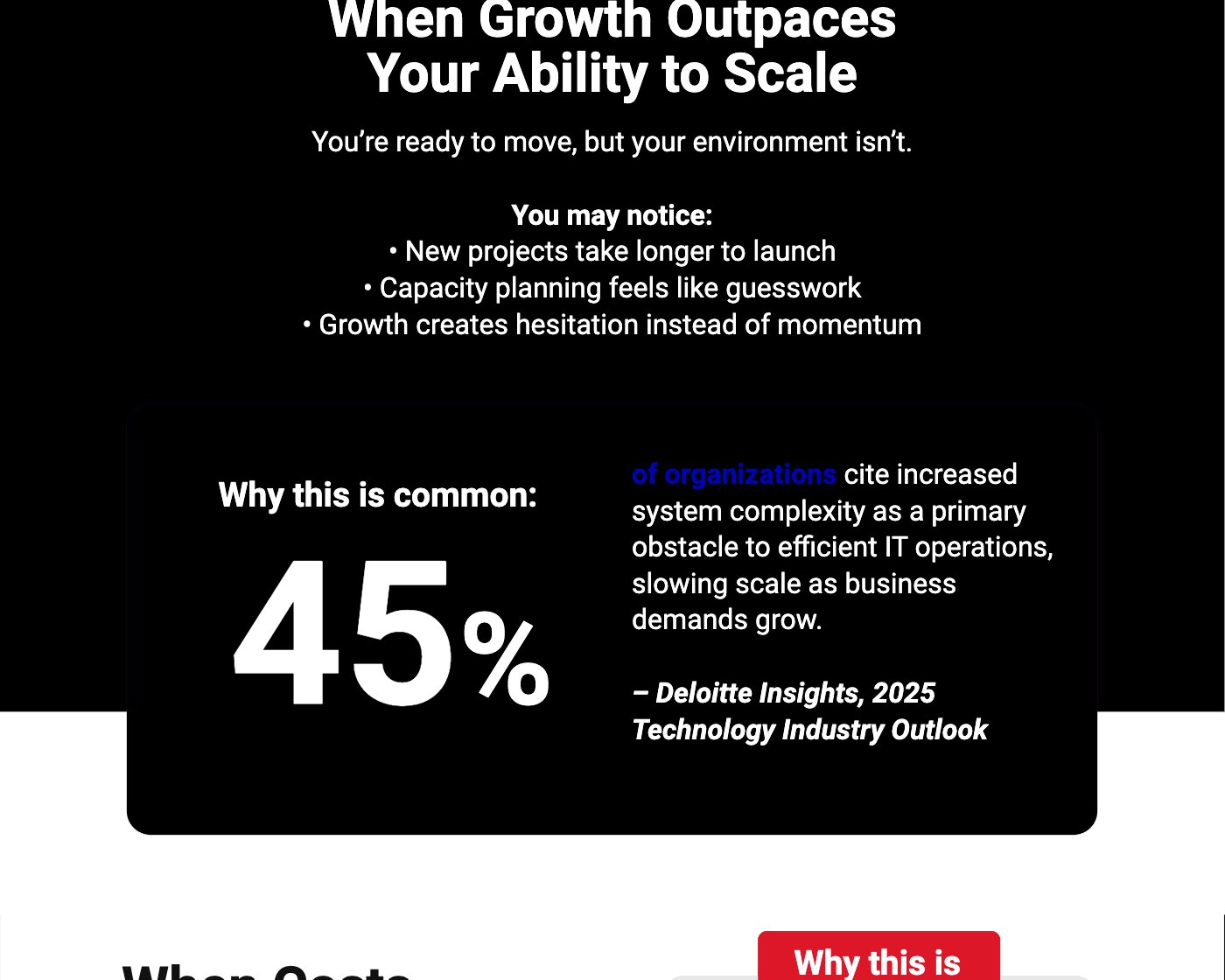
You know spending is increasing. Explaining why is harder. This limit tends to arrive a year after the first, once a few quick fixes, some subscriptions and an emergency hardware purchase have stacked up on one budget line.
You may notice
- Budget conversations feel reactive. The number arrives, then the explanation gets built.
- Costs do not clearly tie back to usage. Nobody can say what sales' share of the cloud bill is.
- Leadership wants clarity you cannot easily provide. The CFO asks a fair question and gets a shrug.
Why this is so common: 77% of organizations struggle with too many technology tools, which reduces visibility and makes IT costs harder to predict, according to the 2025 Cisco Cybersecurity Readiness Index. Tool sprawl is a cost problem before it is a security problem.
| Question from the CFO | Fragile answer | Scaled answer |
|---|---|---|
| Why did IT spend go up? | "A few things came up" | Usage by department, month over month |
| What does growth cost us? | A new quote each time | A per user, per workload rate |
| What can we turn off? | Nobody is sure what is in use | An inventory with owners and renewal dates |
Getting to the right column is a virtual CIO's job: own the inventory, tie every dollar to a workload, bring leadership a forecast instead of a surprise.
Limit three: keeping systems running eats the week
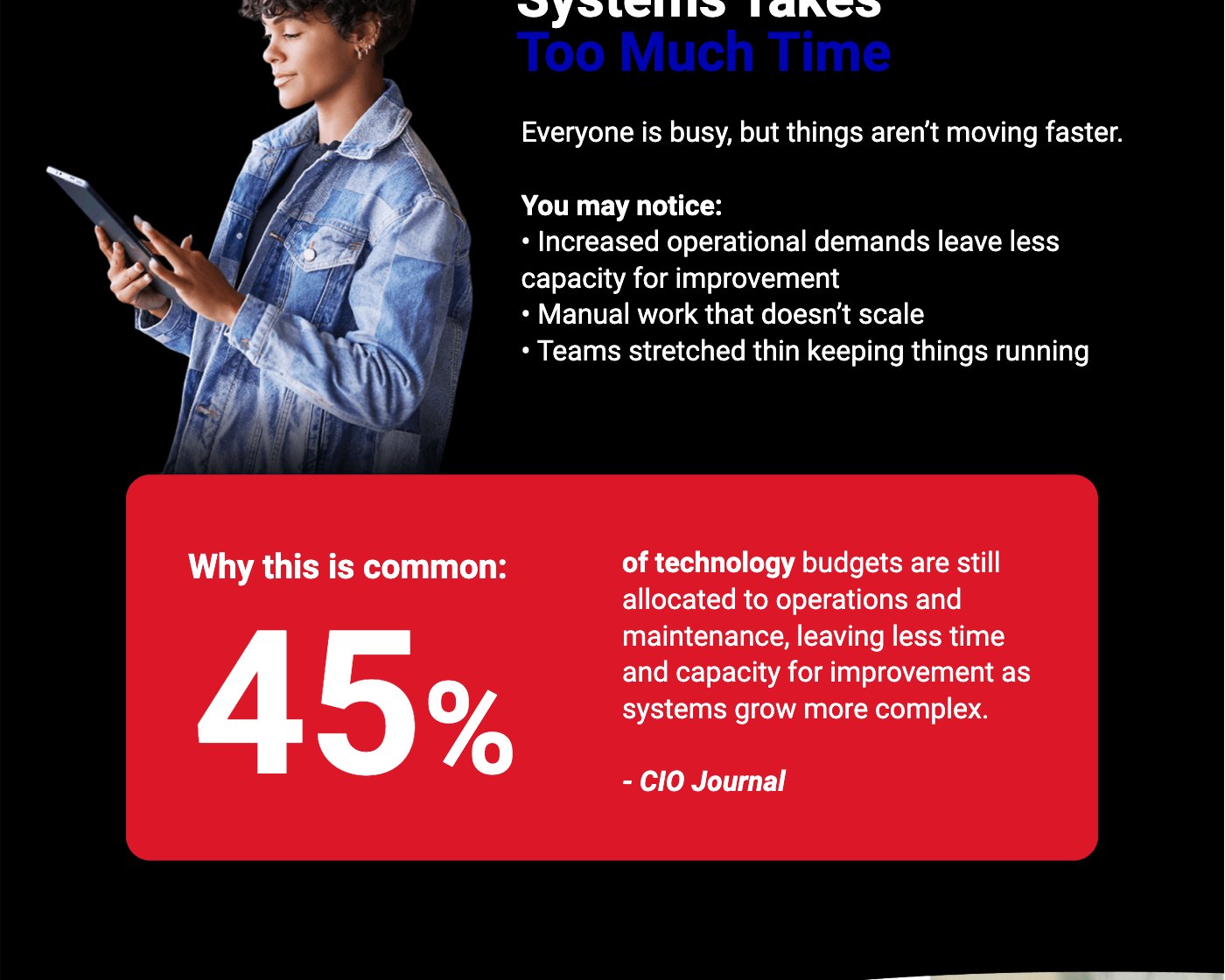
Everyone is busy, but nothing moves faster. Ask the IT manager at any 150 person manufacturer in the north metro and you will hear the same line: Monday through Thursday is spent keeping Friday from happening. Operations has consumed the capacity that was meant for improvement.
You may notice
- Operational demands leave no room to improve. The roadmap exists. Nobody has touched it since spring.
- Manual work that does not scale. Patching, backup checks, user setup and vendor calls, done by hand every week.
- Teams stretched thin keeping things running. One sick day and the help desk queue doubles.
Why this is so common: 45% of technology budgets are still allocated to operations and maintenance, as CIO Journal has reported. Nearly half of technology spend goes to standing still, and that share rarely shrinks on its own, because the people who could change it are stuck maintaining it.
The projects that would remove the maintenance never get done, because the maintenance is in the way.Solution Builders engineering team
Two moves break the loop: automate the repetitive work (Azure does this well for patching, monitoring and backup), and bring in project engineers for the migration itself, so your team is not building the new environment while running the old one.
Limit four: the hybrid environment tipping point
As environments grow more mixed, change gets harder to plan with confidence. A server in Bloomington, a few workloads in Azure, three SaaS platforms, an app that only runs on one box and a VPN holding it together: each piece made sense when it was added. Together they have reached the hybrid environment tipping point, where nobody wants to be the one who touches the system.
You may notice
- Uncertainty about what should stay and what should change. No agreed map of the environment, only people who remember parts of it.
- Concern about disrupting tightly connected systems. "If we move that, what else breaks?" ends the meeting.
- Decisions delayed because everything feels interdependent. Doing nothing becomes the safe choice. It is not.
Why this is so common: 71% of organizations believe a cybersecurity incident could disrupt their business, according to the 2025 Cisco Cybersecurity Readiness Index. Tangled environments are harder to secure, recover and change, and leaders feel all three at once.
Wait until it is all clear
- No map, so no move
- Every change needs everyone in the room
- Risk grows while the decision waits
Move what is ready, keep what works
- Map the dependencies first
- Move one workload, prove it, repeat
- Hybrid by design, not by accident
This is why Azure for growing businesses in the Twin Cities usually means a hybrid plan, not a cutover. Azure runs beside what you already have, so the tipping point becomes a sequence of small, reversible moves instead of one big bet.
A 30 minute self check before you buy anything
Run this with your leadership team and IT lead in the same room. One point per box you can check with a straight face.
- We could say yes to a 30% jump in headcount or orders without a hardware purchase.
- We can explain last quarter's technology spend by department and workload.
- Our IT team spent at least a third of last month on improvement rather than maintenance.
- We have a current map of every system and what depends on it.
- We know which workloads would move to the cloud first, and which would stay.
Four or more and your foundation is ahead of most companies your size in Minnesota. Three or fewer and it is time for the deeper questions in Questions Leaders Ask When Growth Hits Limits. Either way, a friction assessment with Solution Builders is a free 30 minute conversation about where the limits show up today and how Azure could remove them in phases.
Growth without limits for Twin Cities companies
Solution Builders has helped Minnesota businesses grow on solid infrastructure from our Bloomington headquarters since 1995. Our 50+ engineers plan and run Azure migrations for companies with 25 to 500 employees across Minneapolis, St. Paul and Greater Minnesota, from manufacturers on the I-494 corridor to firms with a plant up north and an office downtown. Related services: Cloud Migration, IT Consulting, Professional Services. Contact us or book a 30 minute call.