Solution Builders team
Jump to a section
- Manufacturing is the most attacked industry worldwide because a stopped line pays ransoms. The shop floor, not the office, is now the target.
- Segment first, detect second, recover always. The first three practices remove most of the risk, and the rest fit around production over two quarters.
- Plant controllers run 15 to 25 years and cannot be patched. Protect what you cannot change by controlling what can reach it.
- The same eight practices answer CMMC, customer security questionnaires and the CISA performance goals, so doing them once pays several times over.
Why cybersecurity for manufacturing companies in Minnesota starts on the floor
For most of the last decade a plant manager in Minnesota could assume attackers wanted banks and hospitals. That story is over. Manufacturing has been the most attacked industry in the world for three years running, according to IBM's X Force Threat Intelligence Index 2024. A line that cannot run loses money by the hour, and attackers know what that pressure does to a ransom negotiation. Cybersecurity for manufacturing companies in Minnesota is a production question first and an IT question second.
The Twin Cities make this personal. The I-494 corridor is full of machine shops, food processors, medical device suppliers and defense subcontractors, most with 25 to 500 employees and equipment that predates the smartphone. Dragos reported in its OT Cybersecurity Year in Review 2024 that roughly 70% of ransomware attacks on industrial organizations hit manufacturers.
Protect what you cannot change
Office IT can patch on Tuesday night. A CNC controller running an operating system from 2009 cannot be patched at all, and it may be the most valuable machine in the building. Manufacturing security means protecting what you cannot change, not just fixing what you can.
The eight practices below are in the order we recommend tackling them. None require shutting down a line, and most use tools a midsized manufacturer already pays for.
Segment first: shop floor network security in four moves
You cannot protect a machine you do not know exists, and you cannot stop ransomware that has a straight line from the accounting PC to the PLC. The first four practices fix both problems.
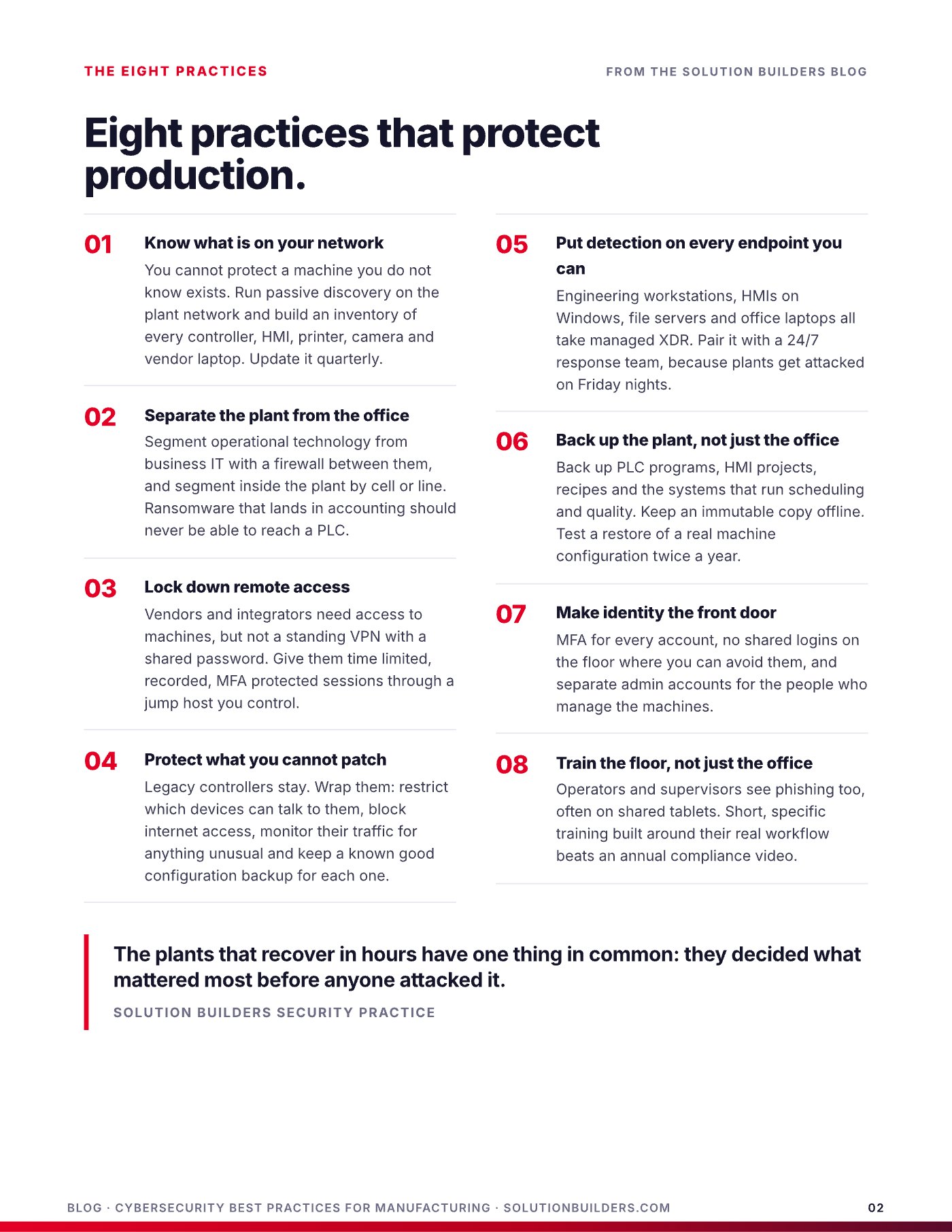
- Know what is on your networkRun passive discovery on the plant network and build an inventory of every controller, HMI, printer, camera and vendor laptop. Passive matters, because an active scanner can knock a controller offline. Update it quarterly.
- Separate the plant from the officePut a firewall between operational technology and business IT, then segment inside the plant by cell or line. Ransomware that lands in accounting should never be able to reach a PLC.
- Lock down remote accessVendors and integrators need to reach machines, but not through a standing VPN with a shared password. Give them time limited, recorded, MFA protected sessions through a jump host you control.
- Protect what you cannot patchLegacy controllers stay. Wrap them: restrict which devices can talk to them, block their internet access, monitor their traffic and keep a known good configuration backup for each one.
Segmentation is where OT and IT security meet, and where most Twin Cities plants have their biggest gap. The firewall and managed switches you already own can draw the walls, and a modern SD-WAN design carries the same zones to a second plant in Greater Minnesota without a private circuit. For a walk through of segmenting a live floor, read our guide on how to improve cybersecurity in manufacturing.
Detect second, recover always: practices five through eight
Walls slow an attacker down. They do not stop one who has phished an engineer's password. The next four practices make sure someone notices, so a bad Friday night becomes a Saturday rebuild, not a three week shutdown.
- Put detection on every endpoint you canEngineering workstations, Windows based HMIs, file servers and office laptops all take managed XDR. Pair it with a 24/7 response team, because plants get attacked on Friday nights.
- Back up the plant, not just the officeBack up PLC programs, HMI projects, recipes and the systems that run scheduling and quality. Keep an immutable copy offline and test a restore of a real machine configuration twice a year.
- Make identity the front doorMultifactor authentication for every account, no shared logins on the floor where you can avoid them, and separate admin accounts for the people who manage the machines.
- Train the floor, not just the officeOperators and supervisors see phishing too, often on shared tablets. Short training built around their real workflow beats an annual compliance video.
The plants that recover in hours have one thing in common: they decided what mattered most before anyone attacked it.Solution Builders Security Practice
Detection and recovery are the two practices manufacturers most often hand to a partner, because a 24/7 security operations center is expensive to staff for one plant. Our cybersecurity services for Minneapolis manufacturers bundle managed XDR, identity monitoring and a human response team into one fixed monthly fee, so the Friday night call goes to an analyst instead of your maintenance lead.
OT and IT security play by different rules
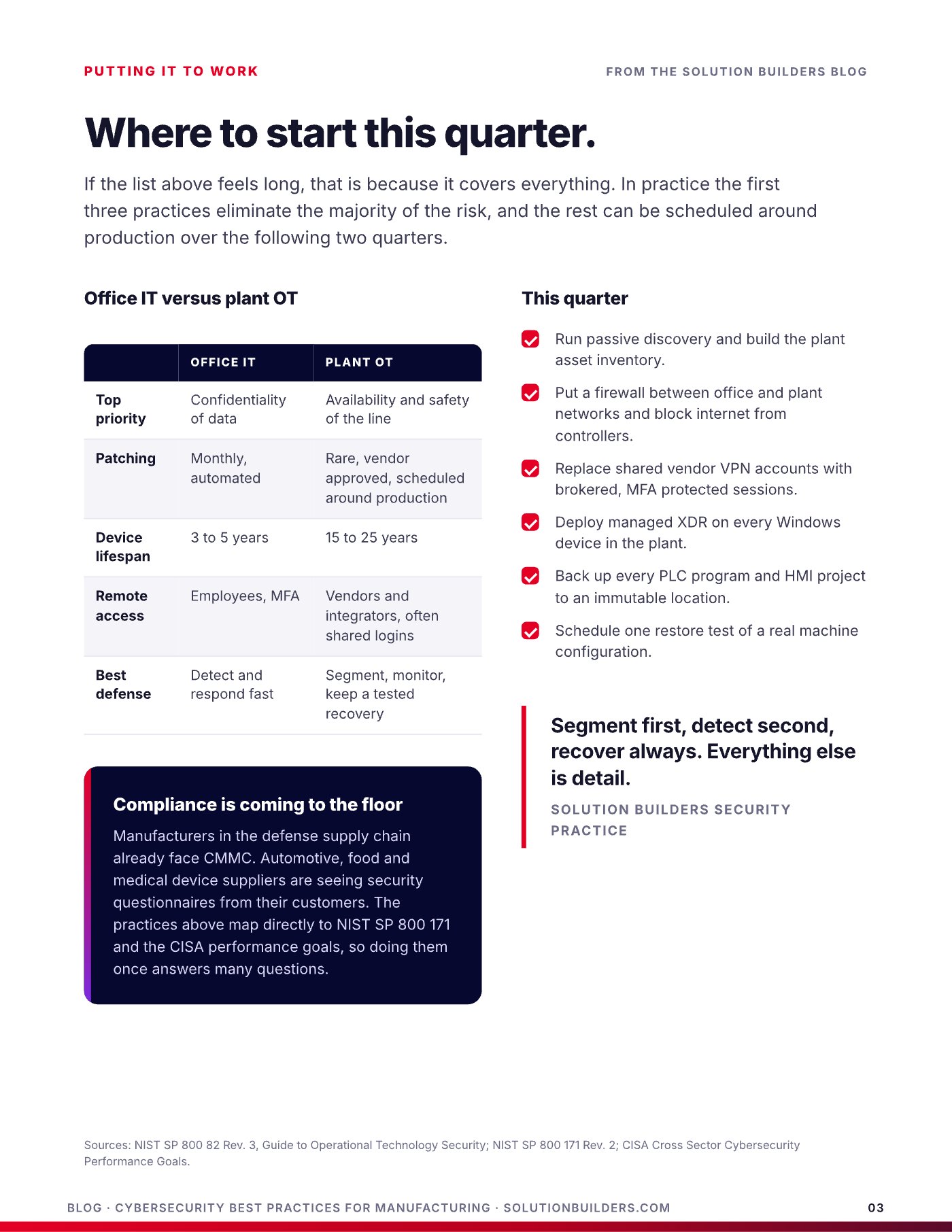
The most common mistake we see is an IT team or provider treating the plant like a slightly dustier office. The priorities are reversed. In the office you protect the confidentiality of data. On the floor you protect the availability of the line and the safety of the people next to it. NIST's Guide to Operational Technology Security is built around that difference.
| Area | Office IT | Plant OT |
|---|---|---|
| Top priority | Confidentiality of data | Availability and safety of the line |
| Patching | Monthly, automated | Rare, vendor approved, scheduled around production |
| Device lifespan | 3 to 5 years | 15 to 25 years |
| Remote access | Employees, MFA | Vendors and integrators, often shared logins |
| Best defense | Detect and respond fast | Segment, monitor, keep a tested recovery |
Do the work once, answer many questions
Manufacturers in the defense supply chain already face CMMC. Automotive, food and medical device suppliers are seeing security questionnaires from their customers. These eight practices map directly to NIST SP 800-171 and the CISA performance goals, so doing them once answers many questions.
If you hold defense contracts, note that as of October 2026 CMMC third party certification is paused while a Reform Task Force reviews the program, but the DFARS 7012 clause, all 110 NIST SP 800-171 controls, SPRS scores and annual affirmations never stopped. Our CMMC compliance team maps shop floor controls to those requirements for Minnesota defense suppliers.
Where to start this quarter
The first three practices eliminate most of the risk, and the rest can be scheduled around production over the next two quarters. Here is the quarter one list we hand a plant manager in Bloomington or St. Paul on day one. Give each item an owner and a date, and review it at the operations meeting.
- Run passive discovery and build the plant asset inventory.
- Put a firewall between office and plant networks and block internet access from controllers.
- Replace shared vendor VPN accounts with brokered, MFA protected sessions.
- Deploy managed XDR on every Windows device in the plant.
- Back up every PLC program and HMI project to an immutable location.
- Schedule one restore test of a real machine configuration, and time it.
Segment first, detect second, recover always. Everything else is detail.Solution Builders Security Practice
Solution Builders has secured Minnesota manufacturers from Bloomington since 1995, with 50+ engineers, a 24/7 security operations center and a SOC 2 Type II audited practice. The Secure pillar of our RISE framework is built for this work. If you want a second set of eyes on your plant, a free 30 minute Security Readiness Snapshot gives you a candid read on where your floor stands and the three things to fix first.
Cybersecurity for manufacturers across Minnesota
Solution Builders has protected Minnesota manufacturers from Bloomington since 1995. Our 50+ engineers and 24/7 security operations center support plants and machine shops with 25 to 500 employees across the Twin Cities, from the I-494 corridor to the medical device and defense suppliers in the suburbs, and companies with a plant in Greater Minnesota and an office in the metro. Related services: Cybersecurity, CMMC Compliance, SD-WAN, Data Backup and Disaster Recovery. Contact us or book a 30 minute call.